A 60-year-old man is brought to the office due to difficulty walking. He reports being "weak" and describes occasional brief episodes of intense back pain. Review of systems is negative for constitutional, pulmonary, cardiac, genitourinary, or other neurologic symptoms, including memory concerns. He has no known medical problems except for a remote history of treated pulmonary tuberculosis. The patient recently emigrated from China to the United States to live with his daughter after his wife died. His daughter says that he is afraid of doctors and has not been evaluated for many years. He does not use tobacco, alcohol, or recreational drugs.
Blood pressure is 138/64 mm Hg and pulse is 74/min. Lung examination is normal. Cardiac auscultation reveals an early diastolic murmur in the aortic area. The abdomen is soft and nontender. Rectal examination shows an unremarkable prostate and normal rectal tone. Motor strength is normal. Bilateral lower extremity reflexes are diminished, and vibration and position sensation is decreased. The patient's gait is unsteady and broad-based.
Laboratory results are as follows: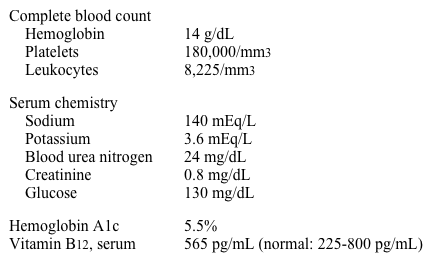
ECG shows normal sinus rhythm. Chest x-ray reveals left upper lobe scarring, widened mediastinum, and calcifications of the ascending aorta and aortic arch.
Which of the following is most helpful in establishing the diagnosis?
A) CT scan of the head
B) Heavy metal screening
C) Interferon-gamma release assay
D) Serum protein electrophoresis
E) Treponema pallidum enzyme immunoassay
Correct Answer:

Verified
Q502: A 46-year-old man comes to the physician
Q503: A 26-year-old woman with new-onset vaginal discharge
Q504: A 25-year-old previously healthy woman comes to
Q505: A 34-year-old man comes to the emergency
Q506: A 46-year-old man comes to an urgent
Q508: A 35-year-old woman comes to the office
Q509: A 39-year-old man comes to the clinic
Q510: A 27-year-old man comes to the office
Q511: An 84-year-old nursing home resident with mild
Q512: A 19-year-old woman comes to the physician
Unlock this Answer For Free Now!
View this answer and more for free by performing one of the following actions

Scan the QR code to install the App and get 2 free unlocks

Unlock quizzes for free by uploading documents