A 28-year-old man comes to the emergency department due to worsening dyspnea, cough, and blood-streaked sputum for the last 3 days. He has had no fatigue, fever, chills, upper respiratory symptoms, skin rash, eye symptoms, or joint pains. The patient has no history of lung disease but takes ibuprofen occasionally for knee pain. He does not use tobacco, alcohol, or illicit drug. His father had a myocardial infarction at age 65 and his mother has rheumatoid arthritis.
Blood pressure is 150/90 mm Hg, pulse is 100/min, and respirations are 24/min. Bilateral crackles are present in both lung bases and mid-lung fields. Extremity examination reveals 1+ pitting edema to the mid-shins bilaterally. The remainder of the examination is unremarkable.
Laboratory results are as follows: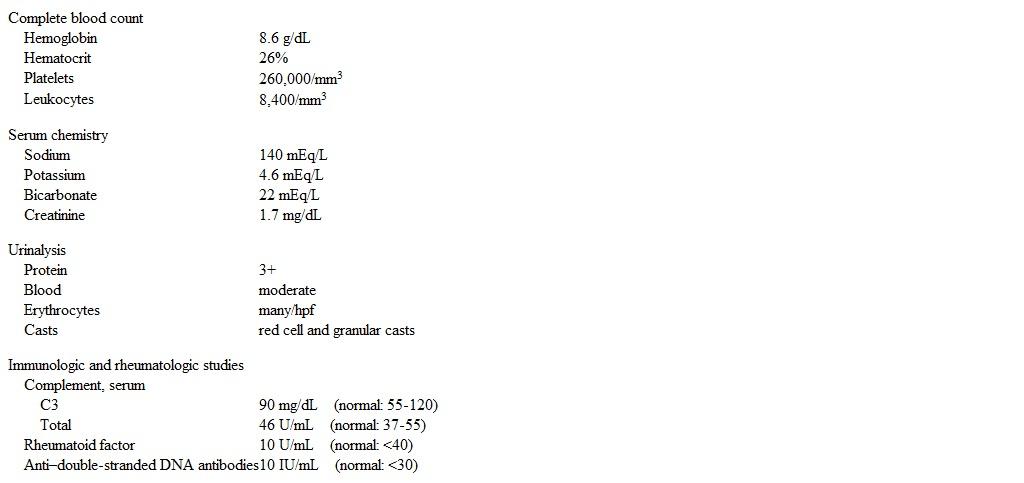 Chest x-ray shows diffuse pulmonary opacities.
Which of the following is the most likely diagnosis in this patient?
A) Anti-glomerular basement membrane antibody disease (Goodpasture syndrome)
B) Cryoglobulinemic vasculitis
C) Eosinophilic granulomatosis with polyangiitis (Churg-Strauss syndrome)
D) Granulomatosis with polyangiitis
E) Systemic lupus erythematosus
Correct Answer:

Verified
Q671: A 40-year-old man comes to the office
Q672: A 38-year-old woman comes to the office
Q673: A 58-year-old man comes to the office
Q674: A 38-year-old woman with type 2 diabetes
Q675: A 54-year-old woman comes to the office
Q677: A 43-year-old man comes to the office
Q678: A 16-year-old girl comes to the office
Q679: A 58-year-old woman comes to the office
Q680: A 53-year-old man is seen for a
Q681: A 40-year-old obese man comes to the
Unlock this Answer For Free Now!
View this answer and more for free by performing one of the following actions

Scan the QR code to install the App and get 2 free unlocks

Unlock quizzes for free by uploading documents