Solved

A 65-Year-Old Man Is Evaluated for Progressively Worsening Dyspnea for the Past

Question 715

Multiple Choice

A 65-year-old man is evaluated for progressively worsening dyspnea for the past year.  His past medical history is significant for hypertension and acid reflux disease.  Six months ago, he complained of a dry cough.  At that visit, his omeprazole dose was increased from 20 mg daily to 20 mg twice daily, and his blood pressure medication was switched from lisinopril to amlodipine.  These interventions did not help, however, and his symptoms continued to worsen.  He is a lifelong nonsmoker and retired after working as a chemical engineer at an oil refinery for 35 years.
His temperature is 37.2 C (99 F) , blood pressure is 120/80 mm Hg, pulse is 78/min, and respirations are 16/min.  His pulse oximetry at rest is 94% on room air and decreases to 82% after walking for 3 minutes.  He has finger clubbing.  There is no jugular venous distension.  Heart sounds are normal without murmurs.  Lung auscultation shows diffuse, dry, mid-inspiratory crackles bilaterally.  There is no swelling or tenderness of any joints, including the proximal interphalangeal and metacarpophalangeal joints of the hands.
Laboratory results are as follows:

A 65-year-old man is evaluated for progressively worsening dyspnea for the past year.  His past medical history is significant for hypertension and acid reflux disease.  Six months ago, he complained of a dry cough.  At that visit, his omeprazole dose was increased from 20 mg daily to 20 mg twice daily, and his blood pressure medication was switched from lisinopril to amlodipine.  These interventions did not help, however, and his symptoms continued to worsen.  He is a lifelong nonsmoker and retired after working as a chemical engineer at an oil refinery for 35 years. His temperature is 37.2 C (99 F) , blood pressure is 120/80 mm Hg, pulse is 78/min, and respirations are 16/min.  His pulse oximetry at rest is 94% on room air and decreases to 82% after walking for 3 minutes.  He has finger clubbing.  There is no jugular venous distension.  Heart sounds are normal without murmurs.  Lung auscultation shows diffuse, dry, mid-inspiratory crackles bilaterally.  There is no swelling or tenderness of any joints, including the proximal interphalangeal and metacarpophalangeal joints of the hands. Laboratory results are as follows:   High-resolution chest CT scan is performed; a representative image is shown below.   Which of the following is the most likely diagnosis in this patient? A) Bronchiectasis B) Cryptogenic organizing pneumonia C) Idiopathic pulmonary fibrosis D) Rheumatoid lung disease E) Sarcoidosis
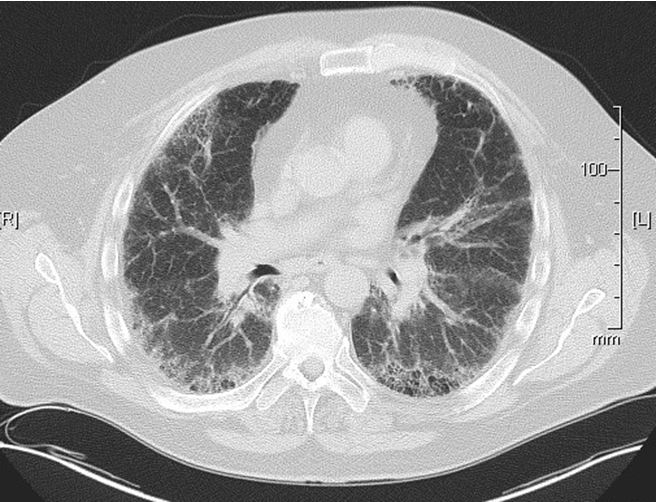
High-resolution chest CT scan is performed; a representative image is shown below.
A 65-year-old man is evaluated for progressively worsening dyspnea for the past year.  His past medical history is significant for hypertension and acid reflux disease.  Six months ago, he complained of a dry cough.  At that visit, his omeprazole dose was increased from 20 mg daily to 20 mg twice daily, and his blood pressure medication was switched from lisinopril to amlodipine.  These interventions did not help, however, and his symptoms continued to worsen.  He is a lifelong nonsmoker and retired after working as a chemical engineer at an oil refinery for 35 years. His temperature is 37.2 C (99 F) , blood pressure is 120/80 mm Hg, pulse is 78/min, and respirations are 16/min.  His pulse oximetry at rest is 94% on room air and decreases to 82% after walking for 3 minutes.  He has finger clubbing.  There is no jugular venous distension.  Heart sounds are normal without murmurs.  Lung auscultation shows diffuse, dry, mid-inspiratory crackles bilaterally.  There is no swelling or tenderness of any joints, including the proximal interphalangeal and metacarpophalangeal joints of the hands. Laboratory results are as follows:   High-resolution chest CT scan is performed; a representative image is shown below.   Which of the following is the most likely diagnosis in this patient? A) Bronchiectasis B) Cryptogenic organizing pneumonia C) Idiopathic pulmonary fibrosis D) Rheumatoid lung disease E) Sarcoidosis
Which of the following is the most likely diagnosis in this patient?


A) Bronchiectasis
B) Cryptogenic organizing pneumonia
C) Idiopathic pulmonary fibrosis
D) Rheumatoid lung disease
E) Sarcoidosis

Correct Answer:

verifed

Verified

Unlock this answer now
Get Access to more Verified Answers free of charge

Related Questions

Unlock this Answer For Free Now!

View this answer and more for free by performing one of the following actions

qr-code

Scan the QR code to install the App and get 2 free unlocks

upload documents

Unlock quizzes for free by uploading documents