A 39-year-old man seeks care for his third episode of gross hematuria. His first episode occurred shortly after onset of an upper respiratory infection 2 years ago. His most recent episode started about 5 days ago. Both episodes lasted 5-10 days and were not associated with either flank or abdominal pain. The episodes had accompanying mild dysuria. There were no blood clots passed. He has no other medical problems. He takes no medication. There is no family history of kidney disease.
His blood pressure is 132/90 mm Hg, pulse is 72/min, and respirations are 12/min. Physical examination shows no significant abnormalities.
The patient's laboratory studies show: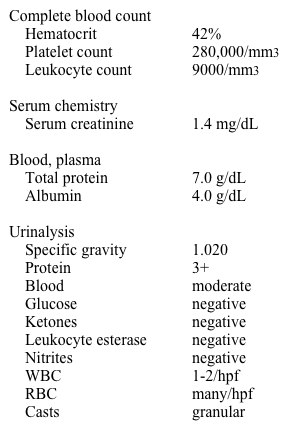
Using phase-contrast microscopy, the pathologist finds several dysmorphic red blood cells in the urine. Which of the following is the most appropriate next step in management?
A) Antibasement membrane antibody test
B) Cystoscopy
C) Kidney CT scan
D) Quantitative assessment of glomerular filtration rate and proteinuria
E) Urine cytology
Correct Answer:

Verified
Q745: A 22-year-old African American man is evaluated
Q746: A 48-year-old woman comes to the clinic
Q747: A 27-year-old man comes to the physician
Q748: A 60-year-old woman is being evaluated for
Q749: An 18-year-old man comes to the office
Q751: A 42-year-old woman comes to the office
Q752: A 54-year-old woman comes to the office
Q753: A 67-year-old man comes to the office
Q754: A 68-year-old African American man is evaluated
Q755: A 22-year-old man comes to the physician
Unlock this Answer For Free Now!
View this answer and more for free by performing one of the following actions

Scan the QR code to install the App and get 2 free unlocks

Unlock quizzes for free by uploading documents