A 22-year-old African American man is evaluated for gross hematuria. He has had 5 days of grossly bloody urine every time he urinates. He denies associated flank or abdominal pain, back or abdominal trauma, fever, chills, or dysuria. There is no family history of either a bleeding disorder or kidney disease. He had a similar episode one year ago which lasted 5-10 days and resolved spontaneously. During that time, he had an unremarkable ultrasound of his kidneys. He has had no recent illnesses and he takes no medications. He had an uncomplicated knee surgery two years ago for a torn ligament. He had two girlfriends over the last year, and he used condoms occasionally.
He is very muscular with a BMI of 25 kg/m2. His blood pressure is 133/82 mm Hg and pulse is 89 /min. He has no costovertebral angle tenderness. Abdominal exam is unremarkable. Laboratory results are as follows: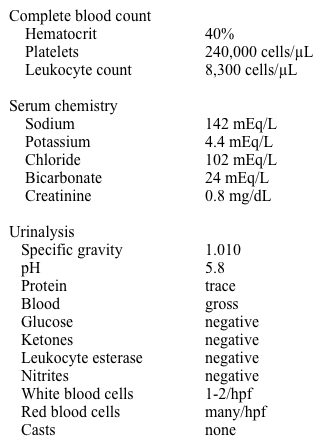
Which of the following is most likely to confirm this patient's diagnosis?
A) Autoantibodies and complement level
B) Coagulation studies
C) Cystoscopy
D) Hemoglobin electrophoresis
E) Renal biopsy
Correct Answer:

Verified
Q740: A 42-year-old man comes to the physician
Q741: A 67-year-old woman is evaluated for intermittent
Q742: You are following five patients who have
Q743: An 80-year-old woman presents to the clinic
Q744: A 65-year-old man comes to the office
Q746: A 48-year-old woman comes to the clinic
Q747: A 27-year-old man comes to the physician
Q748: A 60-year-old woman is being evaluated for
Q749: An 18-year-old man comes to the office
Q750: A 39-year-old man seeks care for his
Unlock this Answer For Free Now!
View this answer and more for free by performing one of the following actions

Scan the QR code to install the App and get 2 free unlocks

Unlock quizzes for free by uploading documents