A 65-year-old man comes to the office for a follow-up evaluation of hematuria. He underwent evaluation for an insurance policy and was told that he had blood in his urine. He has never observed any blood in his urine; however, he has noticed a progressively weaker urinary stream over the past several years and often gets up to urinate at least twice each night. He has no history of flank or abdominal pain, and has never passed a kidney stone or had urinary tract infection. He has smoked more than one pack of cigarettes daily for 40 years. He recently retired from many years of employment in the dye industry.
He has been diagnosed with moderate chronic obstructive lung disease, benign prostatic hypertrophy, degenerative joint disease, and hypertension. His current medications consist of an inhaler containing a beta adrenergic agonist, several over-the-counter NSAIDs, and lisinopril.
His blood pressure is 140/90 mm Hg, pulse is 84/min, and respirations are 20/min. Physical examination findings are compatible with moderate chronic obstructive lung disease. A urinalysis performed in the office shows a positive dipstick and 3-5/hpf RBCs. Subsequently, 2 additional urinalyses are performed; RBCs are 1-2/hpf on the first and 5-10/hpf on the second urinalysis. Urine cytology is negative for malignant cells on 3 occasions. A CT scan of the kidneys is within normal limits. A urine culture is negative.
The patient's laboratory studies reveal: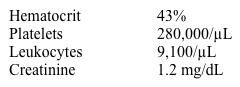
Which of the following is the most appropriate next step in management?
A) Follow-up with urinalyses every 6 months; do further evaluation if hematuria increases
B) Obtain coagulation studies
C) Perform cystoscopy
D) Perform renal MRI
E) Treat for benign prostatic hyperplasia, and see if the hematuria resolves
Correct Answer:

Verified
Q739: A 69-year-old man comes to the office
Q740: A 42-year-old man comes to the physician
Q741: A 67-year-old woman is evaluated for intermittent
Q742: You are following five patients who have
Q743: An 80-year-old woman presents to the clinic
Q745: A 22-year-old African American man is evaluated
Q746: A 48-year-old woman comes to the clinic
Q747: A 27-year-old man comes to the physician
Q748: A 60-year-old woman is being evaluated for
Q749: An 18-year-old man comes to the office
Unlock this Answer For Free Now!
View this answer and more for free by performing one of the following actions

Scan the QR code to install the App and get 2 free unlocks

Unlock quizzes for free by uploading documents