A 37-year-old woman is evaluated for generalized weakness. She has been hospitalized twice over the last year with similar complaints and her serum potassium concentration was found to be < 3.0 mEq/L. Her potassium concentration returned to normal with aggressive potassium replacement. She eats a normal diet and denies vomiting, purging, and cathartic or diuretic use. Her blood pressure is within normal limits. Her only medication is an oral contraceptive. Her review of systems is otherwise unremarkable. Her sister suffers from Crohn's disease and her mother has congestive heart failure, diabetes mellitus, and bipolar disorder.
Her blood pressure is 112/68 mm Hg and her pulse is 90/min. Her BMI is 22 kg/m2. Physical examination is normal.
Laboratory studies are shown below: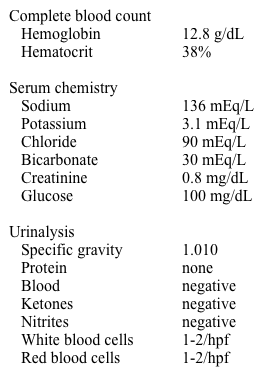
Spot urinary chloride concentrations on two separate occasions were 15 and 65 mEq/L.
Which of the following is most likely to establish diagnosis in this patient?
A) CT angiography of renal arteries
B) Colonoscopy
C) Plasma aldosterone and renin levels
D) Serum insulin and C-peptide levels
E) Urine screen for diuretics
Correct Answer:

Verified
Q761: A 76-year-old woman who has resided in
Q762: A 43-year-old African-American man with known HIV
Q763: A 75-year-old man comes to the office
Q764: An 80-year-old man comes to the physician
Q765: A 68-year-old man with chronic kidney disease
Q767: A 36-year-old woman has increasing nausea and
Q768: A 63-year-old woman with a long history
Q769: A 45-year-old man is evaluated for recurrent
Q770: A 45-year-old man comes to the emergency
Q771: A 49-year-old alcoholic man is admitted for
Unlock this Answer For Free Now!
View this answer and more for free by performing one of the following actions

Scan the QR code to install the App and get 2 free unlocks

Unlock quizzes for free by uploading documents