A 49-year-old alcoholic man is admitted for diarrhea and generalized abdominal pain. His blood pressure is 134/80 mm Hg, pulse is 90/min, respirations are 16/min, and oxygen saturation is 97% on room air. He is disheveled and looks chronically ill. He is oriented to person and place. His mucous membranes are dry. His abdomen is soft and mildly tender in the epigastric region. He has no focal neurologic findings.
An electrocardiogram and chest x-ray is unremarkable. Stool samples are sent for culture and microscopic examination.
Laboratory results are as follows: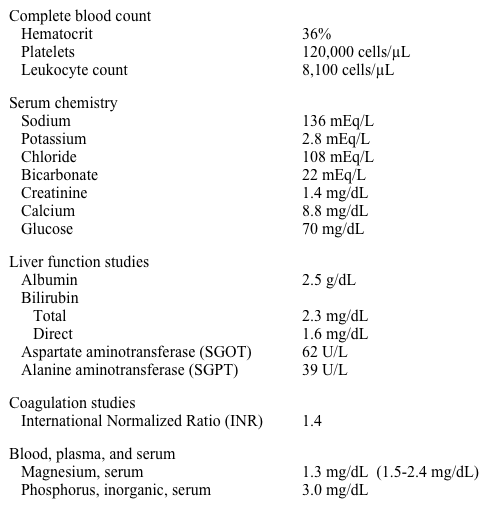
He is given thiamine and a multivitamin intravenously along with three liters of normal saline with 5% dextrose. He also receives intravenous potassium and magnesium supplementation. Thirty-six hours after admission, he complains of severe weakness. His oxygenation has decreased and he appears agitated.
Repeat laboratory results are as follows: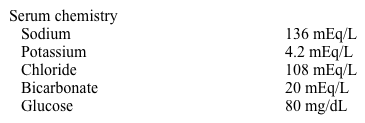
Which of the following is the most likely cause of this patient's new-onset weakness?
A) Alcohol withdrawal
B) Hypomagnesemia
C) Hypophosphatemia
D) Rhabdomyolysis
E) Wernicke's encephalopathy
Correct Answer:

Verified
Q766: A 37-year-old woman is evaluated for generalized
Q767: A 36-year-old woman has increasing nausea and
Q768: A 63-year-old woman with a long history
Q769: A 45-year-old man is evaluated for recurrent
Q770: A 45-year-old man comes to the emergency
Q772: A 63-year-old man comes to the physician
Q773: A 40-year-old woman comes to the office
Q774: A 67-year-old man comes to the physician
Q775: A 36-year-old woman comes to the office
Q776: A 40-year-old man comes to the emergency
Unlock this Answer For Free Now!
View this answer and more for free by performing one of the following actions

Scan the QR code to install the App and get 2 free unlocks

Unlock quizzes for free by uploading documents