A 40-year-old man comes to the emergency department due to acute flank pain and dysuria. He has no associated fever, joint pain, or suprapubic pain. The patient was discharged 5 days ago following hospitalization for central nervous system toxoplasmosis. He has long-standing AIDS (most recent CD4 count: 150/mm3) and had not been compliant with either antiretroviral treatment or trimethoprim-sulfamethoxazole prophylaxis therapy for several months prior to admission. While in the hospital, the patient was started on sulfadiazine and pyrimethamine, and antiretroviral treatment was reinstituted.
Temperature is 37 C (98.6 F) , blood pressure is 122/78 mm Hg, and pulse is 98/min. Mucous membranes are dry. The abdomen is soft, and bilateral costovertebral angle tenderness is present. No rash is present.
Laboratory studies are as follows: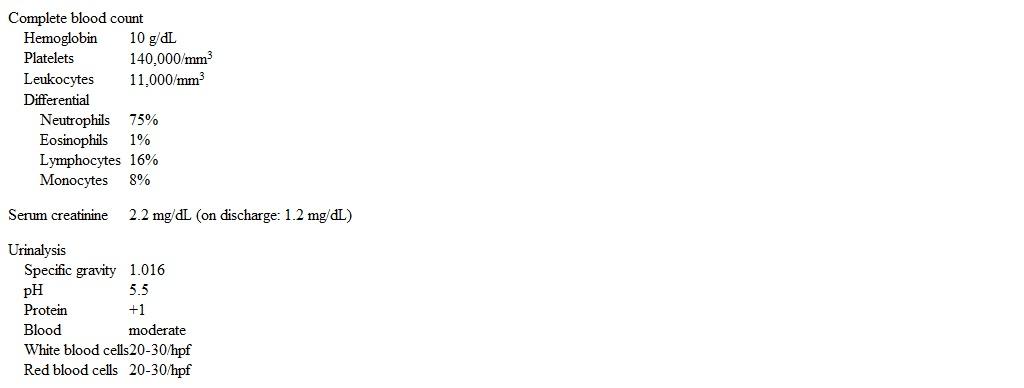 A urinary catheter is placed and produces 10 mL of urine during 6 hours of observation in the emergency department.
Which of the following is most likely to confirm the diagnosis in this patient?
A) Cystoscopy
B) Renal ultrasound
C) Urine culture
D) Urine sediment analysis for crystals
E) Urine sediment analysis for eosinophils
Correct Answer:

Verified
Q771: A 49-year-old alcoholic man is admitted for
Q772: A 63-year-old man comes to the physician
Q773: A 40-year-old woman comes to the office
Q774: A 67-year-old man comes to the physician
Q775: A 36-year-old woman comes to the office
Q777: A 28-year-old woman comes to the office
Q778: A 54-year-old woman with end-stage renal disease
Q779: A 40-year-old woman is referred for evaluation
Q780: A 43-year-old man comes to the physician
Q781: A 64-year-old man comes to the office
Unlock this Answer For Free Now!
View this answer and more for free by performing one of the following actions

Scan the QR code to install the App and get 2 free unlocks

Unlock quizzes for free by uploading documents