A 67-year-old man comes to the physician because of bloody urine. This morning, he noticed gross hematuria with passage of a few small blood clots in his urine. He also reports mild dysuria. He has since continued to have grossly bloody urine with occasional small blood clots. He denies fever, chills, back/flank pain, and bruising or bleeding at other sites. He denies any history of urolithiasis or trauma.
His other medical problems include a history of granulomatosis with polyangiitis (Wegener's) diagnosed 3 years ago. At that time, he was treated with 6 months of oral cyclophosphamide and tapering doses of prednisone. He has subsequently been maintained on oral methotrexate. He denies recent weight loss, arthralgias, or respiratory symptoms.
His blood pressure is 130/86 mm Hg, pulse is 84/min, and respirations are 16/min. He is afebrile. There are no bruises or petechiae. He does not have any flank pain. Cardiopulmonary examination is normal.
After sending a urine sample to the laboratory for culture, the following laboratory results are obtained: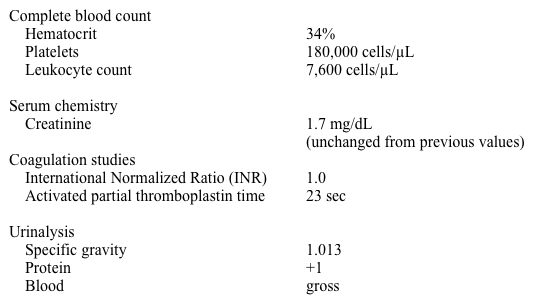
Which of the following would have the highest diagnostic yield?
A) Abdominal CT scan without contrast
B) ANCA, C-reactive protein, and ESR
C) Cystoscopy
D) Phase contrast microscopy of urine red blood cell morphology
E) Ultrasound-guided renal biopsy
Correct Answer:

Verified
Q769: A 45-year-old man is evaluated for recurrent
Q770: A 45-year-old man comes to the emergency
Q771: A 49-year-old alcoholic man is admitted for
Q772: A 63-year-old man comes to the physician
Q773: A 40-year-old woman comes to the office
Q775: A 36-year-old woman comes to the office
Q776: A 40-year-old man comes to the emergency
Q777: A 28-year-old woman comes to the office
Q778: A 54-year-old woman with end-stage renal disease
Q779: A 40-year-old woman is referred for evaluation
Unlock this Answer For Free Now!
View this answer and more for free by performing one of the following actions

Scan the QR code to install the App and get 2 free unlocks

Unlock quizzes for free by uploading documents