A 28-year-old woman comes to the office because of frequent urination. She urinates approximately every 30 to 60 minutes during the day, which makes it difficult to concentrate at work and attend meetings. She also gets up 1 to 2 times per night to urinate. The patient drinks "a lot of fluid to stay caught up." She says that her 'migraines' have worsened recently and she occasionally feels nauseated. She got a new pair of glasses due to worsening of her vision, which she attributes to spending a lot of time at work. She has had no lower abdominal pain or dysuria.
Her other medical problems include anxiety disorder and knee trauma that she sustained three months ago while jogging. She required arthroscopic surgery and took opioid medications for pain control for two weeks. She has not experienced any knee pain since.
Her BMI is 18 kg/m2. Physical examination shows no abnormalities.
Laboratory results are as follows: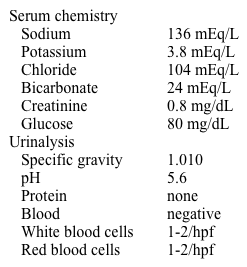
Urine pregnancy test is negative. Eight hours following a water deprivation, her weight remains unchanged and her plasma and urine osmolalties are 284 and 650 mOsm/kg H2O respectively.
Which of the following is the most likely diagnosis?
A) Amphetamine abuse
B) Central diabetes insipidus
C) Nephrogenic diabetes insipidus
D) Primary polydipsia
E) Surreptitious diuretic use
Correct Answer:

Verified
Q772: A 63-year-old man comes to the physician
Q773: A 40-year-old woman comes to the office
Q774: A 67-year-old man comes to the physician
Q775: A 36-year-old woman comes to the office
Q776: A 40-year-old man comes to the emergency
Q778: A 54-year-old woman with end-stage renal disease
Q779: A 40-year-old woman is referred for evaluation
Q780: A 43-year-old man comes to the physician
Q781: A 64-year-old man comes to the office
Q782: A 73-year-old woman comes to the clinic
Unlock this Answer For Free Now!
View this answer and more for free by performing one of the following actions

Scan the QR code to install the App and get 2 free unlocks

Unlock quizzes for free by uploading documents