A 40-year-old woman is referred for evaluation of chronic kidney disease (CKD) . She has a two-year history of intermittent back, bilateral flank, and central abdominal pain. She has lost approximately 15 lbs (6.8 kg) and is easily fatigued. She had an episode of deep venous thrombosis one year ago that has not recurred. She has noticed mild bilateral pedal edema. She works in an office and denies using tobacco or illicit drugs. Up until two years ago, she felt well and is unaware of any chronic medical problems. Her current medications include over-the-counter acetaminophen and ibuprofen for pain control.
Her examination is unremarkable except for diffuse mild abdominal tenderness and bilateral, 2+, brawny lower extremity edema.
Laboratory results are as follows: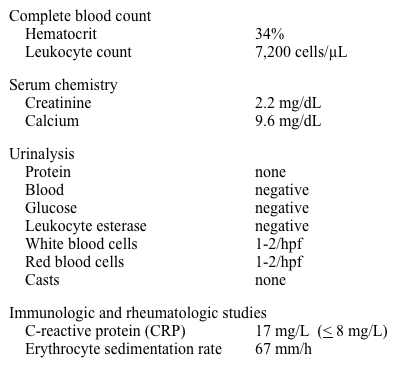
On renal ultrasound, both kidneys measure 12.5 cm (normal 9-12 cm) . There is bilateral clubbing and mild-to-moderate dilation of the calices without dilation of the mid or distal ureters.
Which of the following is the most likely diagnosis?
A) Cervical cancer with spread into the broad ligament
B) Chronic glomerulonephritis
C) Chronic interstitial nephritis
D) Renal tuberculosis
E) Retroperitoneal fibrosis
Correct Answer:

Verified
Q774: A 67-year-old man comes to the physician
Q775: A 36-year-old woman comes to the office
Q776: A 40-year-old man comes to the emergency
Q777: A 28-year-old woman comes to the office
Q778: A 54-year-old woman with end-stage renal disease
Q780: A 43-year-old man comes to the physician
Q781: A 64-year-old man comes to the office
Q782: A 73-year-old woman comes to the clinic
Q783: A 75-year-old man comes for follow-up 6
Q784: A 32-year-old woman comes to the physician
Unlock this Answer For Free Now!
View this answer and more for free by performing one of the following actions

Scan the QR code to install the App and get 2 free unlocks

Unlock quizzes for free by uploading documents