A 65-year-old man comes to the physician to follow up polymyalgia rheumatica with giant cell arteritis. He was started on 60 mg/day of prednisone 6 weeks ago and has been tapered to 20 mg/day. The patient has been taking 1,200 mg/day of supplemental calcium as well as 800 IU/day of vitamin D. He has no visual symptoms. His morning shoulder stiffness and aches have dissipated, and he feels well overall. Blood pressure is 136/84 mm Hg and pulse is 72/min. His weight is 77 kg (169.4 lb) , an increase from 72 kg (158.4 lb) 2 months ago. The patient has no temporal artery tenderness. The remainder of his physical examination is within normal limits. Laboratory results are as follows: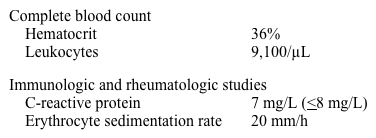
Dual-energy x-ray absorptiometry reveals a T-score of −1.3 at the lumbar spine and −1.2 at the femoral neck. Which of the following is the best next step in preventing fragility fractures in this patient?
A) Calcitonin
B) Daily weight-bearing exercises
C) Denosumab
D) Repeat dual-energy x-ray absorptiometry in 6-12 months
E) Risedronate
Correct Answer:

Verified
Q828: A 25-year-old woman comes to the physician
Q829: A 32-year-old woman comes to the physician
Q830: A 35-year-old immigrant from Eastern Europe comes
Q831: A 65-year-old man comes to the physician
Q832: A 55-year-old man comes to the physician
Q834: A 52-year-old man comes to the physician
Q835: A 55-year-old man comes to the office
Q836: A 52-year-old man with a history of
Q837: A 66-year-old woman comes to the physician
Q838: A community-dwelling 80-year-old patient comes to the
Unlock this Answer For Free Now!
View this answer and more for free by performing one of the following actions

Scan the QR code to install the App and get 2 free unlocks

Unlock quizzes for free by uploading documents