A 17-year-old boy is brought to the emergency department following a motor vehicle accident. He is found to have an extensive cerebral hemorrhage leading to deep coma, as well as fractures of the C4 vertebra, pelvis, and right femur. Following admission to the hospital, he is intubated and central lines are placed. The patient develops acute renal failure due to rhabdomyolysis, which improves rapidly with treatment. He is extubated after regaining consciousness. He also undergoes percutaneous endoscopic gastrostomy tube placement due to persistent problems with swallowing. The patient is unable to ambulate due to quadriparesis resulting from cervical cord injury. Four weeks after his initial injury, he develops nausea and polyuria. His laboratory results are as follows: 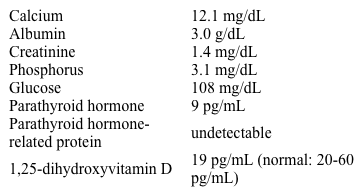 Which of the following is the most likely cause of this patient's hypercalcemia?
A) Hypoalbuminemia
B) Immobilization
C) Malignancy
D) Primary hyperparathyroidism
E) Rhabdomyolysis
F) Vitamin D-induced hypercalcemia
Correct Answer:

Verified
Q281: A 36-year-old woman comes to the office
Q282: A 39-year-old woman who recently underwent thyroidectomy
Q283: A previously healthy, 36-year-old man is hospitalized
Q284: A 28-year-old woman is hospitalized following a
Q285: A 52-year-old woman comes to the office
Q287: A 34-year-old woman comes to the office
Q288: A 33-year-old woman comes to the office
Q289: A 45-year-old woman comes to the office
Q290: A 55-year-old man comes to the office
Q291: A 34-year-old man comes to the office
Unlock this Answer For Free Now!
View this answer and more for free by performing one of the following actions

Scan the QR code to install the App and get 2 free unlocks

Unlock quizzes for free by uploading documents