A 32-year-old woman comes to the office due to abnormal liver imaging. The patient went to the emergency department a week ago for severe right flank pain radiating to the groin. A CT scan revealed a small ureter calculus, which she passed spontaneously the following day. The scan also found a solitary liver lesion, and the patient was advised to follow up with her primary care physician. She reports no right upper quadrant pain, nausea, jaundice, or clay-colored stool. She has no chronic medical problems and has no history of surgery or blood product transfusions. There is no history of cancer or liver disease in her family. She has taken combined oral contraceptives for the past 8 years. The patient does not use tobacco, alcohol, or illicit drugs. She works in a bank, is in a monogamous relationship with her husband, and recently traveled to Europe for her honeymoon. Vital signs are within normal limits. There is no scleral icterus, mucosal lesions, lymphadenopathy, or skin rash. Cardiopulmonary examination shows no abnormalities. Bowel sounds are active in all quadrants. The abdomen is nondistended, soft, and nontender. Liver is not enlarged, and spleen is not palpable. Laboratory results are as follows: 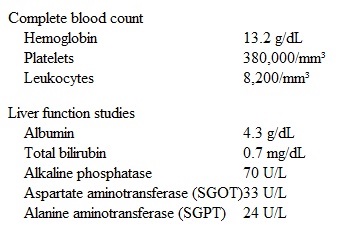 A CT scan of the abdomen reveals a 3-cm, well-demarcated lesion in the right lobe of the liver that shows peripheral enhancement with intravenous contrast administration. There are no areas of hemorrhage, necrosis, or scarring. The remainder of the liver is normal. Which of the following is the most appropriate response to this patient regarding her liver lesion?
A) The lesion is an area of hyperproliferated normal liver cells and no intervention is necessary.
B) We need to do a needle biopsy to determine the nature of the liver mass.
C) We should immediately resect the lesion as it is an aggressive malignancy.
D) Your liver condition may improve if the oral contraceptive is discontinued.
E) Your liver lesion could be a result of parasitic infection, and antimicrobials may be helpful.
Correct Answer:

Verified
Q403: A 62-year-old Hispanic woman comes to the
Q404: A 40-year-old man comes to the clinic
Q405: A 2-week-old girl is brought to the
Q406: A 3-month-old boy is brought to the
Q407: A 3-year-old boy is brought to the
Q409: A 16-year-old male comes to your office
Q410: A 5-week-old boy is brought to the
Q411: A 54-year-old man comes to the office
Q412: A 48-year-old man with alcoholic cirrhosis is
Q413: A 2-year-old boy is brought to the
Unlock this Answer For Free Now!
View this answer and more for free by performing one of the following actions

Scan the QR code to install the App and get 2 free unlocks

Unlock quizzes for free by uploading documents