A 26-year-old woman comes to the clinic for routine HIV care. She mentions that she had "low platelets" when she was tested 2 months ago in an emergency department following a minor motor vehicle collision. The patient has no mucosal bleeding and does not bruise easily. Her menses have been normal. Two years ago, she was diagnosed with HIV after attempting to donate blood. The patient has not begun antiretroviral therapy, and she takes a multivitamin daily. Her temperature is 36.9 C (98.4 F) , blood pressure is 116/78 mm Hg, pulse is 70/min, and respirations are 14/min. On examination, the patient's nasal and oropharyngeal mucosae appear normal. Her abdomen is nontender and nondistended, but the tip of the spleen is palpable on inspiration. There are no purpura or petechiae. Laboratory results are as follows: 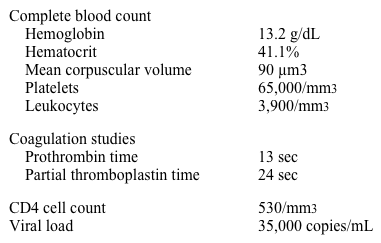
Which of the following treatments is the best next step in management?
A) Antiretroviral therapy
B) Corticosteroids
C) Intravenous immunoglobulin
D) Splenectomy
E) Thrombopoietin
Correct Answer:

Verified
Q545: A 54-year-old man comes to the office
Q546: A 17-year-old girl comes to the office
Q547: A 21-year-old woman comes to the office
Q548: A 10-year-old girl is brought to the
Q549: A 21-year-old woman comes to the office
Q551: A 16-year-old boy comes to the office
Q552: A 21-year-old woman comes to the office
Q553: A healthy 12-month-old boy is brought to
Q554: A 17-year-old girl comes to the office
Q555: A 10-year-old girl is brought to the
Unlock this Answer For Free Now!
View this answer and more for free by performing one of the following actions

Scan the QR code to install the App and get 2 free unlocks

Unlock quizzes for free by uploading documents