A 30-year-old woman, gravida 1 para 0, at 34 weeks gestation comes to the office for a prenatal visit. The patient reports no abdominal pain, vaginal bleeding, or leakage of fluid. Fetal movement is normal. The patient has had urinary frequency throughout her pregnancy, but it has worsened over the last 4 days and is now associated with dysuria. She has no fevers, chills, nausea, vomiting, back pain, or hematuria. The pregnancy has been uncomplicated. The patient has no history of chronic medical conditions and has had no previous surgery. She takes a daily prenatal vitamin. The patient smokes half a pack of cigarettes a day but does not use alcohol or illicit drugs. Temperature is 36.7 C (98.0 F) , blood pressure is 126/78 mm Hg, pulse is 76/min, and respirations are 18/min. BMI is 28 kg/m2. Fetal heart rate is 140/min. On physical examination, the uterus is nontender and fundal height is 34 cm. Suprapubic tenderness is elicited with deep palpation. There is no costovertebral angle tenderness. Laboratory results are as follows: 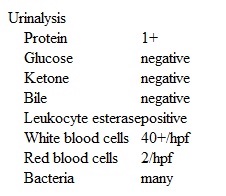 The patient is prescribed an appropriate antibiotic, and a clean-catch urine sample is obtained and sent for culture. The following day, the patient comes to the emergency department with fever, chills, nausea, and flank pain. Temperature is 38.3 C (101 F) , blood pressure is 110/70 mm Hg, pulse is 96/min, and respirations are 16/min. The fetal heart rate tracing has a baseline of 170/min, moderate variability, multiple accelerations, and no decelerations. Tocometer shows no contractions. The left costovertebral angle is tender to palpation. Abdominal examination reveals a gravid, nontender uterus and no abdominal tenderness. A digital cervical examination reveals the cervix to be closed, long, and posterior. There is trace pedal edema over the bilateral lower extremities to the knees. Which of the following is the best next step in management of this patient?
A) Administer intramuscular ceftriaxone, prescribe oral nitrofurantoin, and discharge home
B) Admit to the hospital and administer ceftriaxone
C) Admit to the hospital and administer ciprofloxacin
D) Obtain renal ultrasound to assess for perinephric abscess or renal calculi
E) Prescribe trimethoprim-sulfamethoxazole and discharge home
Correct Answer:

Verified
Q600: A 32-year-old woman comes to the emergency
Q601: A 27-year-old woman comes to the office
Q602: An 8-year-old girl is brought to the
Q603: A 26-year-old man comes to the office
Q604: A 3-year-old girl is brought to the
Q606: A 4-year-old girl is brought to the
Q607: A 30-year-old woman, gravida 1 para 0,
Q608: A 26-year-old man comes to the office
Q609: A 25-year-old man comes to the employee
Q610: A 19-year-old man comes to the student
Unlock this Answer For Free Now!
View this answer and more for free by performing one of the following actions

Scan the QR code to install the App and get 2 free unlocks

Unlock quizzes for free by uploading documents