A 78-year-old man is brought to the office by his daughter, who states that he has become forgetful. Over the past year, his responses have become slow, and he has had increasing difficulties in caring for himself. He was recently seen by another physician, who suspected a "certain type of anemia." He has no urinary or respiratory problems. The patient was previously diagnosed with hypertension and coronary artery disease. He takes lisinopril, metoprolol, and aspirin. He lives with his daughter and son-in-law. He does not use tobacco, alcohol, or illicit drugs. Examination shows an elderly man who is disoriented to time and place and communicates poorly. He speaks softly and slowly and seems to think too much about his answers. The mini-mental state examination (MMSE) score is 22 points (normal >24) . The patient's gait is slow and cautious, as if he were expecting to fall. Laboratory test results are as follows: 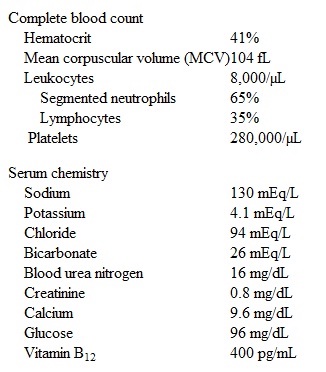 Which of the following is the most appropriate next step in the management of this patient?
A) Order brain MRI
B) Order head CT
C) Order rapid plasma reagin (RPR)
D) Order serum TSH
E) Refer the patient to a psychiatrist
Correct Answer:

Verified
Q697: A 28-year-old man comes to the office
Q698: A 24-year-old man is brought to the
Q699: An 11-month-old boy is brought to the
Q700: A 68 year old male presents to
Q701: A 34-year-old, obese, Caucasian male presents to
Q703: A 78-year-old woman is brought to the
Q704: An 18-year-old man comes to the physician
Q705: A 65-year-old man comes to the office
Q706: An 18-year-old man comes to the physician
Q707: A 32-year-old Caucasian female presents to your
Unlock this Answer For Free Now!
View this answer and more for free by performing one of the following actions

Scan the QR code to install the App and get 2 free unlocks

Unlock quizzes for free by uploading documents