A 38-year-old woman comes to the office due to worsening asthma symptoms for 2-3 days. She has shortness of breath, wheezing, and productive cough. The patient describes thick sputum that was blood-tinged yesterday. She was diagnosed with asthma 12 years ago but says that it had not been this bad until last year. For the past year the patient has had 2 hospitalizations for asthma exacerbations but has never been intubated. She completed a course of oral prednisone and azithromycin 2 months ago. Current medications include a daily fluticasone inhaler and as-needed albuterol inhaler. The patient reports no decrease in appetite or weight loss and has not travelled outside of her home state of New Jersey in the past 2 years. She works as a school teacher and does not use tobacco, alcohol, or illicit drugs. The patient has no second-hand tobacco exposure and no known allergies. Her grandmother also has asthma. Temperature is 37 C (98.6 F) , blood pressure is 123/80 mm Hg, pulse is 94/min, and respirations are 16/min. Pulse oximetry shows 95% on room air. Pulmonary examination reveals scattered wheezes. Heart sounds are normal. There is no clubbing, peripheral edema, or skin rashes. Complete blood count shows the following: 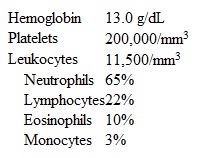 Further laboratory evaluation of the patient shows a serum total IgE level of >1,000 ng/mL. High-resolution CT scan of the lungs confirms the presence of bilateral upper lobe infiltrates and central bronchiectasis. Which of the following is the best next step in management of this patient?
A) Albendazole
B) Antituberculous therapy
C) Fluconazole
D) Levofloxacin
E) Oral prednisone
Correct Answer:

Verified
Q898: A 22-year-old man comes to the clinic
Q899: A 22-year-old woman is brought to the
Q900: A 22-year-old woman is brought to the
Q901: A 17-year-old boy is brought to the
Q902: A 43-year-old man comes to the office
Q904: A 28-year-old man with a history of
Q905: A 75-year-old man is admitted to the
Q906: A 56-year-old, previously healthy man is admitted
Q907: A 38-year-old woman comes to the office
Q908: A 64-year-old man comes to the emergency
Unlock this Answer For Free Now!
View this answer and more for free by performing one of the following actions

Scan the QR code to install the App and get 2 free unlocks

Unlock quizzes for free by uploading documents