A 40-year-old woman is brought to the emergency department by paramedics after a motor vehicle collision. She was driving and wearing a seatbelt when her car was hit by another vehicle from the opposite direction. Her car went off the road and hit a tree. When paramedics arrived at the scene, the patient was noted to have an open femur fracture but was alert and oriented. Her medical issues include hyperlipidemia and mitral valve prolapse with mild regurgitation. She takes no medications. The patient undergoes open reduction and internal fixation of the femur fracture. She receives intravenous fluids and pain control postoperatively. The next morning she experiences left-sided chest discomfort and shortness of breath. Temperature is 37.6 C (99.7 F) , blood pressure is 120/70 mm Hg, pulse is 100/min, and respirations are 30/min. Pulse oximetry shows 84% on room air. Physical examination reveals an area of tenderness over the left chest wall where the seatbelt was placed. On pulmonary examination, the patient has rales over the left upper lung. A 2/6 holosystolic murmur is present over the cardiac apex. Laboratory results are as follows: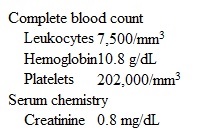 ECG shows sinus tachycardia with no ST-segment or T-wave changes. Chest x-ray shows irregular opacification predominantly of the left upper lung.
What is the most likely cause of this patient's respiratory symptoms?
A) Acute respiratory distress syndrome
B) Cardiogenic pulmonary edema
C) Fat embolism
D) Pulmonary contusion
E) Pulmonary embolism
Correct Answer:

Verified
Q939: A 6-month-old boy is brought to the
Q940: A 55-year-old man comes to the emergency
Q941: A 72-year-old woman is found to be
Q942: A 60-year-old man with a history of
Q943: A 40-year-old woman is brought to the
Q945: A 61-year-old Caucasian female presents to her
Q946: A 59-year-old man comes to the office
Q947: A 79-year-old woman is hospitalized after a
Q948: A 20-month-old girl is brought to the
Q949: A 60-year-old man with a history of
Unlock this Answer For Free Now!
View this answer and more for free by performing one of the following actions

Scan the QR code to install the App and get 2 free unlocks

Unlock quizzes for free by uploading documents