A 60-year-old man comes to the emergency department due to severe abdominal pain and an inability to void urine for the past 18 hours. The patient has a year-long history of urinary hesitancy and a weak urinary stream but has always been able to urinate prior to today. He has not had fever, chills, dysuria, or recent genitourinary trauma or procedures. The patient also has a history of chronic arthritis of the lumbar spine and was recently prescribed baclofen, which has provided some pain relief. He does not use tobacco, alcohol, or illicit drugs. Temperature is 36.5 C (97.7 F) , blood pressure is 145/90 mm Hg, pulse is 95/min, and respirations are 18/min. The patient appears restless and in moderate distress. Abdominal examination reveals suprapubic fullness and moderate tenderness to palpation with no guarding or rebound tenderness. An enlarged, smooth, nontender prostate is palpated by digital rectal examination; no masses or fecal impaction are present. There is no tenderness to palpation of the lower back. Abbreviated testing of strength and sensory function is normal. Laboratory results are as follows: 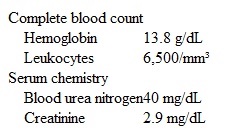 What is the best next step in management of this patient?
A) Infusion of intravenous fluid
B) Observation with repeated voiding trials
C) Suprapubic bladder aspiration for microscopy and culture
D) Suprapubic catheterization
E) Urethral catheterization
Correct Answer:

Verified
Q1011: A 26-year-old Italian-American man comes to your
Q1012: A 26-year-old Italian-American man comes to your
Q1013: A 45-year-old man comes to the physician
Q1014: A 32-year-old woman with systemic lupus erythematosus
Q1015: A 9-month-old boy is brought to the
Q1017: A 26-year-old Italian-American man comes to your
Q1018: A 55-year-old man comes to the office
Q1019: An 18-year-old woman comes to the office
Q1020: Paramedics bring a 24-year-old man who was
Q1021: A 52-year-old man comes to the office
Unlock this Answer For Free Now!
View this answer and more for free by performing one of the following actions

Scan the QR code to install the App and get 2 free unlocks

Unlock quizzes for free by uploading documents