Passage
At the blood-brain barrier, the cerebral spinal fluid (CSF) is separated from lymphatic circulation by epithelial cells bound by tight junctions. Within the central nervous system (CNS) , CSF surrounds and protects the brain and spinal cord and is believed to function in waste clearance for the CNS analogous to the role of the lymphatic system within the body.This waste clearance system has been dubbed the "glymphatic system." Although the mechanism of clearance is largely unknown, specialized glial cells known as astrocytes appear to modify the interstitial volume between neurons. This increase in interstitial volume allows for greater CSF flow, which increases the efficiency of neurotoxic clearance. Waste products removed from the brain include metabolic products such as ammonia and harmful compounds such as amyloid proteins.Recent advances in imaging technology suggest that interstitial clearance may be modified during sleep. To test this hypothesis, researchers indirectly studied changes in interstitial volume by measuring the percentage of CSF coverage in animal models during the first hour of sleep and again during the first hour of wakefulness (Figure 1) .
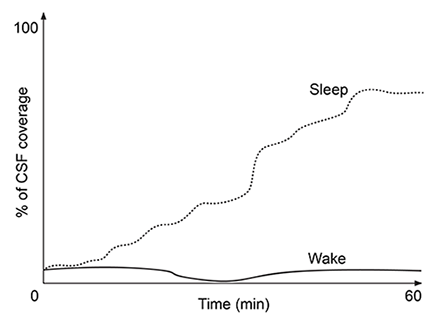 Figure 1. Percentage of CSF coverage of interstitial space during sleep and wakefulness
-Which of the following is true regarding the organization of neuronal tracts in the spinal cord?
A) Afferent neuronal fibers carry motor commands from the brain to the body through tracts in the spinal gray matter.
B) Afferent neuronal fibers carry sensory information from the body to the brain through tracts in the spinal gray matter.
C) Efferent neuronal fibers carry motor commands from the brain to the body through tracts in the spinal white matter.
D) Efferent neuronal fibers carry sensory information from the body to the brain through tracts in the spinal white matter.
Correct Answer:

Verified
Q12: Passage
Quantitative fluorescence recovery after photobleaching (FRAP) is
Q13: Passage
At the blood-brain barrier, the cerebral spinal
Q14: Passage
Quantitative fluorescence recovery after photobleaching (FRAP) is
Q15: Passage
The lumen of the human gut is
Q16: Passage
At the blood-brain barrier, the cerebral spinal
Q18: Passage
Quantitative fluorescence recovery after photobleaching (FRAP) is
Q19: Passage
Quantitative fluorescence recovery after photobleaching (FRAP) is
Q20: Passage
The lumen of the human gut is
Q21: Passage
Lipopolysaccharides (LPS) found in gram-negative bacterial cells
Q22: Passage
The Bloom syndrome helicase (BLM) transcript is
Unlock this Answer For Free Now!
View this answer and more for free by performing one of the following actions

Scan the QR code to install the App and get 2 free unlocks

Unlock quizzes for free by uploading documents