A 34-year-old woman comes to the emergency department because of right flank pain and vomiting for 5 hours. She has had fever and chills for the past 2 days. She attended a barbecue 3 days ago, where she ate egg salad. She underwent surgery for left ovarian torsion a year ago. Menses occur at regular 28-day intervals and last 5 days. She is sexually active with two male partners and uses condoms inconsistently. Her only medication is an oral contraceptive pill. She is 163 cm (5 ft 4 in) tall and weighs 72.5 kg (160 lb) ; BMI is 28 kg/m2. She appears uncomfortable. Her temperature is 38.9°C (102°F) , pulse is 101/min, and blood pressure is 118/76 mm Hg. The lungs are clear to auscultation. The right lower quadrant and right flank show severe tenderness to palpation. Pelvic examination shows no abnormalities. Laboratory studies show: 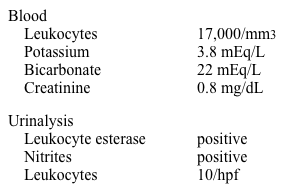 Blood and urine cultures are performed, and empiric antibiotics are initiated. Urine cultures grow gram-negative rods that are lactose-fermenting and indole-positive. Which of the following is the most likely organism causing this patient's infection?
A) Enterobacter cloacae
B) Escherichia coli
C) Haemophilus influenzae
D) Proteus mirabilis
E) Pseudomonas aeruginosa
Correct Answer:

Verified
Q72: An 8-year-old boy is brought to the
Q73: A 16-year-old boy is brought to the
Q74: A 24-year-old woman, gravida 1, para 0,
Q75: A 32-year-old man comes to the physician
Q76: A 64-year-old man comes to the emergency
Q78: A 52-year-old man is brought to the
Q79: A 43-year-old man comes to the office
Q80: A 2800-g (6-lb 3-oz) male newborn is
Q81: A 67-year-old man comes to the physician
Q82: A 59-year-old man comes to the emergency
Unlock this Answer For Free Now!
View this answer and more for free by performing one of the following actions

Scan the QR code to install the App and get 2 free unlocks

Unlock quizzes for free by uploading documents