The age of a fossil can be estimated by analyzing the decay of radioisotopes within the accompanying rock. If you suspected a fossil was 100 million years old, which type of radioisotopes would you use to analyze the accompanying rock?
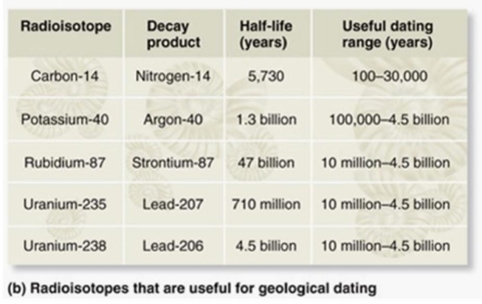
A) Potassium-40/Argon-40 (half-life = 1.3 billion years; useful dating range =100,000-4.5 billion years)
B) Rubidium-87/Strontium-87 (half-life = 47 billion years; useful dating range = 10 million-4.5 billion years)
C) Uranium-235/Lead-207 (half-life = 710 million years; useful dating range = 10 million-4.5 billion years)
D) Carbon-14/Nitrogen-14 (half-life = 5,730 years; useful dating range = 100-50,000 years)
E) Uranium-238/Lead-238 (half-life 4.5 billion years; useful dating range = 10 million-4.5 billion years)
Correct Answer:

Verified
Q3: Suppose you wanted to investigate ideas on
Q4: A protobiont
A) has a boundary, or membrane.
B)
Q5: When lipids, phosphates, carbohydrates and RNA were
Q6: You have just invented a time machine
Q7: Both DNA and RNA can store information,
Q9: A scientist found an unweathered igneous rock
Q10: Which would be most likely to be
Q11: The first known fossils of living cells
Q12: To explain the origin of the nuclear
Q13: The major difference between the endosymbiotic relationship
Unlock this Answer For Free Now!
View this answer and more for free by performing one of the following actions

Scan the QR code to install the App and get 2 free unlocks

Unlock quizzes for free by uploading documents