







 Chat with AI

Deck 9: Water, Electrolytes and Temperature Regulation
Full screen (f)

Question

Question
Question
Question
Question
Question
Question
Question
Question
Question
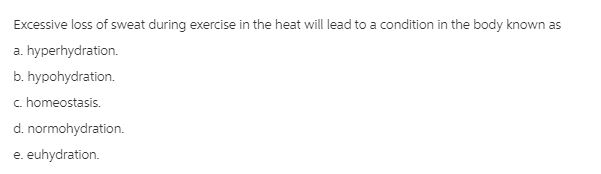
Question
Question
Question
Question
Question

Unlock Deck
Sign up to unlock the cards in this deck!
Unlock Deck
Unlock Deck
1/15

Play

Full screen (f)
Deck 9: Water, Electrolytes and Temperature Regulation
1
Discuss the means whereby your body maintains normal water balance. Include in your discussion the role of the blood, hypothalamus, pituitary gland, antidiuretic hormone, and kidney.
The kidney maintains the normal level of the body water. Normohydration or euhydration is the term used to represent the maintain of normal levels of body water and dehydration is the loss of the body water. The body possesses an efficient mechanism to maintain the normal levels of body water, which is termed as homeostasis.
Normal water levels of the body fluids in various compartments are maintained by a feedback mechanism like osmotic pressure receptors, antidiuretic hormone and kidneys. The main reason for the feedback mechanis is the osmololity process.
When the body losses, excess water or intake of water is low, the blood becomes highly concentrated and the blood needs to obtain water from the body cells like osmoreceptors present in the hypothalamus.
The osmoreceptor cells react with the highly concentrated body fluids and stimulates the antidiuretic hormone (ADH) from the pituitary gland. The ADH or arginine vasopressin travels by the blood and reaches the kidneys and initiates to absorb the most amount of water. The ADH is the only hormone that regulates the body normal water level.
Normal water levels of the body fluids in various compartments are maintained by a feedback mechanism like osmotic pressure receptors, antidiuretic hormone and kidneys. The main reason for the feedback mechanis is the osmololity process.
When the body losses, excess water or intake of water is low, the blood becomes highly concentrated and the blood needs to obtain water from the body cells like osmoreceptors present in the hypothalamus.
The osmoreceptor cells react with the highly concentrated body fluids and stimulates the antidiuretic hormone (ADH) from the pituitary gland. The ADH or arginine vasopressin travels by the blood and reaches the kidneys and initiates to absorb the most amount of water. The ADH is the only hormone that regulates the body normal water level.
2
Which of the following blood pressure values for adults 18 years of age and older represents the minimal blood pressure for the first stage of hypertension (mild)? The values listed are systolic and diastolic, in that order.
A) 130 and 80
B) 130 and 90
C) 140 and 90
D) 160 and 100
E) 210 and 120
A) 130 and 80
B) 130 and 90
C) 140 and 90
D) 160 and 100
E) 210 and 120
Hypertension is a persistent rise in blood pressure than the normal. The average normal adult blood pressure is 120/80 mm Hg (120 is the systolic and 80 is the diastolic pressure) and the pressure exceeding 140/90 is considered as high blood pressure. Depend upon the severity, hypertension is classified as follows. 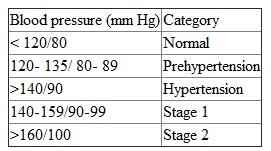 Thus, the diagnostic blood pressure range for the first stage of hypertension for adults 18 years above and elderly individuals is, 140 to 90 mmHg.
Thus, the options (a), (b), (d), and (e) are incorrect as they refer to incorrect blood pressure range.
Thus, the correct option is,
Thus, the diagnostic blood pressure range for the first stage of hypertension for adults 18 years above and elderly individuals is, 140 to 90 mmHg. Thus, the options (a), (b), (d), and (e) are incorrect as they refer to incorrect blood pressure range.
Thus, the correct option is,
3
Name the four components of heat stress that are recorded by the wet-bulb globe temperature (WBGT) thermometer, and discuss how each factor may contribute to heat stress during exercise under warm environmental conditions.
When the body temperature increases with exercise in a warm or hot environment, the individual should prone to hyperthermia, due to heat stress.
The four components of heat stress that are recorded by wet-bulb globe temperature thermometer in an active individual are as follows:
• Air temperature: When the air temperature is 80º F (27º C) or above or the humidity and solar radiation are high in the atmosphere, caution should be advised to the individual due chance of risk of heat stress during the exercise.
• Relative humidity: The cooling system for the body during exercise is the evaporation of sweat. When the humidity rises due to water content increased in the air, affects the ability to produce sweat.
When the humidity is 70% or above, the sweat evaporation will decrease and with humidity 90 to 100% the heat loss will be near zero. Then, caution should be given when the humidity exceeds 50%-60%.
• Air movement: Heat can be carried away by convection when still the air is limited. A small breeze can keep the body temperature normal by moving heat from the skin surface.
• Radiation: An additional heat stress or heat load may be created due to radiant heat from the sun.
All the four components of heat stress are measured by wet-bulb globe temperature (WBGT) thermometer. The air temperature was measured by a dry-bulb thermometer (DB), relative humidity and air movements are measured by a wet-bulb thermometer (WB) and the globe thermometer (G) measures the radiation.
The four components of heat stress that are recorded by wet-bulb globe temperature thermometer in an active individual are as follows:
• Air temperature: When the air temperature is 80º F (27º C) or above or the humidity and solar radiation are high in the atmosphere, caution should be advised to the individual due chance of risk of heat stress during the exercise.
• Relative humidity: The cooling system for the body during exercise is the evaporation of sweat. When the humidity rises due to water content increased in the air, affects the ability to produce sweat.
When the humidity is 70% or above, the sweat evaporation will decrease and with humidity 90 to 100% the heat loss will be near zero. Then, caution should be given when the humidity exceeds 50%-60%.
• Air movement: Heat can be carried away by convection when still the air is limited. A small breeze can keep the body temperature normal by moving heat from the skin surface.
• Radiation: An additional heat stress or heat load may be created due to radiant heat from the sun.
All the four components of heat stress are measured by wet-bulb globe temperature (WBGT) thermometer. The air temperature was measured by a dry-bulb thermometer (DB), relative humidity and air movements are measured by a wet-bulb thermometer (WB) and the globe thermometer (G) measures the radiation.
4
Which of the following does not occur in acclimatization to exercise in the heat?
A) increased sweat production during exercise
B) increased blood volume
C) a lower rise in the core temperature during exercise
D) a lower rise in the heart rate response to exercise
E) an increased sodium loss in each liter of sweat
A) increased sweat production during exercise
B) increased blood volume
C) a lower rise in the core temperature during exercise
D) a lower rise in the heart rate response to exercise
E) an increased sodium loss in each liter of sweat
Unlock Deck
Unlock for access to all 15 flashcards in this deck.
Unlock Deck
k this deck
5
Your friend is going to run a marathon. The projected weather forecast is sunny, warm, and humid. What advice would you offer regarding consumption of fluids, including carbohydrate and electrolytes, before and during the race?
Unlock Deck
Unlock for access to all 15 flashcards in this deck.
Unlock Deck
k this deck
6
Which of the following statements is false?
A) The maximal sweat rate appears to be about 2-3 liters per hour.
B) Dehydration as low as 2 percent of the body weight may lead to a decrease in aerobic endurance performance.
C) Sweat is mainly water.
D) The major electrolytes found in sweat are calcium and potassium.
A) The maximal sweat rate appears to be about 2-3 liters per hour.
B) Dehydration as low as 2 percent of the body weight may lead to a decrease in aerobic endurance performance.
C) Sweat is mainly water.
D) The major electrolytes found in sweat are calcium and potassium.
Unlock Deck
Unlock for access to all 15 flashcards in this deck.
Unlock Deck
k this deck
7
List and discuss five strategies to help reduce the hazards associated with exercise in a hot environment.
Unlock Deck
Unlock for access to all 15 flashcards in this deck.
Unlock Deck
k this deck
8
Which of the following is most limited in the DASH diet?
A) calcium
B) fiber
C) magnesium
D) sodium
E) potassium
F) phytonutrients
A) calcium
B) fiber
C) magnesium
D) sodium
E) potassium
F) phytonutrients
Unlock Deck
Unlock for access to all 15 flashcards in this deck.
Unlock Deck
k this deck
9
What is high blood pressure? Why is it dangerous to your health? What lifestyle behaviors may help in its prevention or treatment
Unlock Deck
Unlock for access to all 15 flashcards in this deck.
Unlock Deck
k this deck
10
Unlock Deck
Unlock for access to all 15 flashcards in this deck.
Unlock Deck
k this deck
11
Which of the following is not one of the physical means whereby heat is lost from the human body?
A) condensation
B) conduction
C) evaporation
D) convection
E) radiation
A) condensation
B) conduction
C) evaporation
D) convection
E) radiation
Unlock Deck
Unlock for access to all 15 flashcards in this deck.
Unlock Deck
k this deck
12
A high relative humidity and sunshine impose a heat stress during exercise by their adverse effects on the body, respectively, as
A) increased condensation of sweat and decreased radiant heat to the body.
B) increased convection heat loss and decreased radiant heat to the body.
C) decreased evaporation of sweat and increased radiant heat to the body.
D) decreased condensation of sweat and decreased convection of heat to the body.
E) increased evaporation of sweat and increased convection of heat to the body.
A) increased condensation of sweat and decreased radiant heat to the body.
B) increased convection heat loss and decreased radiant heat to the body.
C) decreased evaporation of sweat and increased radiant heat to the body.
D) decreased condensation of sweat and decreased convection of heat to the body.
E) increased evaporation of sweat and increased convection of heat to the body.
Unlock Deck
Unlock for access to all 15 flashcards in this deck.
Unlock Deck
k this deck
13
Calculate the increase in the body temperature, in degrees Celsius, that would occur if an individual was unable to dissipate heat and were exercising at an intensity of 3 liters of oxygen per minute for 20 minutes. The athlete weighs 60 kg, her mechanical efficiency is 20 percent, and the specific heat of her body is 0.83.
A) 2.2
B) 4.8
C) 10.2
D) 6.0
E) 9.4
A) 2.2
B) 4.8
C) 10.2
D) 6.0
E) 9.4
Unlock Deck
Unlock for access to all 15 flashcards in this deck.
Unlock Deck
k this deck
14
Which of the following statements regarding bottled water is false?
A) Bottled water is normally much more expensive than municipal water supplies.
B) Bottled water must conform to the same safety standards as municipal water supplies.
C) Some bottled waters are simply municipal water that has undergone purification.
D) Bottled water normally contains more fluoride than fluoridated municipal water supplies.
A) Bottled water is normally much more expensive than municipal water supplies.
B) Bottled water must conform to the same safety standards as municipal water supplies.
C) Some bottled waters are simply municipal water that has undergone purification.
D) Bottled water normally contains more fluoride than fluoridated municipal water supplies.
Unlock Deck
Unlock for access to all 15 flashcards in this deck.
Unlock Deck
k this deck
15
During prolonged endurance exercise in the heat, excessive intake of water and inadequate intake of salt may lead to a dangerous health condition known as
A) hypercalcemia.
B) hypotension.
C) hypohydration.
D) hyponatremia.
E) hyperkalemia.
A) hypercalcemia.
B) hypotension.
C) hypohydration.
D) hyponatremia.
E) hyperkalemia.
Unlock Deck
Unlock for access to all 15 flashcards in this deck.
Unlock Deck
k this deck
Unlock Deck
Unlock for access to all 15 flashcards in this deck.






