







 Chat with AI

Deck 11: Analysis of Covariance, Multivariate Anova, and Related Multivariate Analyses
Full screen (f)

Question

Question
Question
Question
Question
Question
Question
Question
Question
Question
Question
Question
Question
Question
Question
Question
Question
Question
Question
Question
Question
Question
Question
Question
Question
Question
Questions pertain to the following table (Table 11), which presents results for a fictitious analysis of outcomes from a randomized controlled trial.
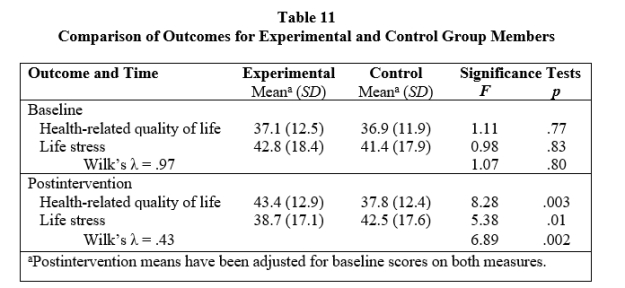
-Refer to Table 11. What type of analysis is being reported in this table?
A) MANOVA
B) MANCOVA
C) MANOVA and ANCOVA
D) MANOVA and MANCOVA
-Refer to Table 11. What type of analysis is being reported in this table?
A) MANOVA
B) MANCOVA
C) MANOVA and ANCOVA
D) MANOVA and MANCOVA
Question
Questions pertain to the following table (Table 11), which presents results for a fictitious analysis of outcomes from a randomized controlled trial.
-Refer to Table 11. How much variance in post-test scores was accounted for in the analysis?
A) 97%
B) 57%
C) 43%
D) 3%
-Refer to Table 11. How much variance in post-test scores was accounted for in the analysis?
A) 97%
B) 57%
C) 43%
D) 3%
Question
Questions pertain to the following table (Table 11), which presents results for a fictitious analysis of outcomes from a randomized controlled trial.
-Refer to Table 11. What essential piece of information about the analysis is missing from this table?
A) Effect size
B) Sample size
C) Significance criterion
D) 95% CIs
-Refer to Table 11. What essential piece of information about the analysis is missing from this table?
A) Effect size
B) Sample size
C) Significance criterion
D) 95% CIs

Unlock Deck
Sign up to unlock the cards in this deck!
Unlock Deck
Unlock Deck
1/28

Play

Full screen (f)
Deck 11: Analysis of Covariance, Multivariate Anova, and Related Multivariate Analyses
1
The general linear model (GLM) is the foundation for which of the following statistical analyses?
A) t-tests
B) ANOVA
C) Multiple regression
D) All of the above
A) t-tests
B) ANOVA
C) Multiple regression
D) All of the above
D
2
Which of the following type of sums of squares within the GLM is the basic (default) type for most analyses?
A) Type I
B) Type II
C) Type III
D) Type IV
A) Type I
B) Type II
C) Type III
D) Type IV
C
3
A covariate in ANCOVA is:
A) Always a pretest measure of the outcome variable
B) A second dependent variable
C) An interaction term
D) A variable the researcher wants to statistically control
A) Always a pretest measure of the outcome variable
B) A second dependent variable
C) An interaction term
D) A variable the researcher wants to statistically control
D
4
Which of the following statements is true?
A) Adjusted means reflect group means on an outcome, net of the effect of covariates.
B) Adjusted means cannot be computed when the covariate is a pretest measure of the outcome.
C) The null hypothesis in ANCOVA is that the unadjusted group means are equal.
D) If unadjusted group means are equal, the adjusted group means will also be equal.
A) Adjusted means reflect group means on an outcome, net of the effect of covariates.
B) Adjusted means cannot be computed when the covariate is a pretest measure of the outcome.
C) The null hypothesis in ANCOVA is that the unadjusted group means are equal.
D) If unadjusted group means are equal, the adjusted group means will also be equal.
Unlock Deck
Unlock for access to all 28 flashcards in this deck.
Unlock Deck
k this deck
5
An assumption in ANCOVA that is not an assumption in ANOVA is that:
A) The dependent variable is normally distributed
B) The regression of the dependent variable on the covariate is equal across groups
C) Variances across groups are equal
D) Participants were randomly selected from their respective populations
A) The dependent variable is normally distributed
B) The regression of the dependent variable on the covariate is equal across groups
C) Variances across groups are equal
D) Participants were randomly selected from their respective populations
Unlock Deck
Unlock for access to all 28 flashcards in this deck.
Unlock Deck
k this deck
6
Technically, for which of the following designs is ANCOVA most appropriate?
A) A time series design
B) A randomized controlled pretest-posttest design
C) A case-control design
D) A nonequivalent control group design
A) A time series design
B) A randomized controlled pretest-posttest design
C) A case-control design
D) A nonequivalent control group design
Unlock Deck
Unlock for access to all 28 flashcards in this deck.
Unlock Deck
k this deck
7
Effect size for adjusted group differences in ANCOVA is reflected in which of these indexes?
A) R2
B) eta2
C) Partial eta2
D) Beta weights
A) R2
B) eta2
C) Partial eta2
D) Beta weights
Unlock Deck
Unlock for access to all 28 flashcards in this deck.
Unlock Deck
k this deck
8
Which of the following statements is true?
A) Change scores are used as the dependent variable in ANCOVA.
B) Change scores are used as the covariate in ANCOVA.
C) Change scores tend to be less reliable than scores on the original measures used to compute them.
D) An advantage of change scores is that they are not susceptible to floor or ceiling effects.
A) Change scores are used as the dependent variable in ANCOVA.
B) Change scores are used as the covariate in ANCOVA.
C) Change scores tend to be less reliable than scores on the original measures used to compute them.
D) An advantage of change scores is that they are not susceptible to floor or ceiling effects.
Unlock Deck
Unlock for access to all 28 flashcards in this deck.
Unlock Deck
k this deck
9
Which of the following is not a test statistic for MANOVA?
A) Bartlett's test
B) Hotelling's trace
C) Wilk's lambda
D) Pillai's trace
A) Bartlett's test
B) Hotelling's trace
C) Wilk's lambda
D) Pillai's trace
Unlock Deck
Unlock for access to all 28 flashcards in this deck.
Unlock Deck
k this deck
10
Which of the following statements about MANOVA is not true?
A) The independent variable in MANOVA is a nominal (categorical) variable.
B) Individual dependent variable's contribution to significant MANOVA results can be evaluated through stepdown analysis.
C) MANOVA works best when dependent variables are highly negatively correlated.
D) There can be multiple dependent variables, but only one independent variable in MANOVA.
A) The independent variable in MANOVA is a nominal (categorical) variable.
B) Individual dependent variable's contribution to significant MANOVA results can be evaluated through stepdown analysis.
C) MANOVA works best when dependent variables are highly negatively correlated.
D) There can be multiple dependent variables, but only one independent variable in MANOVA.
Unlock Deck
Unlock for access to all 28 flashcards in this deck.
Unlock Deck
k this deck
11
λ is analogous to which of the following?
A) R2
B) 1 - R2
C) 1 - R
D) F
A) R2
B) 1 - R2
C) 1 - R
D) F
Unlock Deck
Unlock for access to all 28 flashcards in this deck.
Unlock Deck
k this deck
12
The Box M test is used to evaluate which of the following assumptions?
A) Homogeneity of the variance-covariance matrix
B) Sphericity
C) Compound symmetry
D) Homogeneity of regression across groups
A) Homogeneity of the variance-covariance matrix
B) Sphericity
C) Compound symmetry
D) Homogeneity of regression across groups
Unlock Deck
Unlock for access to all 28 flashcards in this deck.
Unlock Deck
k this deck
13
A mixed design RM-ANOVA is needed when:
A) A group is compared over three or more points in time
B) Two or more groups are compared over time
C) Change scores over time have been computed for two or more groups
D) The GLM cannot be assumed to be appropriate
A) A group is compared over three or more points in time
B) Two or more groups are compared over time
C) Change scores over time have been computed for two or more groups
D) The GLM cannot be assumed to be appropriate
Unlock Deck
Unlock for access to all 28 flashcards in this deck.
Unlock Deck
k this deck
14
The test that can be used to assess whether the assumption of sphericity has been violated in a RM-ANOVA is:
A) Box M
B) Greenhouse-Geisser
C) Huynh-Feldt
D) Mauchly
A) Box M
B) Greenhouse-Geisser
C) Huynh-Feldt
D) Mauchly
Unlock Deck
Unlock for access to all 28 flashcards in this deck.
Unlock Deck
k this deck
15
When sphericity has been violated in an RM-ANOVA, which of the following can be used as a correction factor in the analysis?
A) Lambda multiplied by degrees of freedom
B) Lambda multiplied by the value of F
C) Epsilon multiplied by degrees of freedom
D) Epsilon multiplied by the statistical criterion (α)
A) Lambda multiplied by degrees of freedom
B) Lambda multiplied by the value of F
C) Epsilon multiplied by degrees of freedom
D) Epsilon multiplied by the statistical criterion (α)
Unlock Deck
Unlock for access to all 28 flashcards in this deck.
Unlock Deck
k this deck
16
When the assumption of sphericity has been violated in a mixed-design RM-ANOVA with four time periods, an alternative analysis is:
A) MANOVA
B) ANCOVA
C) Multiple regression
D) Canonical correlation
A) MANOVA
B) ANCOVA
C) Multiple regression
D) Canonical correlation
Unlock Deck
Unlock for access to all 28 flashcards in this deck.
Unlock Deck
k this deck
17
What is the minimum number of variables in a canonical analysis?
A) 2
B) 3
C) 4
D) 5
A) 2
B) 3
C) 4
D) 5
Unlock Deck
Unlock for access to all 28 flashcards in this deck.
Unlock Deck
k this deck
18
In canonical analysis, correlations between the original variables and composite canonical variates are called:
A) Roots
B) Structure coefficients
C) Rcs
D) Lambda coefficients
A) Roots
B) Structure coefficients
C) Rcs
D) Lambda coefficients
Unlock Deck
Unlock for access to all 28 flashcards in this deck.
Unlock Deck
k this deck
19
Discriminant analysis cannot be used when:
A) The dependent variable is dichotomous
B) The dependent variable is a ratio-level measure
C) Predictors include categorical and continuous variables
D) The sample size is larger than the number of predictors
A) The dependent variable is dichotomous
B) The dependent variable is a ratio-level measure
C) Predictors include categorical and continuous variables
D) The sample size is larger than the number of predictors
Unlock Deck
Unlock for access to all 28 flashcards in this deck.
Unlock Deck
k this deck
20
Which of the following statements about discriminant function analysis is true?
A) Discriminant analysis is used in similar applications to canonical analysis.
B) A D score is predicted in the standardized form of the discriminant equation.
C) There are always at least two discriminant functions in a discriminant analysis.
D) The number of discriminant functions equals the number of groups minus one or the number of predictors.
A) Discriminant analysis is used in similar applications to canonical analysis.
B) A D score is predicted in the standardized form of the discriminant equation.
C) There are always at least two discriminant functions in a discriminant analysis.
D) The number of discriminant functions equals the number of groups minus one or the number of predictors.
Unlock Deck
Unlock for access to all 28 flashcards in this deck.
Unlock Deck
k this deck
21
A researcher compared diabetic patients randomly assigned to an experimental and control group in terms of three measures of cognitive functioning, controlling for blood pressure measurements at baseline. Which analysis was likely used?
A) ANCOVA
B) MANOVA
C) MANCOVA
D) Mixed-design RM-ANOVA
A) ANCOVA
B) MANOVA
C) MANCOVA
D) Mixed-design RM-ANOVA
Unlock Deck
Unlock for access to all 28 flashcards in this deck.
Unlock Deck
k this deck
22
A researcher compared male versus female adolescents with regard to mean monthly alcohol consumption at the end of each year of high school. Which analysis was likely used?
A) MANOVA
B) MANCOVA
C) Mixed-design RM-ANOVA
D) Discriminant analysis
A) MANOVA
B) MANCOVA
C) Mixed-design RM-ANOVA
D) Discriminant analysis
Unlock Deck
Unlock for access to all 28 flashcards in this deck.
Unlock Deck
k this deck
23
A researcher compared smokers and nonsmokers on scores on a physical functioning measure, controlling for weight (measured via the body mass index). Which analysis was likely used?
A) ANCOVA
B) MANOVA
C) MANCOVA
D) Canonical analysis
A) ANCOVA
B) MANOVA
C) MANCOVA
D) Canonical analysis
Unlock Deck
Unlock for access to all 28 flashcards in this deck.
Unlock Deck
k this deck
24
A researcher used a range of demographic and clinical variables to predict which patients would experience a fall during their hospitalization. Which analysis was likely used?
A) ANCOVA
B) Mixed-design RM-ANOVA
C) Canonical analysis
D) Discriminant analysis
A) ANCOVA
B) Mixed-design RM-ANOVA
C) Canonical analysis
D) Discriminant analysis
Unlock Deck
Unlock for access to all 28 flashcards in this deck.
Unlock Deck
k this deck
25
A researcher used a set of prehospital admission characteristics to understand patient's anxiety, depression, and uncertainty 2 days after surgery. Which analysis was likely used?
A) MANOVA
B) Mixed-design RM-ANOVA
C) Canonical analysis
D) Discriminant analysis
A) MANOVA
B) Mixed-design RM-ANOVA
C) Canonical analysis
D) Discriminant analysis
Unlock Deck
Unlock for access to all 28 flashcards in this deck.
Unlock Deck
k this deck
26
Questions pertain to the following table (Table 11), which presents results for a fictitious analysis of outcomes from a randomized controlled trial.
-Refer to Table 11. What type of analysis is being reported in this table?
A) MANOVA
B) MANCOVA
C) MANOVA and ANCOVA
D) MANOVA and MANCOVA
-Refer to Table 11. What type of analysis is being reported in this table?
A) MANOVA
B) MANCOVA
C) MANOVA and ANCOVA
D) MANOVA and MANCOVA
Unlock Deck
Unlock for access to all 28 flashcards in this deck.
Unlock Deck
k this deck
27
Questions pertain to the following table (Table 11), which presents results for a fictitious analysis of outcomes from a randomized controlled trial.
-Refer to Table 11. How much variance in post-test scores was accounted for in the analysis?
A) 97%
B) 57%
C) 43%
D) 3%
-Refer to Table 11. How much variance in post-test scores was accounted for in the analysis?
A) 97%
B) 57%
C) 43%
D) 3%
Unlock Deck
Unlock for access to all 28 flashcards in this deck.
Unlock Deck
k this deck
28
Questions pertain to the following table (Table 11), which presents results for a fictitious analysis of outcomes from a randomized controlled trial.
-Refer to Table 11. What essential piece of information about the analysis is missing from this table?
A) Effect size
B) Sample size
C) Significance criterion
D) 95% CIs
-Refer to Table 11. What essential piece of information about the analysis is missing from this table?
A) Effect size
B) Sample size
C) Significance criterion
D) 95% CIs
Unlock Deck
Unlock for access to all 28 flashcards in this deck.
Unlock Deck
k this deck
Unlock Deck
Unlock for access to all 28 flashcards in this deck.






