







 Chat with AI


International Marketing 15th Edition by Cateora Graham
Edition 15ISBN: 978-9339204464International Marketing 15th Edition by Cateora Graham
Edition 15ISBN: 978-9339204464 Exercise 6
A Sea Launch Recovery
CIRCA 2008
Sea Launch engineers say the three-week round-trip journey across the Pacific Ocean is the most rewarding part of their jobs. The cruise is the culmination of nearly two months of work preparing the rocket, payload, and launch teams for the mission. Prior to operations at Home Port, about 18 months goes into the planning, flight design, and logistics. "It's really nice to know most of the reviews are over and we're finally ready to launch," said Bill Rujevcan, mission director for the company's next flight.
More than 300 people take the trip to the company's equatorial launch site about 1,400 miles south of Hawaii. The crew includes workers from several nations, including: Ukraine, Russia, Norway, the Philippines, and the United States. Ukraine-based Yuzhnoye and Yuzhmash build the Zenit 3SL rocket's first and second stages, while Energia of Russia manufactures the Block DM-SL upper stage for the rocket. Norwegian ship officers manage marine operations, and Filipino deckhands work on both the Sea Launch Commander and the Odyssey launch platform. U.S. employees from the Boeing Co. fill management roles and provide the flight design, payload fairing, and satellite adapter. Astrotech, a contractor, oversees processing of customer payloads inside a clean room at the company's Payload Processing Facility at Home Port in Long Beach, California.
After 27 missions in nine years of business, Sea Launch is thriving in the do-or-die commercial launch industry. The company's Zenit 3SL rocket has suffered three setbacks in that time. Two were total failures. The rocket's success rate places it among the top tier of heavy-lift launchers on the commercial market, and the company's launch backlog seems to confirm that. Sea Launch is already booking payloads for launch in the future. Next year is sold out, according to company officials.
Sea Launch Home Port is a decommissioned U.S. Navy facility on the tip of a manmade peninsula at the Port of Long Beach. The Sea Launch buildings are all left over from the Navy except for the Payload Processing Facility, which the company built in the late 1990s. The company's pier is home to two one-of-a-kind vessels-the Sea Launch Commander and the Odyssey launch platform. The Sea Launch Commander carries about 240 people, ranging from rocket technicians and corporate leaders to chefs and helicopter pilots. The Commander houses a state-of-the-art launch control center divided between two sections designed for Ukrainian and Russian engineers and American engineers and managers. The cavernous rocket assembly and checkout hall is located on the command ship's lower deck and stretches nearly the entire length of the vessel. The facility is capable of supporting two simultaneous launch campaigns using staging and integration compartments and a fueling cell. Giant cranes inside the high bays lift rocket stages, which sits on Russian-gauge rails on the floor integration room floor. The rocket's ground support equipment inside the Sea Launch Commander is virtually identical to hardware used for Zenit launches at the Baikonur Cosmodrome in Kazakhstan, according to Sea Launch officials.
The Sea Launch Commander was specially constructed for Sea Launch at a Scotland shipyard by the maritime unit of Kvaerner, then a leading Norwegian industrial company. Measuring 656 feet long and 105 feet wide, the command ship was outfitted with more than 600 tons of rocket support equipment in Russia before sailing to Long Beach in 1998. The massive ship's crew quarters are home to Sea Launch's international employees during their stay in the United States.
The Sea Launch Commander and the Odyssey platform are seen here docked at Home Port.

As Ukrainian and Russian engineers complete work to ready the Zenit rocket, technicians inside Sea Launch's Payload Processing Facility are busy preparing the booster's satellite payload down the road from the docked vessels. When both groups are ready, the spacecraft is transported about 1,000 feet and loaded into the Sea Launch Commander's final assembly hall on the roll-on, roll-off vessel. Already enclosed in the payload fairing, the satellite is attached to the Zenit-3SL's upper stage to complete the rocket's construction.
EchoStar 11, the payload for Sea Launch's mission this month, was rolled from the clean room to the command ship hangar June 25. The 12,150-pound satellite was bolted to the Block DM-SL upper stage a day later. The rocket was next moved to the Odyssey Launch Platform. The launcher, which weighs about 100,000 pounds without propellant, is transferred in a high- precision operation more 200 feet above the waters of Long Beach Harbor.
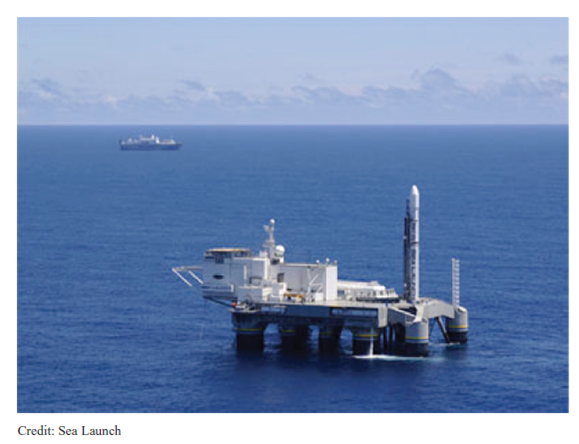
The Sea Launch Commander first pulls in front of Odyssey and the rocket is rolled out of the integration hall. The rocket is then hoisted into Odyssey's hangar, where it stays during the transit from Long Beach to the launch site. Sea Launch then lifts the 200-foot-tall rocket upright on its launch pad for a final series of tests to make sure all systems are ready to set sail for the equator.
"That's our last big test before we leave," Rujevcan said.
Odyssey, the slower of the company's two ships, usually leaves Long Beach a few days before the Sea Launch Commander. The launch platform left port for the EchoStar 11 campaign last week. With a top speed of about 12 knots, Odyssey's crew of 70 sailors and engineers serve as caretakers of the Zenit rocket during the 2,882-mile transit to the launch site along the equator at 154 degrees west longitude.
Odyssey is a converted North Sea oil drilling platform built in Japan in 1983. Kvaerner's maritime division modified the vessel between 1995 and 1997 to support rocket launches, according to Sea Launch. The changes included adding two extra vertical support columns, effectively extending the length of the platform to 436 feet. The deck extension was needed to make room for the Zenit launch pad, an immense hole in Odyssey's deck with a gas diffuser directly beneath it, said Paula Korn, Sea Launch spokesperson. Workers replaced more than 20 miles of wiring on Odyssey after Sea Launch suffered a failure on the launch pad during a liftoff last year. The platform underwent a slate of repairs, including the replacement of a destroyed gas deflector and the repainting of the ship, Korn said.
The Sea Launch Commander pulled out of port this weekend to begin its trek to the equatorial Pacific. The ship will rendezvous with Odyssey at sea later this week. Officials keep busy during the trip by completing a handful of final prelaunch reviews, two countdown rehearsals and several other meetings, Rujevcan said. The ships also offer a number of recreational activities for the launch team. The Sea Launch Commander carries basketball and volleyball courts, a swimming pool, and a movie theater, not to mention opportunities to play pool, foosball and air hockey. Crews also enjoy access to DirecTV programming and XM Satellite Radio, two regular customers for Sea Launch. The Sea Launch Commander is furnished with a full-service cafeteria and bar, but the booze stops flowing soon after the ships arrive at the launch site.
Odyssey's ballast tanks are filled with seawater to submerge the platform's pontoons to a depth of about 65 feet to help keep the vessel stable. The command ship pulls alongside Odyssey and technicians move between the vessels using a 115-foot-long link bridge. The team begins the launch countdown three days prior to liftoff. The Sea Launch Commander sails three-and-a-half miles away from Odyssey a day before launch. A helicopter transfers final personnel and equipment between the vessels. The Zenit 3SL rocket is rolled out of its hangar and erected on the pad about 27 hours before the scheduled launch. Pneumatic pistons power the erector during the 10-minute lifting operation, and technicians torque four hold-down bolts to firmly attach the rocket to the launch pad. The bolts automatically retract from the booster at liftoff. The countdown enters an automated sequence five hours before launch, and the team serves as watchdogs to ensure no preset parameters are breached. The final workers are evacuated from Odyssey about three hours prior to launch.
During the final countdown, Odyssey's marine crew occupies a remote control station on the bridge of the Sea Launch Commander. The consoles give the marine officers full control of the launch platform three-and-a-half miles away. Fueling of the Zenit 3SL's three stages with kerosene and liquid oxygen begins two hours and 40 minutes before liftoff. Fuel and oxidizer tanks aboard Odyssey hold enough propellant for three launch attempts, according to Rujevcan. Managers hold their final poll 36 minutes before launch, and the rocket's umbilical arm detaches from the rocket at the 17-minute point. The Zenit's automated sequence reaches a last milestone with one minute to go. "At that point, we are committed to launch unless the sequence tells us to stop," Rujevcan said.
Now on his 18th mission to the equator, Rujevcan is one of three certified Sea Launch mission directors. The mission director is the final authority on whether the launch occurs. "I am the ultimate go guy," he said. Rujevcan oversees a team of about 50 engineers inside the Launch Control Center. The launch team typically conducts three launch rehearsals during each campaign to hone their skills. The launch team monitors the rocket, weather, ship systems, and ground stations to ensure they are all ready for launch. Notices of the launch are issued for vessels traveling in the area to keep at least 25 miles from Odyssey during the final countdown. Sea Launch helicopters and ship-based radar. Officials closely watch Odyssey's exact location during the final moments before launch. Managers allow a tolerance of two kilometers, or about 1.2 miles, from the standard launch site at the intersection of the equator and 154 degrees west longitude. Powerful underwater azimuth thrusters hold Odyssey's heading at launch time. The platform must be within one degree of the expected orientation for launch.
A Sea Launch campaign in November was plagued by persistent strong ocean currents and high winds. The underwater thrusters were not enough to match the unruly conditions, and the platform constantly drifted out of position. Officials eventually ordered the ships to return to California after more than two weeks on station at the mid-Pacific launch site. Engineers have since installed extra generators on Odyssey to increase the amount of time the vessel can stay at sea. The unusual experience with ocean currents is an example of how Sea Launch continues to encounter challenges and learn from experience, Korn said. Rujevcan agreed. "After 27 missions, you just see a little bit of everything," Rujevcan said. "It's never really routine to the point of complacency."
CIRCA 2009, HOW FAST THINGS CAN CHANGE!
Sea Launch's bankruptcy filing this week was brought on by recurring financial losses, partially stemming from a 2007 rocket failure that helped set off a cascading series of delays and customer defections, according to court records.
A file image shows a Zenit rocket on the Odyssey floating pad ready for flight and the Commander ship overseeing the countdown nearby.
The launch services provider and five affiliated businesses filed for Chapter 11 Bankruptcy protection in a Delaware court. In the filing, the company said it is unable to repay debt or secure new financing, making bankruptcy reorganization the "best avenue" to keep the company afloat. Officials say they intend to continue normal business operations, including the pursuit of new launch contracts to bring in new revenue. Whether satellite operators will sign with a company in bankruptcy remains to be seen, but Sea Launch leaders attempted to ease their concerns. "We want to assure our customers, employees, suppliers and partners that Sea Launch intends to continue to operate after the filing," said Kjell Karlsen, president and general manager of Sea Launch. "Chapter 11 reorganization provides an opportunity for us to continue operations and focus on building our future plans. We are grateful for the continued support of our customers and partners while we focus on reorganizing for the future."
Two more launches had been planned for 2009. Sea Launch has contracts for 10 launches through 2012, officials said. Sea Launch reported assets between $100 million and $500 million and estimated debt of almost $2 billion. The company will explore the potential sale of one or more of its business units during the bankruptcy proceedings, officials said. The company has long been on shaky financial ground and has "struggled to recognize the success envisioned" when it was formed in 1995, according to the filing.
Officials blamed the weak commercial launch industry, skyrocketing hardware costs, the credit crunch, and intense competition from other launch providers for being unable to "stabilize their business or meet their financial targets," according to a declaration by Brett Carman, Sea Launch's vice president and chief financial officer. Carman cited Sea Launch's government-backed competitors in Europe and Russia, which snatched commercial satellites left stranded on the ground following a dramatic launch failure in January 2007. That accident destroyed the Zenit 3SL rocket and a Dutch telecommunications satellite before they even left the launch pad. The massive explosion also damaged the company's Odyssey launch platform and grounded the Zenit rocket for nearly one year. Sea Launch has completed nine launches since returning to flight in January 2008, including six missions staged from sea and three flights under the company's Land Launch subsidiary. But the delays caused several customers to move their launches to Arianespace and International Launch Services, Sea Launch's primary competitors, to ensure their satellites could be sent into orbit on time.
Arianespace offers dual-payload launches on its Ariane 5 rocket, while ILS uses the venerable Russian Proton booster launched from the Baikonur Cosmodrome in Kazakhstan. "The impact from the failure was largely focused on lost schedule time," said Paula Korn, a Sea Launch spokesperson. "While we were able to reschedule some of our customers' missions, a few missions were reassigned or moved off the Sea Launch system to other launch providers." One customer, Hughes Network Systems, moved their satellite to an Ariane 5 rocket a month after the mishap. Hughes also filed a claim for a $44.4 million reimbursement for advance payments the satellite operator had already paid Sea Launch. After Sea Launch contested the claim, an arbitration decision earlier this year ruled in favor of Hughes, saying the launch provider had to pay the advance payments plus interest, an amount totaling $52.3 million.
A standstill agreement brokered in March between Sea Launch and Hughes later expired, and Hughes filed another petition earlier this month to recoup the money. The parties could not reach a payment agreement by the June 22 deadline, the same day Sea Launch filed its Chapter 11 petition. In a written response to questions, Korn said delays in the delivery of crucial rocket equipment caused further delays, exacerbating Sea Launch's financial problems. The missed delivery milestones were blamed partly on the world's financial crisis. The late deliveries also made it more difficult for Sea Launch to meet its customers' schedule requirements, causing more payloads to jump to other rockets. Sea Launch has lost three more payloads so far this year to the Proton rocket, according to an ILS statement last week. Carman's declaration also detailed debts owed Sea Launch's investors and creditors, including $119 million in cost overruns still unpaid from the company's early development work in the late 1990s.
Sea Launch is owned by corporate shareholders in the United States, Russia, Norway, and Ukraine. Boeing Co. holds a 40 percent stake in the partnership, providing support services and hardware for the Zenit rocket's payload unit. Sea Launch owes Boeing nearly $1 billion in loans, trade debt, and partner liabilities, according to the bankruptcy filing. Russia-based Energia, which holds a 25 percent interest, builds the rocket's Block DM-SL upper stage and supports launch vehicle integration and mission operations. Aker, a Norwegian shipbuilder, constructed the company's command ship and launch platform and owns 20 percent of the company. Ukrainian rocket manufacturers Yuzhnye and Yuzhnoye control a 15 percent share of Sea Launch.
Sea Launch owes more than $1.5 billion to its investors, according to figures provided in court documents. The rest of its debt is in bank loans. The company stopped paying its suppliers as its financial health slipped, according to Monday's filing. "Boeing and the other Sea Launch partners support Sea Launch's effort to explore restructuring alternatives through an orderly bankruptcy court process," Boeing said in a written statement. Sea Launch and its Land Launch division have carried out 33 missions since 1999. Thirty of those launches were deemed total successes. "We are hoping to get back on our feet and move forward, doing what we do best, putting our customers' satellites in orbit," Korn said.
CIRCA 2010
Launch services provider Sea Launch Co. is in advanced negotiations with two potential strategic investors and expects to emerge from Chapter 11 bankruptcy proceedings by midyear and to return to operations in 2011, Sea Launch President Kjell Karlsen said. Karlsen declined to name one of the investors. The other is Space Launch Services, created by Excalibur Almaz, a company founded to launch astronauts into orbit to stay at a space station based on existing Russian hardware. The company also has been looking at making the Russian-Ukrainian Zenit launch system capable of launching astronauts. Sea Launch uses the Zenit rocket to launch satellites. "It's a tough market, that's for certain, and there aren't a lot of Elon Musks around," Karlsen said, referring to the Internet entrepreneur who has devoted much of his fortune to starting the rocket-launch company Space Exploration Technologies.
Space Launch Services has been providing Sea Launch with sufficient cash to carry it through Chapter 11 but has not yet confirmed whether it has the will or the resources to operate Sea Launch as a business. Space Launch Services officials, attending the March 3 World Space Risk Forum in Dubai, said one option they are considering is whether to relocate the Sea Launch ocean-launch platform closer to U.S. territory. A launch from U.S. territorial waters would have the dual advantage of reducing the time and expense of positioning the floating launch platform in the Pacific Ocean on the equator, and increasing the possibility that Sea Launch could qualify as a U.S. launch system and thereby compete for U.S. civil government launch contracts. In an interview, Karlsen said that post-Chapter 11, a Sea Launch operation freed from its debt service could be operated for about $50 million per year. The biggest cost is the Sea Launch Commander control ship, which accompanies the Odyssey launch platform to and from the launch site.
Sea Launch lost money every year since its first flight in 1999 and accumulated some $1.4 billion in losses before filing for protection under Chapter 11 of the U.S. bankruptcy code in mid-2009. Karlsen said Sea Launch has three contracts-one from Intelsat of Washington and Luxembourg, and two from Paris-based Eutelsat-on its books. Refurbishing the launch platform and the command ship after months of inactivity would not be expensive, he said, and the commercial launch market-in the form of satellite fleet operator support for Sea Launch-appears to want Sea Launch back in business.
Sea Launch's investors, led by Boeing, which had a 40 percent equity stake in the company, are now involved in the Chapter 11 bankruptcy court proceedings in Delaware, their lawyers hoping to salvage at least part of these companies' investment. Boeing also is seeking reimbursement from Sea Launch's Russian and Ukrainian partners for Boeing loans made on behalf of the company. Karlsen said that when it comes to a decision point, Boeing, Aker of Norway, and RSC Energia of Russia and Yuzhnoye of Ukraine will agree it is in their interests to have Sea Launch return to flight, even if it means abandoning hope of recouping their investment. The alternative-a Chapter 7 liquidation of Sea Launch's assets-would fetch between $100 million and $130 million, Karlsen said.
2010, INDIA UPS THE ANTE
India plans to cut satellite launch cost by half with the heavy-lift rocket that it is developing, a senior space department official said. The country is also aiming a two-to-three fold increase in the number of spacecraft launches from this year, Chairman of Indian Space Research Organisation K Radhakrishnan said. GSLV-Mk III that ISRO is developing now would bring down the satellite launch cost at least by half, at present, the launch cost is pegged at around USD 20,000 per kilogram, he said. GSLV-Mk III, which would have the capability to launch satellites of four tonne class, nearly twice the mass that ISRO can currently carry to space, is expected to be operational in next two-three years. Delivering the inaugural lecture of IIScAA (Indian Institute of Science Alumni Association), he said India currently has 211 communication transponders, including 195 operational.
Assess its competitors.
CIRCA 2008
Sea Launch engineers say the three-week round-trip journey across the Pacific Ocean is the most rewarding part of their jobs. The cruise is the culmination of nearly two months of work preparing the rocket, payload, and launch teams for the mission. Prior to operations at Home Port, about 18 months goes into the planning, flight design, and logistics. "It's really nice to know most of the reviews are over and we're finally ready to launch," said Bill Rujevcan, mission director for the company's next flight.
More than 300 people take the trip to the company's equatorial launch site about 1,400 miles south of Hawaii. The crew includes workers from several nations, including: Ukraine, Russia, Norway, the Philippines, and the United States. Ukraine-based Yuzhnoye and Yuzhmash build the Zenit 3SL rocket's first and second stages, while Energia of Russia manufactures the Block DM-SL upper stage for the rocket. Norwegian ship officers manage marine operations, and Filipino deckhands work on both the Sea Launch Commander and the Odyssey launch platform. U.S. employees from the Boeing Co. fill management roles and provide the flight design, payload fairing, and satellite adapter. Astrotech, a contractor, oversees processing of customer payloads inside a clean room at the company's Payload Processing Facility at Home Port in Long Beach, California.
After 27 missions in nine years of business, Sea Launch is thriving in the do-or-die commercial launch industry. The company's Zenit 3SL rocket has suffered three setbacks in that time. Two were total failures. The rocket's success rate places it among the top tier of heavy-lift launchers on the commercial market, and the company's launch backlog seems to confirm that. Sea Launch is already booking payloads for launch in the future. Next year is sold out, according to company officials.
Sea Launch Home Port is a decommissioned U.S. Navy facility on the tip of a manmade peninsula at the Port of Long Beach. The Sea Launch buildings are all left over from the Navy except for the Payload Processing Facility, which the company built in the late 1990s. The company's pier is home to two one-of-a-kind vessels-the Sea Launch Commander and the Odyssey launch platform. The Sea Launch Commander carries about 240 people, ranging from rocket technicians and corporate leaders to chefs and helicopter pilots. The Commander houses a state-of-the-art launch control center divided between two sections designed for Ukrainian and Russian engineers and American engineers and managers. The cavernous rocket assembly and checkout hall is located on the command ship's lower deck and stretches nearly the entire length of the vessel. The facility is capable of supporting two simultaneous launch campaigns using staging and integration compartments and a fueling cell. Giant cranes inside the high bays lift rocket stages, which sits on Russian-gauge rails on the floor integration room floor. The rocket's ground support equipment inside the Sea Launch Commander is virtually identical to hardware used for Zenit launches at the Baikonur Cosmodrome in Kazakhstan, according to Sea Launch officials.
The Sea Launch Commander was specially constructed for Sea Launch at a Scotland shipyard by the maritime unit of Kvaerner, then a leading Norwegian industrial company. Measuring 656 feet long and 105 feet wide, the command ship was outfitted with more than 600 tons of rocket support equipment in Russia before sailing to Long Beach in 1998. The massive ship's crew quarters are home to Sea Launch's international employees during their stay in the United States.
The Sea Launch Commander and the Odyssey platform are seen here docked at Home Port.
As Ukrainian and Russian engineers complete work to ready the Zenit rocket, technicians inside Sea Launch's Payload Processing Facility are busy preparing the booster's satellite payload down the road from the docked vessels. When both groups are ready, the spacecraft is transported about 1,000 feet and loaded into the Sea Launch Commander's final assembly hall on the roll-on, roll-off vessel. Already enclosed in the payload fairing, the satellite is attached to the Zenit-3SL's upper stage to complete the rocket's construction.
EchoStar 11, the payload for Sea Launch's mission this month, was rolled from the clean room to the command ship hangar June 25. The 12,150-pound satellite was bolted to the Block DM-SL upper stage a day later. The rocket was next moved to the Odyssey Launch Platform. The launcher, which weighs about 100,000 pounds without propellant, is transferred in a high- precision operation more 200 feet above the waters of Long Beach Harbor.
The Sea Launch Commander first pulls in front of Odyssey and the rocket is rolled out of the integration hall. The rocket is then hoisted into Odyssey's hangar, where it stays during the transit from Long Beach to the launch site. Sea Launch then lifts the 200-foot-tall rocket upright on its launch pad for a final series of tests to make sure all systems are ready to set sail for the equator.
"That's our last big test before we leave," Rujevcan said.
Odyssey, the slower of the company's two ships, usually leaves Long Beach a few days before the Sea Launch Commander. The launch platform left port for the EchoStar 11 campaign last week. With a top speed of about 12 knots, Odyssey's crew of 70 sailors and engineers serve as caretakers of the Zenit rocket during the 2,882-mile transit to the launch site along the equator at 154 degrees west longitude.
Odyssey is a converted North Sea oil drilling platform built in Japan in 1983. Kvaerner's maritime division modified the vessel between 1995 and 1997 to support rocket launches, according to Sea Launch. The changes included adding two extra vertical support columns, effectively extending the length of the platform to 436 feet. The deck extension was needed to make room for the Zenit launch pad, an immense hole in Odyssey's deck with a gas diffuser directly beneath it, said Paula Korn, Sea Launch spokesperson. Workers replaced more than 20 miles of wiring on Odyssey after Sea Launch suffered a failure on the launch pad during a liftoff last year. The platform underwent a slate of repairs, including the replacement of a destroyed gas deflector and the repainting of the ship, Korn said.
The Sea Launch Commander pulled out of port this weekend to begin its trek to the equatorial Pacific. The ship will rendezvous with Odyssey at sea later this week. Officials keep busy during the trip by completing a handful of final prelaunch reviews, two countdown rehearsals and several other meetings, Rujevcan said. The ships also offer a number of recreational activities for the launch team. The Sea Launch Commander carries basketball and volleyball courts, a swimming pool, and a movie theater, not to mention opportunities to play pool, foosball and air hockey. Crews also enjoy access to DirecTV programming and XM Satellite Radio, two regular customers for Sea Launch. The Sea Launch Commander is furnished with a full-service cafeteria and bar, but the booze stops flowing soon after the ships arrive at the launch site.
Odyssey's ballast tanks are filled with seawater to submerge the platform's pontoons to a depth of about 65 feet to help keep the vessel stable. The command ship pulls alongside Odyssey and technicians move between the vessels using a 115-foot-long link bridge. The team begins the launch countdown three days prior to liftoff. The Sea Launch Commander sails three-and-a-half miles away from Odyssey a day before launch. A helicopter transfers final personnel and equipment between the vessels. The Zenit 3SL rocket is rolled out of its hangar and erected on the pad about 27 hours before the scheduled launch. Pneumatic pistons power the erector during the 10-minute lifting operation, and technicians torque four hold-down bolts to firmly attach the rocket to the launch pad. The bolts automatically retract from the booster at liftoff. The countdown enters an automated sequence five hours before launch, and the team serves as watchdogs to ensure no preset parameters are breached. The final workers are evacuated from Odyssey about three hours prior to launch.
During the final countdown, Odyssey's marine crew occupies a remote control station on the bridge of the Sea Launch Commander. The consoles give the marine officers full control of the launch platform three-and-a-half miles away. Fueling of the Zenit 3SL's three stages with kerosene and liquid oxygen begins two hours and 40 minutes before liftoff. Fuel and oxidizer tanks aboard Odyssey hold enough propellant for three launch attempts, according to Rujevcan. Managers hold their final poll 36 minutes before launch, and the rocket's umbilical arm detaches from the rocket at the 17-minute point. The Zenit's automated sequence reaches a last milestone with one minute to go. "At that point, we are committed to launch unless the sequence tells us to stop," Rujevcan said.
Now on his 18th mission to the equator, Rujevcan is one of three certified Sea Launch mission directors. The mission director is the final authority on whether the launch occurs. "I am the ultimate go guy," he said. Rujevcan oversees a team of about 50 engineers inside the Launch Control Center. The launch team typically conducts three launch rehearsals during each campaign to hone their skills. The launch team monitors the rocket, weather, ship systems, and ground stations to ensure they are all ready for launch. Notices of the launch are issued for vessels traveling in the area to keep at least 25 miles from Odyssey during the final countdown. Sea Launch helicopters and ship-based radar. Officials closely watch Odyssey's exact location during the final moments before launch. Managers allow a tolerance of two kilometers, or about 1.2 miles, from the standard launch site at the intersection of the equator and 154 degrees west longitude. Powerful underwater azimuth thrusters hold Odyssey's heading at launch time. The platform must be within one degree of the expected orientation for launch.
A Sea Launch campaign in November was plagued by persistent strong ocean currents and high winds. The underwater thrusters were not enough to match the unruly conditions, and the platform constantly drifted out of position. Officials eventually ordered the ships to return to California after more than two weeks on station at the mid-Pacific launch site. Engineers have since installed extra generators on Odyssey to increase the amount of time the vessel can stay at sea. The unusual experience with ocean currents is an example of how Sea Launch continues to encounter challenges and learn from experience, Korn said. Rujevcan agreed. "After 27 missions, you just see a little bit of everything," Rujevcan said. "It's never really routine to the point of complacency."
CIRCA 2009, HOW FAST THINGS CAN CHANGE!
Sea Launch's bankruptcy filing this week was brought on by recurring financial losses, partially stemming from a 2007 rocket failure that helped set off a cascading series of delays and customer defections, according to court records.
A file image shows a Zenit rocket on the Odyssey floating pad ready for flight and the Commander ship overseeing the countdown nearby.
The launch services provider and five affiliated businesses filed for Chapter 11 Bankruptcy protection in a Delaware court. In the filing, the company said it is unable to repay debt or secure new financing, making bankruptcy reorganization the "best avenue" to keep the company afloat. Officials say they intend to continue normal business operations, including the pursuit of new launch contracts to bring in new revenue. Whether satellite operators will sign with a company in bankruptcy remains to be seen, but Sea Launch leaders attempted to ease their concerns. "We want to assure our customers, employees, suppliers and partners that Sea Launch intends to continue to operate after the filing," said Kjell Karlsen, president and general manager of Sea Launch. "Chapter 11 reorganization provides an opportunity for us to continue operations and focus on building our future plans. We are grateful for the continued support of our customers and partners while we focus on reorganizing for the future."
Two more launches had been planned for 2009. Sea Launch has contracts for 10 launches through 2012, officials said. Sea Launch reported assets between $100 million and $500 million and estimated debt of almost $2 billion. The company will explore the potential sale of one or more of its business units during the bankruptcy proceedings, officials said. The company has long been on shaky financial ground and has "struggled to recognize the success envisioned" when it was formed in 1995, according to the filing.
Officials blamed the weak commercial launch industry, skyrocketing hardware costs, the credit crunch, and intense competition from other launch providers for being unable to "stabilize their business or meet their financial targets," according to a declaration by Brett Carman, Sea Launch's vice president and chief financial officer. Carman cited Sea Launch's government-backed competitors in Europe and Russia, which snatched commercial satellites left stranded on the ground following a dramatic launch failure in January 2007. That accident destroyed the Zenit 3SL rocket and a Dutch telecommunications satellite before they even left the launch pad. The massive explosion also damaged the company's Odyssey launch platform and grounded the Zenit rocket for nearly one year. Sea Launch has completed nine launches since returning to flight in January 2008, including six missions staged from sea and three flights under the company's Land Launch subsidiary. But the delays caused several customers to move their launches to Arianespace and International Launch Services, Sea Launch's primary competitors, to ensure their satellites could be sent into orbit on time.
Arianespace offers dual-payload launches on its Ariane 5 rocket, while ILS uses the venerable Russian Proton booster launched from the Baikonur Cosmodrome in Kazakhstan. "The impact from the failure was largely focused on lost schedule time," said Paula Korn, a Sea Launch spokesperson. "While we were able to reschedule some of our customers' missions, a few missions were reassigned or moved off the Sea Launch system to other launch providers." One customer, Hughes Network Systems, moved their satellite to an Ariane 5 rocket a month after the mishap. Hughes also filed a claim for a $44.4 million reimbursement for advance payments the satellite operator had already paid Sea Launch. After Sea Launch contested the claim, an arbitration decision earlier this year ruled in favor of Hughes, saying the launch provider had to pay the advance payments plus interest, an amount totaling $52.3 million.
A standstill agreement brokered in March between Sea Launch and Hughes later expired, and Hughes filed another petition earlier this month to recoup the money. The parties could not reach a payment agreement by the June 22 deadline, the same day Sea Launch filed its Chapter 11 petition. In a written response to questions, Korn said delays in the delivery of crucial rocket equipment caused further delays, exacerbating Sea Launch's financial problems. The missed delivery milestones were blamed partly on the world's financial crisis. The late deliveries also made it more difficult for Sea Launch to meet its customers' schedule requirements, causing more payloads to jump to other rockets. Sea Launch has lost three more payloads so far this year to the Proton rocket, according to an ILS statement last week. Carman's declaration also detailed debts owed Sea Launch's investors and creditors, including $119 million in cost overruns still unpaid from the company's early development work in the late 1990s.
Sea Launch is owned by corporate shareholders in the United States, Russia, Norway, and Ukraine. Boeing Co. holds a 40 percent stake in the partnership, providing support services and hardware for the Zenit rocket's payload unit. Sea Launch owes Boeing nearly $1 billion in loans, trade debt, and partner liabilities, according to the bankruptcy filing. Russia-based Energia, which holds a 25 percent interest, builds the rocket's Block DM-SL upper stage and supports launch vehicle integration and mission operations. Aker, a Norwegian shipbuilder, constructed the company's command ship and launch platform and owns 20 percent of the company. Ukrainian rocket manufacturers Yuzhnye and Yuzhnoye control a 15 percent share of Sea Launch.
Sea Launch owes more than $1.5 billion to its investors, according to figures provided in court documents. The rest of its debt is in bank loans. The company stopped paying its suppliers as its financial health slipped, according to Monday's filing. "Boeing and the other Sea Launch partners support Sea Launch's effort to explore restructuring alternatives through an orderly bankruptcy court process," Boeing said in a written statement. Sea Launch and its Land Launch division have carried out 33 missions since 1999. Thirty of those launches were deemed total successes. "We are hoping to get back on our feet and move forward, doing what we do best, putting our customers' satellites in orbit," Korn said.
CIRCA 2010
Launch services provider Sea Launch Co. is in advanced negotiations with two potential strategic investors and expects to emerge from Chapter 11 bankruptcy proceedings by midyear and to return to operations in 2011, Sea Launch President Kjell Karlsen said. Karlsen declined to name one of the investors. The other is Space Launch Services, created by Excalibur Almaz, a company founded to launch astronauts into orbit to stay at a space station based on existing Russian hardware. The company also has been looking at making the Russian-Ukrainian Zenit launch system capable of launching astronauts. Sea Launch uses the Zenit rocket to launch satellites. "It's a tough market, that's for certain, and there aren't a lot of Elon Musks around," Karlsen said, referring to the Internet entrepreneur who has devoted much of his fortune to starting the rocket-launch company Space Exploration Technologies.
Space Launch Services has been providing Sea Launch with sufficient cash to carry it through Chapter 11 but has not yet confirmed whether it has the will or the resources to operate Sea Launch as a business. Space Launch Services officials, attending the March 3 World Space Risk Forum in Dubai, said one option they are considering is whether to relocate the Sea Launch ocean-launch platform closer to U.S. territory. A launch from U.S. territorial waters would have the dual advantage of reducing the time and expense of positioning the floating launch platform in the Pacific Ocean on the equator, and increasing the possibility that Sea Launch could qualify as a U.S. launch system and thereby compete for U.S. civil government launch contracts. In an interview, Karlsen said that post-Chapter 11, a Sea Launch operation freed from its debt service could be operated for about $50 million per year. The biggest cost is the Sea Launch Commander control ship, which accompanies the Odyssey launch platform to and from the launch site.
Sea Launch lost money every year since its first flight in 1999 and accumulated some $1.4 billion in losses before filing for protection under Chapter 11 of the U.S. bankruptcy code in mid-2009. Karlsen said Sea Launch has three contracts-one from Intelsat of Washington and Luxembourg, and two from Paris-based Eutelsat-on its books. Refurbishing the launch platform and the command ship after months of inactivity would not be expensive, he said, and the commercial launch market-in the form of satellite fleet operator support for Sea Launch-appears to want Sea Launch back in business.
Sea Launch's investors, led by Boeing, which had a 40 percent equity stake in the company, are now involved in the Chapter 11 bankruptcy court proceedings in Delaware, their lawyers hoping to salvage at least part of these companies' investment. Boeing also is seeking reimbursement from Sea Launch's Russian and Ukrainian partners for Boeing loans made on behalf of the company. Karlsen said that when it comes to a decision point, Boeing, Aker of Norway, and RSC Energia of Russia and Yuzhnoye of Ukraine will agree it is in their interests to have Sea Launch return to flight, even if it means abandoning hope of recouping their investment. The alternative-a Chapter 7 liquidation of Sea Launch's assets-would fetch between $100 million and $130 million, Karlsen said.
2010, INDIA UPS THE ANTE
India plans to cut satellite launch cost by half with the heavy-lift rocket that it is developing, a senior space department official said. The country is also aiming a two-to-three fold increase in the number of spacecraft launches from this year, Chairman of Indian Space Research Organisation K Radhakrishnan said. GSLV-Mk III that ISRO is developing now would bring down the satellite launch cost at least by half, at present, the launch cost is pegged at around USD 20,000 per kilogram, he said. GSLV-Mk III, which would have the capability to launch satellites of four tonne class, nearly twice the mass that ISRO can currently carry to space, is expected to be operational in next two-three years. Delivering the inaugural lecture of IIScAA (Indian Institute of Science Alumni Association), he said India currently has 211 communication transponders, including 195 operational.
Assess its competitors.
Explanation


This question doesn’t have an expert verified answer yet, let Quizplus AI Copilot help.

International Marketing 15th Edition by Cateora Graham

Why don’t you like this exercise?
Other Minimum 8 character and maximum 255 character
Character 255






