







 Chat with AI


International Marketing 15th Edition by Cateora Graham
Edition 15ISBN: 978-9339204464International Marketing 15th Edition by Cateora Graham
Edition 15ISBN: 978-9339204464 Exercise 43
National Office Machines-Motivating Japanese Salespeople: Straight Salary or Commission
National Office Machines of Dayton, Ohio, manufacturer of cash registers, electronic data processing equipment, adding machines, and other small office equipment, recently entered into a joint venture with Nippon Cash Machines of Tokyo, Japan. Last year, National Office Machines (NOM) had domestic sales of over $1.4 billion and foreign sales of nearly $700 million. In addition to the United States, it operates in most of western Europe, the Mideast, and some parts of the Far East. In the past, it had no significant sales or sales force in Japan, though the company was represented there by a small trading company until a few years ago. In the United States, NOM is one of the leaders in the field and is considered to have one of the most successful and aggressive sales forces found in this highly competitive industry.
Nippon Cash Machines (NCM) is an old-line cash register manufacturing company organized in 1882. At one time, Nippon was the major manufacturer of cash register equipment in Japan, but it has been losing ground since 1970 even though it produces perhaps the best cash register in Japan. Last year's sales were 9 billion yen, a 15 percent decrease from sales the prior year. The fact that it produces only cash registers is one of the major problems; the merger with NOM will give it much-needed breadth in product offerings. Another hoped-for strength to be gained from the joint venture is managerial leadership, which is sorely needed.
Fourteen Japanese companies have products that compete with Nippon; other competitors include several foreign giants such as IBM, National Cash Register, and Unisys of the United States, and Sweda Machines of Sweden. Nippon has a small sales force of 21 people, most of whom have been with the company their entire adult careers. These salespeople have been responsible for selling to Japanese trading companies and to a few larger purchasers of equipment.
Part of the joint venture agreement included doubling the sales force within a year, with NOM responsible for hiring and training the new salespeople, who must all be young, college-trained Japanese nationals. The agreement also allowed for U.S. personnel in supervisory positions for an indeterminate period of time and for retaining the current Nippon sales force.
One of the many sales management problems facing the Nippon/American Business Machines Corporation (NABMC, the name of the new joint venture) was which sales compensation plan to use. That is, should it follow the Japanese tradition of straight salary and guaranteed employment with no individual incentive program, or the U.S. method (very successful for NOM in the United States) of commissions and various incentives based on sales performance, with the ultimate threat of being fired if sales quotas go continuously unfilled
The immediate response to the problem might well be one of using the tried-and-true U.S. compensation methods, since they have worked so well in the United States and are perhaps the kind of changes needed and expected from U.S. management. NOM management is convinced that salespeople selling its kinds of products in a competitive market must have strong incentives to produce. In fact, NOM had experimented on a limited basis in the United States with straight salary about ten years ago, and it was a bomb. Unfortunately, the problem is considerably more complex than it appears on the surface.
One of the facts to be faced by NOM management is the traditional labor-management relations and employment systems in Japan. The roots of the system go back to Japan's feudal era, when a serf promised a lifetime of service to his lord in exchange for a lifetime of protection. By the start of Japan's industrial revolution in the 1880s, an unskilled worker pledged to remain with a company all his useful life if the employer would teach him the new mechanical arts. The tradition of spending a lifetime with a single employer survives today mainly because most workers like it that way. The very foundations of Japan's management system are based on lifetime employment, promotion through seniority, and single-company unions. There is little chance of being fired, pay raises are regular, and there is a strict order of job-protecting seniority.
Japanese workers at larger companies still are protected from outright dismissal by union contracts and an industrial tradition that some personnel specialists believe has the force of law. Under this tradition, a worker can be dismissed after an initial trial period only for gross cause, such as theft or some other major infraction. As long as the company remains in business, the worker isn't discharged, or even furloughed, simply because there isn't enough work to be done.
Besides the guarantee of employment for life, the typical Japanese worker receives many fringe benefits from the company. Bank loans and mortgages are granted to lifetime employees on the assumption that they will never lose their jobs and therefore the ability to repay. Just how paternalistic the typical Japanese firm can be is illustrated by a statement from the Japanese Ministry of Foreign Affairs that gives the example of A, a male worker who is employed in a fairly representative company in Tokyo.
To begin with, A lives in a house provided by his company, and the rent he pays is amazingly low when compared with average city rents. The company pays his daily trips between home and factory. A's working hours are from 9:00 a.m. to 5:00 p.m. with a break for lunch, which he usually takes in the company restaurant at a very cheap price. He often brings home food, clothing, and other miscellaneous articles he has bought at the company store at a discount ranging from 10 percent to 30 percent below city prices. The company store even supplies furniture, refrigerators, and television sets on an installment basis, for which, if necessary, A can obtain a loan from the company almost free of interest.
In case of illness, A is given free medical treatment in the company hospital, and if his indisposition extends over a number of years, the company will continue paying almost his full salary. The company maintains lodges at seaside or mountain resorts where A can spend the holidays or an occasional weekend with the family at moderate prices…. It must also be remembered that when A reaches retirement age (usually 55) he will receive a lump-sum retirement allowance or a pension, either of which will assure him a relatively stable living for the rest of his life.
Even though A is only an example of a typical employee, a salesperson can expect the same treatment. Job security is such an expected part of everyday life that no attempt is made to motivate the Japanese salesperson in the same manner as in the United States; as a consequence, selling traditionally has been primarily an order-taking job. Except for the fact that sales work offers some travel, entry to outside executive offices, the opportunity to entertain, and similar side benefits, it provides a young person with little other incentive to surpass basic quotas and drum up new business. The traditional Japanese bonuses are given twice yearly, can be up to 40 percent of base pay, and are no larger for salespeople than any other functional job in the company.
As a key executive in a Mitsui-affiliated engineering firm put it recently, "The typical salesman in Japan isn't required to have any particular talent." In return for meeting sales quotas, most Japanese salespeople draw a modest monthly salary, sweetened about twice a year by bonuses. Manufacturers of industrial products generally pay no commission or other incentives to boost their businesses.
Besides the problem of motivation, a foreign company faces other different customs when trying to put together and manage a sales force. Class systems and the Japanese distribution system, with its penchant for reciprocity, put a strain on the creative talents of the best sales managers, as Simmons, the U.S. bedding manufacturer, was quick to learn.
In the field, Simmons found itself stymied by the bewildering realities of Japanese marketing, especially the traditional distribution system that operates on a philosophy of reciprocity that goes beyond mere business to the core of the Japanese character: A favor of any kind is a debt that must be repaid. To lead another person on in business and then turn against that person is to lose face, abhorrent to most Japanese. Thus, the owner of large Western-style apartments, hotels, or developments buys his beds from the supplier to whom he owes a favor, no matter what the competition offers.
In small department and other retail stores, where most items are handled on consignment, the bond with the supplier is even stronger. Consequently, all sales outlets are connected in a complicated web that runs from the largest supplier, with a huge national sales force, to the smallest local distributor, with a handful of door-to- door salespeople. The system is self-perpetuating and all but impossible to crack from the outside.
However, there is some change in attitude taking place as both workers and companies start discarding traditions for the job mobility common in the United States. Skilled workers are willing to bargain on the strength of their experience in an open labor market in an effort to get higher wages or better job opportunities; in the United States, it's called shopping around. And a few companies are showing a willingness to lure workers away from other concerns. A number of companies are also plotting how to rid themselves of deadwood workers accumulated as a result of promotions by strict seniority.
Toyo Rayon company, Japan's largest producer of synthetic fibers, started reevaluating all its senior employees every five years with the implied threat that those who don't measure up to the company's expectations have to accept reassignment and possibly demotion; some may even be asked to resign. A chemical engineering and construction firm asked all its employees over 42 to negotiate a new contract with the company every two years. Pay raises and promotions go to those the company wants to keep. For those who think they are worth more than the company is willing to pay, the company offers retirement with something less than the $30,000 lump-sum payment the average Japanese worker receives at age 55.
More Japanese are seeking jobs with foreign firms as the lifetime-employment ethic slowly changes. The head of student placement at Aoyama Gakuin University reports that each year the number of students seeking jobs with foreign companies increases. Bank of America, Japan Motorola, Imperial Chemical Industries, and American Hospital Supply are just a few of the companies that have been successful in attracting Japanese students. Just a few years ago, all Western companies were places to avoid.
Even those companies that are successful work with a multitude of handicaps. American companies often lack the intricate web of personal connections that their Japanese counterparts rely on when recruiting. Furthermore, American companies have the reputation for being quick to hire and even quicker to fire, whereas Japanese companies still preach the virtues of lifelong job security. Those U.S. companies that are successful are offering big salaries and promises of Western-style autonomy. According to a recent study, 20- to 29-year-old Japanese prefer an employer-changing environment to a single lifetime employer. They complain that the Japanese system is unfair because promotions are based on age and seniority. A young recruit, no matter how able, has to wait for those above him to be promoted before he too can move up. Some feel that if you are really capable, you are better off working with an American company.
Some foreign firms entering Japan have found that their meritbased promotion systems have helped them attract bright young recruits. In fact, a survey done by Nihon Keizai Shimbun, Japan's leading business newspaper, found that 80 percent of top managers at 450 major Japanese corporations wanted the seniority promotion system abolished. But, as one Japanese manager commented, "We see more people changing their jobs now, and we read many articles about companies restructuring, but despite this, we won't see major changes coming quickly."
A few U.S. companies operating in Japan are experimenting with incentive plans. Marco and Company, a belting manufacturer and Japanese distributor for Power Packing and Seal Company, was persuaded by Power to set up a travel plan incentive for salespeople who topped their regular sales quotas. Unorthodox as the idea was for Japan, Marco went along. The first year, special one-week trips to Far East holiday spots like Hong Kong, Taiwan, Manila, and Macao were inaugurated. Marco's sales of products jumped 212 percent, and the next year, sales were up an additional 60 percent.
IBM also has made a move toward chucking the traditional Japanese sales system (salary plus a bonus but no incentives). For about a year, it has been working with a combination that retains the semiannual bonus while adding commission payments on sales over preset quotas. "It's difficult to apply a straight commission system in selling computers because of the complexities of the product," an IBM Japan official said. "Our salesmen don't get big commissions because other employees would be jealous." To head off possible ill feeling, therefore, some nonselling IBM employees receive monetary incentives.
Most Japanese companies seem reluctant to follow IBM's example because they have doubts about directing older salespeople to go beyond their usual order-taking role. High-pressure tactics are not well accepted here, and sales channels are often pretty well set by custom and long practice (e.g., a manufacturer normally deals with one trading company, which in turn sells only to customers A, B, C, and D). A salesperson or trading company, for that matter, is not often encouraged to go after customer Z and get it away from a rival supplier.
The Japanese market is becoming more competitive and there is real fear on the part of NOM executives that the traditional system
Exhibit 1
Life Goals
just won't work in a competitive market. However, the proponents of the incentive system concede that the system really has not been tested over long periods or even adequately in the short term because it has been applied only in a growing market. In other words, was it the incentive system that caused the successes achieved by the companies, or was it market growth Other companies following the traditional method of compensation and employee relations also have had sales increases during the same period.
The problem is further complicated for NABMC because it will have both new and old salespeople. The young Japanese seem eager to accept the incentive method, but older ones are hesitant. How do you satisfy both since you must, by agreement, retain all the sales staff
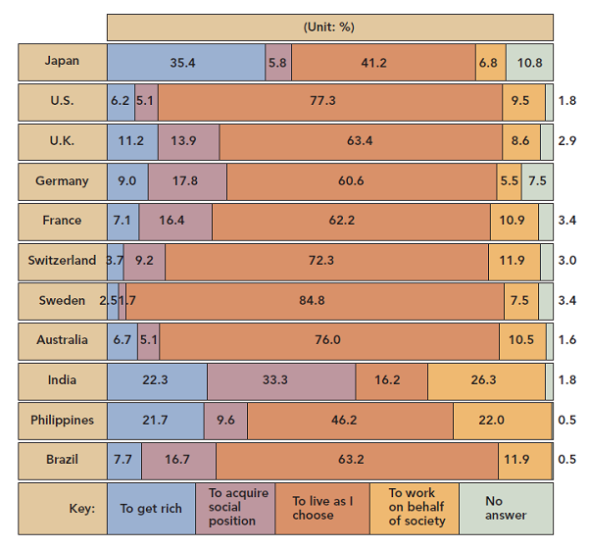
A study done by the Japanese government on attitudes of youth around the world suggests that younger Japanese may be more receptive to U.S. incentive methods than one would anticipate. In a study done by the Japanese prime minister's office, there were some surprising results when Japanese responses were compared with responses of similar-aged youths from other countries. Exhibit 1 summarizes some of the information gathered on life goals. One point that may be of importance in shedding light on the decision NOM has to make is a comparison of Japanese attitudes with young people in 11 other countries-the Japanese young people are less satisfied with their home life, school, and working situations and are more passive in their attitudes toward social and political problems. Furthermore, almost one-third of those employed said they were dissatisfied with their present jobs primarily because of low income and short vacations. Asked if they had to choose between a difficult job with responsibility and authority or an easy job without responsibility and authority, 64 percent of the Japanese picked the former, somewhat less than the 70 to 80 percent average in other countries.
Another critical problem lies with the nonsales employees; traditionally, all employees on the same level are treated equally, whether sales, production, or staff. How do you encourage competitive, aggressive salesmanship in a market unfamiliar with such tactics, and how do you compensate salespeople to promote more aggressive selling in the face of tradition-bound practices of paternalistic company behavior
Develop some principles of motivation that could be applied by an international marketer in other countries.
National Office Machines of Dayton, Ohio, manufacturer of cash registers, electronic data processing equipment, adding machines, and other small office equipment, recently entered into a joint venture with Nippon Cash Machines of Tokyo, Japan. Last year, National Office Machines (NOM) had domestic sales of over $1.4 billion and foreign sales of nearly $700 million. In addition to the United States, it operates in most of western Europe, the Mideast, and some parts of the Far East. In the past, it had no significant sales or sales force in Japan, though the company was represented there by a small trading company until a few years ago. In the United States, NOM is one of the leaders in the field and is considered to have one of the most successful and aggressive sales forces found in this highly competitive industry.
Nippon Cash Machines (NCM) is an old-line cash register manufacturing company organized in 1882. At one time, Nippon was the major manufacturer of cash register equipment in Japan, but it has been losing ground since 1970 even though it produces perhaps the best cash register in Japan. Last year's sales were 9 billion yen, a 15 percent decrease from sales the prior year. The fact that it produces only cash registers is one of the major problems; the merger with NOM will give it much-needed breadth in product offerings. Another hoped-for strength to be gained from the joint venture is managerial leadership, which is sorely needed.
Fourteen Japanese companies have products that compete with Nippon; other competitors include several foreign giants such as IBM, National Cash Register, and Unisys of the United States, and Sweda Machines of Sweden. Nippon has a small sales force of 21 people, most of whom have been with the company their entire adult careers. These salespeople have been responsible for selling to Japanese trading companies and to a few larger purchasers of equipment.
Part of the joint venture agreement included doubling the sales force within a year, with NOM responsible for hiring and training the new salespeople, who must all be young, college-trained Japanese nationals. The agreement also allowed for U.S. personnel in supervisory positions for an indeterminate period of time and for retaining the current Nippon sales force.
One of the many sales management problems facing the Nippon/American Business Machines Corporation (NABMC, the name of the new joint venture) was which sales compensation plan to use. That is, should it follow the Japanese tradition of straight salary and guaranteed employment with no individual incentive program, or the U.S. method (very successful for NOM in the United States) of commissions and various incentives based on sales performance, with the ultimate threat of being fired if sales quotas go continuously unfilled
The immediate response to the problem might well be one of using the tried-and-true U.S. compensation methods, since they have worked so well in the United States and are perhaps the kind of changes needed and expected from U.S. management. NOM management is convinced that salespeople selling its kinds of products in a competitive market must have strong incentives to produce. In fact, NOM had experimented on a limited basis in the United States with straight salary about ten years ago, and it was a bomb. Unfortunately, the problem is considerably more complex than it appears on the surface.
One of the facts to be faced by NOM management is the traditional labor-management relations and employment systems in Japan. The roots of the system go back to Japan's feudal era, when a serf promised a lifetime of service to his lord in exchange for a lifetime of protection. By the start of Japan's industrial revolution in the 1880s, an unskilled worker pledged to remain with a company all his useful life if the employer would teach him the new mechanical arts. The tradition of spending a lifetime with a single employer survives today mainly because most workers like it that way. The very foundations of Japan's management system are based on lifetime employment, promotion through seniority, and single-company unions. There is little chance of being fired, pay raises are regular, and there is a strict order of job-protecting seniority.
Japanese workers at larger companies still are protected from outright dismissal by union contracts and an industrial tradition that some personnel specialists believe has the force of law. Under this tradition, a worker can be dismissed after an initial trial period only for gross cause, such as theft or some other major infraction. As long as the company remains in business, the worker isn't discharged, or even furloughed, simply because there isn't enough work to be done.
Besides the guarantee of employment for life, the typical Japanese worker receives many fringe benefits from the company. Bank loans and mortgages are granted to lifetime employees on the assumption that they will never lose their jobs and therefore the ability to repay. Just how paternalistic the typical Japanese firm can be is illustrated by a statement from the Japanese Ministry of Foreign Affairs that gives the example of A, a male worker who is employed in a fairly representative company in Tokyo.
To begin with, A lives in a house provided by his company, and the rent he pays is amazingly low when compared with average city rents. The company pays his daily trips between home and factory. A's working hours are from 9:00 a.m. to 5:00 p.m. with a break for lunch, which he usually takes in the company restaurant at a very cheap price. He often brings home food, clothing, and other miscellaneous articles he has bought at the company store at a discount ranging from 10 percent to 30 percent below city prices. The company store even supplies furniture, refrigerators, and television sets on an installment basis, for which, if necessary, A can obtain a loan from the company almost free of interest.
In case of illness, A is given free medical treatment in the company hospital, and if his indisposition extends over a number of years, the company will continue paying almost his full salary. The company maintains lodges at seaside or mountain resorts where A can spend the holidays or an occasional weekend with the family at moderate prices…. It must also be remembered that when A reaches retirement age (usually 55) he will receive a lump-sum retirement allowance or a pension, either of which will assure him a relatively stable living for the rest of his life.
Even though A is only an example of a typical employee, a salesperson can expect the same treatment. Job security is such an expected part of everyday life that no attempt is made to motivate the Japanese salesperson in the same manner as in the United States; as a consequence, selling traditionally has been primarily an order-taking job. Except for the fact that sales work offers some travel, entry to outside executive offices, the opportunity to entertain, and similar side benefits, it provides a young person with little other incentive to surpass basic quotas and drum up new business. The traditional Japanese bonuses are given twice yearly, can be up to 40 percent of base pay, and are no larger for salespeople than any other functional job in the company.
As a key executive in a Mitsui-affiliated engineering firm put it recently, "The typical salesman in Japan isn't required to have any particular talent." In return for meeting sales quotas, most Japanese salespeople draw a modest monthly salary, sweetened about twice a year by bonuses. Manufacturers of industrial products generally pay no commission or other incentives to boost their businesses.
Besides the problem of motivation, a foreign company faces other different customs when trying to put together and manage a sales force. Class systems and the Japanese distribution system, with its penchant for reciprocity, put a strain on the creative talents of the best sales managers, as Simmons, the U.S. bedding manufacturer, was quick to learn.
In the field, Simmons found itself stymied by the bewildering realities of Japanese marketing, especially the traditional distribution system that operates on a philosophy of reciprocity that goes beyond mere business to the core of the Japanese character: A favor of any kind is a debt that must be repaid. To lead another person on in business and then turn against that person is to lose face, abhorrent to most Japanese. Thus, the owner of large Western-style apartments, hotels, or developments buys his beds from the supplier to whom he owes a favor, no matter what the competition offers.
In small department and other retail stores, where most items are handled on consignment, the bond with the supplier is even stronger. Consequently, all sales outlets are connected in a complicated web that runs from the largest supplier, with a huge national sales force, to the smallest local distributor, with a handful of door-to- door salespeople. The system is self-perpetuating and all but impossible to crack from the outside.
However, there is some change in attitude taking place as both workers and companies start discarding traditions for the job mobility common in the United States. Skilled workers are willing to bargain on the strength of their experience in an open labor market in an effort to get higher wages or better job opportunities; in the United States, it's called shopping around. And a few companies are showing a willingness to lure workers away from other concerns. A number of companies are also plotting how to rid themselves of deadwood workers accumulated as a result of promotions by strict seniority.
Toyo Rayon company, Japan's largest producer of synthetic fibers, started reevaluating all its senior employees every five years with the implied threat that those who don't measure up to the company's expectations have to accept reassignment and possibly demotion; some may even be asked to resign. A chemical engineering and construction firm asked all its employees over 42 to negotiate a new contract with the company every two years. Pay raises and promotions go to those the company wants to keep. For those who think they are worth more than the company is willing to pay, the company offers retirement with something less than the $30,000 lump-sum payment the average Japanese worker receives at age 55.
More Japanese are seeking jobs with foreign firms as the lifetime-employment ethic slowly changes. The head of student placement at Aoyama Gakuin University reports that each year the number of students seeking jobs with foreign companies increases. Bank of America, Japan Motorola, Imperial Chemical Industries, and American Hospital Supply are just a few of the companies that have been successful in attracting Japanese students. Just a few years ago, all Western companies were places to avoid.
Even those companies that are successful work with a multitude of handicaps. American companies often lack the intricate web of personal connections that their Japanese counterparts rely on when recruiting. Furthermore, American companies have the reputation for being quick to hire and even quicker to fire, whereas Japanese companies still preach the virtues of lifelong job security. Those U.S. companies that are successful are offering big salaries and promises of Western-style autonomy. According to a recent study, 20- to 29-year-old Japanese prefer an employer-changing environment to a single lifetime employer. They complain that the Japanese system is unfair because promotions are based on age and seniority. A young recruit, no matter how able, has to wait for those above him to be promoted before he too can move up. Some feel that if you are really capable, you are better off working with an American company.
Some foreign firms entering Japan have found that their meritbased promotion systems have helped them attract bright young recruits. In fact, a survey done by Nihon Keizai Shimbun, Japan's leading business newspaper, found that 80 percent of top managers at 450 major Japanese corporations wanted the seniority promotion system abolished. But, as one Japanese manager commented, "We see more people changing their jobs now, and we read many articles about companies restructuring, but despite this, we won't see major changes coming quickly."
A few U.S. companies operating in Japan are experimenting with incentive plans. Marco and Company, a belting manufacturer and Japanese distributor for Power Packing and Seal Company, was persuaded by Power to set up a travel plan incentive for salespeople who topped their regular sales quotas. Unorthodox as the idea was for Japan, Marco went along. The first year, special one-week trips to Far East holiday spots like Hong Kong, Taiwan, Manila, and Macao were inaugurated. Marco's sales of products jumped 212 percent, and the next year, sales were up an additional 60 percent.
IBM also has made a move toward chucking the traditional Japanese sales system (salary plus a bonus but no incentives). For about a year, it has been working with a combination that retains the semiannual bonus while adding commission payments on sales over preset quotas. "It's difficult to apply a straight commission system in selling computers because of the complexities of the product," an IBM Japan official said. "Our salesmen don't get big commissions because other employees would be jealous." To head off possible ill feeling, therefore, some nonselling IBM employees receive monetary incentives.
Most Japanese companies seem reluctant to follow IBM's example because they have doubts about directing older salespeople to go beyond their usual order-taking role. High-pressure tactics are not well accepted here, and sales channels are often pretty well set by custom and long practice (e.g., a manufacturer normally deals with one trading company, which in turn sells only to customers A, B, C, and D). A salesperson or trading company, for that matter, is not often encouraged to go after customer Z and get it away from a rival supplier.
The Japanese market is becoming more competitive and there is real fear on the part of NOM executives that the traditional system
Exhibit 1
Life Goals
just won't work in a competitive market. However, the proponents of the incentive system concede that the system really has not been tested over long periods or even adequately in the short term because it has been applied only in a growing market. In other words, was it the incentive system that caused the successes achieved by the companies, or was it market growth Other companies following the traditional method of compensation and employee relations also have had sales increases during the same period.
The problem is further complicated for NABMC because it will have both new and old salespeople. The young Japanese seem eager to accept the incentive method, but older ones are hesitant. How do you satisfy both since you must, by agreement, retain all the sales staff
A study done by the Japanese government on attitudes of youth around the world suggests that younger Japanese may be more receptive to U.S. incentive methods than one would anticipate. In a study done by the Japanese prime minister's office, there were some surprising results when Japanese responses were compared with responses of similar-aged youths from other countries. Exhibit 1 summarizes some of the information gathered on life goals. One point that may be of importance in shedding light on the decision NOM has to make is a comparison of Japanese attitudes with young people in 11 other countries-the Japanese young people are less satisfied with their home life, school, and working situations and are more passive in their attitudes toward social and political problems. Furthermore, almost one-third of those employed said they were dissatisfied with their present jobs primarily because of low income and short vacations. Asked if they had to choose between a difficult job with responsibility and authority or an easy job without responsibility and authority, 64 percent of the Japanese picked the former, somewhat less than the 70 to 80 percent average in other countries.
Another critical problem lies with the nonsales employees; traditionally, all employees on the same level are treated equally, whether sales, production, or staff. How do you encourage competitive, aggressive salesmanship in a market unfamiliar with such tactics, and how do you compensate salespeople to promote more aggressive selling in the face of tradition-bound practices of paternalistic company behavior
Develop some principles of motivation that could be applied by an international marketer in other countries.
Explanation


This question doesn’t have an expert verified answer yet, let Quizplus AI Copilot help.

International Marketing 15th Edition by Cateora Graham

Why don’t you like this exercise?
Other Minimum 8 character and maximum 255 character
Character 255






