A 17-year-old boy is brought to the office due to occasional blood in the urine. The first episode occurred 1 year ago during a flulike illness, and resolved spontaneously. The patient had a similar episode about 6 months ago, which also seemed to resolve. He has no other medical conditions and does not use tobacco or alcohol. There is no history of blood or kidney disorders in the family. Vital signs are normal. On laboratory evaluation, blood urea nitrogen level is 14 mg/dL and creatinine is 0.8 mg/dL. Urinalysis results are as follows: 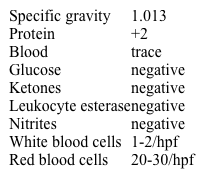 A renal biopsy is performed. Which of the following findings is most likely to be seen on microscopic evaluation?
A) Apple-green birefringent mesangial deposits
B) Crescent formation with linear IgG deposits
C) Effacement of podocyte foot processes
D) Granular IgG and C3 deposits
E) Lamellated basement membrane
F) Mesangial deposition of IgA
G) Sclerosis of a portion of some glomeruli
H) Thin basement membrane
Correct Answer:

Verified
Q715: A 16-year-old boy is brought to the
Q716: A 50-year-old man with polycystic kidney disease
Q717: Results of the laboratory tests show an
Q718: A 7-year-old boy is brought to the
Q719: A 68-year-old man comes to the office
Q721: A 5-year-old boy is brought to the
Q722: A 42-year-old man comes to the office
Q723: A 60-year-old woman is being evaluated for
Q724: A 4-year-old girl developed acute-onset colicky abdominal
Q725: A 67-year-old man comes to the office
Unlock this Answer For Free Now!
View this answer and more for free by performing one of the following actions

Scan the QR code to install the App and get 2 free unlocks

Unlock quizzes for free by uploading documents