A 50-year-old man is brought to the emergency department due to fever, malaise, confusion, and worsening headache for the last 8 days. He has a history of advanced AIDS and is noncompliant with antiretroviral therapy. His most recent CD4 lymphocyte count a month ago was 29/mm3. His other medical problems include hypertension and chronic hepatitis C infection.
The patient's temperature is 38.8 C (101.8 F) , blood pressure is 110/70 mm Hg, pulse is 94/min, and respirations are 16/min. He is disoriented to place and time and has a left-sided visual field deficit. The remainder of the examination is unremarkable.
CT scan of the head without contrast is normal. A lumbar puncture yields the following results: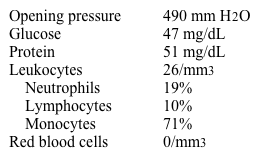
India ink preparation of the cerebrospinal fluid shows encapsulated yeast. The patient is started on amphotericin B.
In addition to antifungal therapy, which of the following is the most effective strategy to improve this patient's outcome?
A) Acetazolamide
B) Corticosteroids
C) Immediate antiretroviral therapy
D) Mannitol
E) Serial lumbar punctures
Correct Answer:

Verified
Q95: A 24-year-old man with sickle cell disease
Q96: A 60-year-old woman comes to the emergency
Q97: A 61-year-old woman comes to the emergency
Q98: A 67-year-old man comes to the emergency
Q99: A 62-year-old man is brought to the
Q101: A 23-year-old woman is brought to the
Q102: A 34-year-old man comes to the emergency
Q103: A 28-year-old man comes to the emergency
Q104: A 43-year-old man comes to the emergency
Q105: A 33-year-old man comes to the emergency
Unlock this Answer For Free Now!
View this answer and more for free by performing one of the following actions

Scan the QR code to install the App and get 2 free unlocks

Unlock quizzes for free by uploading documents