A 20-year-old college student is brought to the emergency department due to progressive lethargy and confusion. He is obtunded and unable to answer questions, but his friend says the patient has had shaking chills and diarrhea since last night. He has no prior medical problems other than a nasal fracture following a bar fight 3 days ago, which was reduced and stabilized with nasal packing at another hospital. The patient takes no medications and has no known drug allergies. He lives in a dormitory and recently returned from a hiking trip in North Carolina.
Temperature is 39.4 C (103 F) , blood pressure is 84/42 mm Hg, pulse is 126/min, and respirations are 18/min. Examination shows an ill-appearing man. Pupils are equal, round, and reactive. Anterior packing is present in the left nostril. There is diffuse erythema of the mucous membranes and skin, including the palms and soles. Mild pitting edema is present in both legs.
Laboratory results are as follows: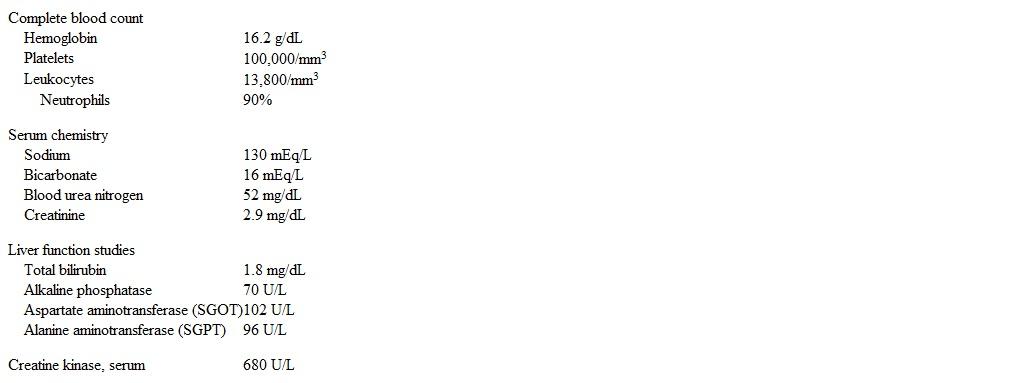 CT scan of the head reveals no abnormalities. Venous access is established, and intravenous fluids are administered.
Which of the following is the most appropriate antimicrobial therapy for this patient?
A) Ceftriaxone
B) Doxycycline
C) Penicillin G
D) Vancomycin and cefepime
E) Vancomycin and clindamycin
Correct Answer:

Verified
Q111: A 72-year-old woman comes to the emergency
Q112: A 24-year-old man comes to the emergency
Q113: A 51-year-old woman comes to the emergency
Q114: A 48-year-old man comes to the emergency
Q115: A 24-year-old woman comes to the emergency
Q117: A 23-year-old woman is brought to the
Q118: A previously healthy 24-year-old woman comes to
Q119: A 43-year-old man with a history of
Q120: A 68-year-old man is brought to the
Q121: A 45-year-old woman is brought to the
Unlock this Answer For Free Now!
View this answer and more for free by performing one of the following actions

Scan the QR code to install the App and get 2 free unlocks

Unlock quizzes for free by uploading documents