A 28-year-old woman with fever and lethargy is brought to the emergency department accompanied by her roommate. The roommate reports that the patient appeared well last night but awoke this morning confused. Throughout the morning she became increasingly confused and eventually unarousable, prompting her roommate to call an ambulance. Her past medical history is significant for idiopathic thrombocytopenia purpura. There is no history of recent travel.
Her temperature is 39.4 C (103 F) , blood pressure is 84/42 mm Hg, pulse is 122/min, and respirations are 28/min. Oxygen saturation is 90% on room air. Physical examination shows an ill-appearing woman. Pupils are equal and round but sluggish. Lungs have patchy rales. Abdominal examination reveals a surgical scar in the left upper quadrant. There are diffuse ecchymotic areas throughout the torso and lower extremities, with areas of bullae and vesicle formation. There is no rash on the palms or soles. There are no meningeal signs.
Laboratory results as follows: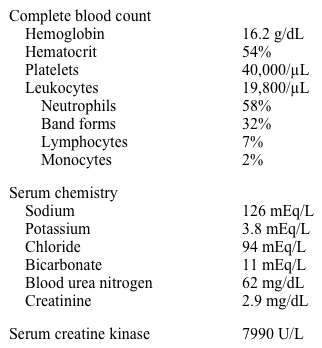
Chest x-ray reveals bilateral pulmonary infiltrates.
Which of the following antibiotics would be most effective at targeting the suspected pathogen?
A) Ampicillin
B) Ceftriaxone
C) Clindamycin
D) Doxycycline
E) Vancomycin
Correct Answer:

Verified
Q104: A 43-year-old man comes to the emergency
Q105: A 33-year-old man comes to the emergency
Q106: A 40-year-old man with known HIV infection
Q107: A 62-year-old man with a history of
Q108: A 52-year-old man comes to the emergency
Q110: A 24-year-old man comes to the emergency
Q111: A 72-year-old woman comes to the emergency
Q112: A 24-year-old man comes to the emergency
Q113: A 51-year-old woman comes to the emergency
Q114: A 48-year-old man comes to the emergency
Unlock this Answer For Free Now!
View this answer and more for free by performing one of the following actions

Scan the QR code to install the App and get 2 free unlocks

Unlock quizzes for free by uploading documents