A 45-year-old woman is evaluated for fatigue and exertional dyspnea. She has had difficulty walking for more than 1 or 2 blocks without becoming short of breath. She uses 2 pillows to sleep. Past medical history is significant for hyperlipidemia, hypertension, and type 2 diabetes mellitus. The patient smoked a pack a day for 15 years but quit 10 years ago. She does not use alcohol or illicit drugs. Temperature is 36.7 C (98 F) , blood pressure is 150/90 mm Hg, pulse is 80/min, and respirations are 16/min. BMI is 55 kg/m2. On physical examination, jugular venous distension is difficult to visualize due to a thick neck. Lungs are clear to auscultation without wheezes or crackles. Heart sounds are distant. The abdomen is obese and nontender. There is trace bilateral lower-extremity edema. Neurological examination is within normal limits. Chest x-ray is of poor quality due to under-penetration but shows no obvious abnormalities. ECG shows low-voltage QRS complexes but no significant ST-segment or T-wave abnormalities. Laboratory results are as follows: 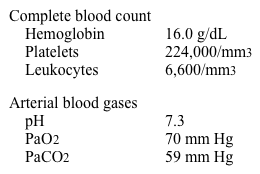 Which of the following is the predominant cause of this patient's dyspnea?
A) Airway inflammation and bronchospasm
B) Alveolar hypoventilation
C) Left ventricular contractile dysfunction
D) Neuromuscular dysfunction
E) Ventilation-perfusion mismatch
Correct Answer:

Verified
Q127: A 21-year-old woman comes to the physician
Q128: A 24-year-old man comes to the urgent
Q129: A 53-year-old man comes to the office
Q130: A 62-year-old woman comes to the office
Q131: A 43-year-old woman with congestive heart failure,
Q133: A 61-year-old man is evaluated for progressive
Q134: A 68-year-old woman comes to the office
Q135: An 18-year-old girl comes to the office
Q136: A 32-year-old man comes to the office
Q137: A 58-year-old man with a 45-pack-year smoking
Unlock this Answer For Free Now!
View this answer and more for free by performing one of the following actions

Scan the QR code to install the App and get 2 free unlocks

Unlock quizzes for free by uploading documents