A 56-year-old man comes to the office due to 3 months of dyspnea that was initially exertional but has progressively worsened to the point that the patient is now breathless even at rest. He has not had any chest pain, palpitations, syncope, or ankle swelling. The patient has no significant past medical history, and he takes no medications. He has been smoking a pack of cigarettes daily for the last 30 years and has been drinking alcohol heavily for the past 5 years. His mother died of breast cancer at age 57. The patient's temperature is 37.1 C (98.8 F) , blood pressure is 113/76 mm Hg, and pulse is 86/min. A third heart sound is heard on cardiac auscultation; there are no murmurs. Chest auscultation indicates bibasilar crackles. His abdomen is soft and with no evidence of ascites. Laboratory results are as follows: 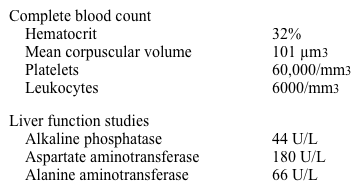 Chest x-ray reveals cardiac silhouette enlargement and signs of pulmonary venous congestion. Echocardiography shows a dilated left ventricle with an estimated left ventricular ejection fraction of 25%. Coronary angiography reveals no evidence of obstructive coronary artery disease. Which of the following measures is most likely to reverse this patient's heart function?
A) Abstinence from alcohol
B) Cessation of cigarette smoking
C) Initiation of ACE inhibitor therapy
D) Initiation of digoxin therapy
E) Niacin supplementation
F) Prednisolone therapy
G) Reduction of salt intake
Correct Answer:

Verified
Q159: A 32-year-old man comes to the clinic
Q160: A 60-year-old man comes to the office
Q161: A 42-year-old man comes to the office
Q162: A 25-year-old man comes to the office
Q163: A 34-year-old man calls the office requesting
Q165: A 28-year-old man comes to the office
Q166: A 20-year-old woman comes to the office
Q167: A 25-year-old man comes to the emergency
Q168: A 40-year-old man comes to the office
Q169: A 27-year-old woman comes to the office
Unlock this Answer For Free Now!
View this answer and more for free by performing one of the following actions

Scan the QR code to install the App and get 2 free unlocks

Unlock quizzes for free by uploading documents