A 37-year-old woman comes to the office with a 7-month history of galactorrhea and amenorrhea. She has also had worsening vaginal dryness, but no headaches or visual symptoms. The patient's medical history is unremarkable, and she does not use tobacco, alcohol, or illicit drugs. She is married, has 2 children, and remarks that her family is "complete." The patient's husband has undergone vasectomy. Her temperature is 36.7 C (98 F) , blood pressure is 120/80 mm Hg, pulse is 72/min, and respirations are 14/min. Visual field testing is normal. Pregnancy test is negative, serum prolactin level is 150 ng/mL (154 ng/mL on repeat measurement) , and thyrotropin (TSH) and serum creatinine are normal. MRI of the pituitary gland reveals a 6-mm hypointense lesion, as shown in the image below, which is consistent with a pituitary adenoma. 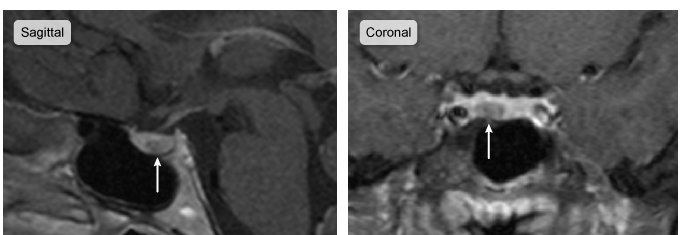 Which of the following is the most appropriate next step in management of this patient?
A) Monitoring by periodic serum prolactin and MRI
B) Radiotherapy
C) Transsphenoidal surgery
D) Treatment with cabergoline
E) Treatment with estrogen
Correct Answer:

Verified
Q1036: A 60-year-old man comes to the office
Q1037: A 54-year-old man comes to the office
Q1038: A 65-year-old woman comes to the emergency
Q1039: A 65-year-old man comes to the office
Q1040: A 62-year-old woman comes to the office
Q1042: A 75-year-old woman comes to the office
Q1043: A 46-year-old man comes to the office
Q1044: A 56-year-old man comes to the physician
Q1045: A 21-year-old woman comes to the office
Q1046: A 34-year-old woman comes to the office
Unlock this Answer For Free Now!
View this answer and more for free by performing one of the following actions

Scan the QR code to install the App and get 2 free unlocks

Unlock quizzes for free by uploading documents