A 42-year-old man comes to the hospital after a day of severe abdominal pain and vomiting. He describes the pain as constant and nagging, localizing to the upper abdomen, and radiating to the back. The patient has not been to a physician in years and has no previous medical conditions or surgeries. He takes no medications. He drinks large amounts of alcohol, but does not use tobacco or illicit drugs. His temperature is 36.7° C (98° F) , blood pressure is 110/80 mm Hg, pulse is 90/min, and respirations are 14/min. The patient is admitted to the hospital and given opioid analgesics and intravenous fluids. On day 2 of his hospitalization, his blood pressure drops to 80/60 mm Hg and his pulse increases to 120/min and regular. His oxygen saturation is 92% on 2 L nasal canula oxygen. Examination shows normal jugular venous pressure. Bilateral crackles are heard on lung auscultation. The patient's abdomen is mildly distended, and there is tenderness in the epigastrium. His urine output is 8 mL/hr. He has received a total of 4 L IV fluids over the last 24 hours. Laboratory results are as follows: 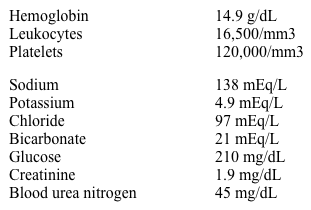 Which of the following is the most likely cause of this patient's hypotension?
A) Increased vascular permeability
B) Myocardial infarction
C) Opioid overdose
D) Occult bleeding
E) Pericardial effusion
F) Pseudocyst formation
Correct Answer:

Verified
Q1078: A 40-year-old, previously healthy woman comes to
Q1079: A 45-year-old woman comes to the physician
Q1080: A 35-year-old man comes to the office
Q1081: A 45-year-old male presents for a routine
Q1082: A 52-year-old woman comes to the physician
Q1084: A 68-year-old woman comes to the emergency
Q1085: A 62-year-old man comes to the office
Q1086: A 45-year-old man comes to the clinic
Q1087: A 64-year-old man comes to the office
Q1088: A 45-year-old man comes to the emergency
Unlock this Answer For Free Now!
View this answer and more for free by performing one of the following actions

Scan the QR code to install the App and get 2 free unlocks

Unlock quizzes for free by uploading documents