A 37-year-old man is admitted to the hospital due to a 10-day-history of fever, nonproductive cough, and dyspnea on exertion. The patient has a history of HIV infection for 10 years and has been noncompliant with medications. Temperature is 38.5 C (101.3 F) , blood pressure is 120/80 mm Hg, pulse is 102/min, and respirations are 20/min. Pulse oximetry shows 90% on room air and 96% on 2 L/min oxygen. BMI is 20 kg/m2. Physical examination reveals bilateral lung crackles and chest x-ray reveals bilateral interstitial infiltrates. The patient is started on appropriate antibiotics and intravenous normal saline at 150 mL/hr. Two days later, his dyspnea is improved but he develops confusion. Repeat vital signs are as follows: Temperature is 37.5 C (99.5 F) , blood pressure is 118/80 mm Hg, pulse is 84/min, and respirations are 16/min. Mucous membranes are moist. There is no jugular venous distension. Lung examination reveals better air entry with reduction of crackles. Heart sounds are normal. There is no peripheral edema. Laboratory studies from the day of admission and today are as follows: 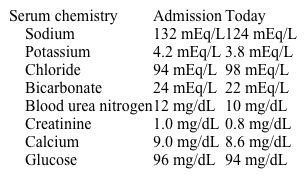 Total intravenous intake of normal saline since admission is ~5 L. Which of the following is the most likely cause of this patient's hyponatremia?
A) Dilutional hyponatremia with suppressed antidiuretic hormone secretion
B) Effective arterial blood volume depletion with secondary hyperaldosteronism
C) Factitious hyponatremia
D) Inappropriate antidiuretic hormone secretion
E) Total body volume depletion
Correct Answer:

Verified
Q1443: Walking for 6 minutes causes mild dyspnea,
Q1444: A 52-year-old woman comes to the office
Q1445: An 80-year-old woman is brought to the
Q1446: A 44-year-old man comes to the office
Q1447: A 56-year-old woman is brought to the
Q1449: A 56-year-old woman is brought to the
Q1450: A 33-year-old postpartum woman is brought to
Q1451: A 36-year-old woman comes to the office
Q1452: A 56-year-old obese man comes to the
Q1453: A 72-year-old man is brought to the
Unlock this Answer For Free Now!
View this answer and more for free by performing one of the following actions

Scan the QR code to install the App and get 2 free unlocks

Unlock quizzes for free by uploading documents