A 32-year-old man is brought to the emergency department due to difficulty walking and frequent falls. One week ago he had numbness in his toes and fingertips that progressed to lower-extremity weakness. He had an upper respiratory tract infection 4 weeks ago that resolved spontaneously. The patient has no bowel or bladder complaints. His past medical history is unremarkable. His temperature is 36.9° C (98.5° F) , blood pressure is 130/70 mm Hg supine and 100/62 mm Hg standing, pulse is 102/min, and respirations are 18/min. Physical examination shows muscle weakness in both lower extremities and absent knee and ankle reflexes bilaterally. The sensory examination is unremarkable. Lumbar puncture is performed and cerebrospinal fluid analysis results are as follows: 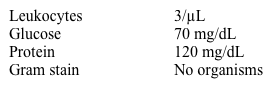 What is the most appropriate next step in management of this patient?
A) Cyclosporine
B) Intravenous acyclovir
C) Intravenous immunoglobulin
D) Intravenous methylprednisolone
E) Pyridostigmine
F) Riluzole
Correct Answer:

Verified
Q1659: A 62-year-old woman comes to the office
Q1660: A 40-year-old woman comes to the office
Q1661: A 36-year-old woman comes to the office
Q1662: A 70-year-old man with a 10-year history
Q1663: A 57-year-old man comes to the office
Q1665: A 56-year-old man comes to the emergency
Q1666: A 26-year-old previously healthy woman is brought
Q1667: A middle-aged woman is found wandering the
Q1668: A 24-year-old woman comes to the office
Q1669: A 34-year-old woman comes to the physician
Unlock this Answer For Free Now!
View this answer and more for free by performing one of the following actions

Scan the QR code to install the App and get 2 free unlocks

Unlock quizzes for free by uploading documents