A 66-year-old woman comes to the office to follow up for heart failure. Four weeks ago, she was diagnosed with new onset heart failure with reduced ejection fraction of 30%. At that time, ECG showed normal sinus rhythm, narrow QRS complexes, and T-wave inversion in the lateral leads. Coronary angiogram revealed no significant coronary artery disease. She is feeling better except for mild exertional fatigue. The patient typically uses 2 pillows to sleep and gets up once at night to urinate. She has no lightheadedness. Her only other medical condition is type 2 diabetes mellitus. Current medical therapy is sacubitril-valsartan, metoprolol succinate, and furosemide. Blood pressure is 109/60 mm Hg, pulse is 62/min, and respirations are 12/min. Pulse oximetry shows 98% on room air. Examination shows normal jugular venous pressure, clear lungs, and a 2/6 pansystolic murmur at the apex. The abdomen is soft and nontender. She has no peripheral edema. Laboratory results are as follows: 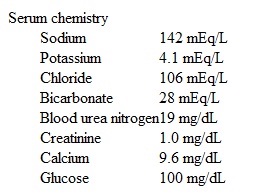 Which of the following is the most appropriate next step in pharmacotherapy management of this patient?
A) Add spironolactone to current regimen
B) Add lisinopril to current regimen
C) Add metolazone to current regimen
D) Decrease metoprolol succinate dose
E) Discontinue furosemide
Correct Answer:

Verified
Q69: A 3-week-old male infant with Down's syndrome is
Q70: A 38-year-old woman comes to the physician
Q71: A 62-year-old man with hypertension and heart
Q72: A 39-year-old man comes to the emergency
Q73: A 47-year-old man is brought to the
Q75: A 3-week-old male infant with Down's syndrome is
Q76: A 64-year-old man comes to the office
Q77: A 62-year-old man is brought to the
Q78: A 62-year-old man comes to the office
Q79: A 63-year-old man comes to the office
Unlock this Answer For Free Now!
View this answer and more for free by performing one of the following actions

Scan the QR code to install the App and get 2 free unlocks

Unlock quizzes for free by uploading documents