Passage
In 2010, the United States (U.S.) had an incarcerated population of about 1.6 million, up from about 300,000 in 1980. Some experts suggest that the exponential rise in the inmate population has been largely due to the "war on drugs," initiated in the 1980s, which led to more aggressive laws against drug use and distribution. Increases in arrests and imprisonment, however, have not affected all segments of the U.S. population equally. Although the total population was about 50% male in 2010, the prison population was about 93% male and reflective of additional racial and ethnic disparities (Figure 1) .
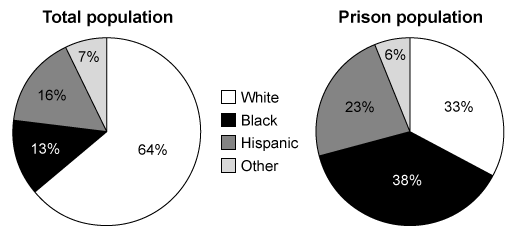 Figure 1 Total population and prison population by race and ethnicity in the United States in 2010Research suggests that black and white people use drugs at similar rates, but black people are more likely to end up in the criminal justice system for drug use. This overrepresentation of black people in the prison population can be partly explained by discrimination at the individual and institutional levels. For example, if police departments focus their resources in predominantly black neighborhoods based on the assumption that black individuals are more likely to commit a crime, then police officers (who may similarly believe black people commit more crimes than white people) are more likely to witness black people committing crimes, thereby confirming the belief. Discrimination operates at every level of the criminal justice system: Black people are more likely than white people to be arrested, prosecuted, and convicted for drug use and receive, on average, longer sentences.High rates of recidivism also perpetuate the demographic disparity of the prison population. It is estimated that about 75% of released prisoners will be rearrested within five years. Experts suggest that, once convicted of a felony, individuals find that their status as a former felon (or "ex-convict") dominates all their other statuses, making it difficult to reintegrate into society. The social stigma of criminality makes it hard for ex-convicts to secure employment, which often leads to further crime. Ex-convicts are also more closely monitored by police and far more likely to be arrested and convicted for minor offenses.
-According to the passage, the "war on drugs" made drug use and distribution:
A) less taboo through the implementation of more informal sanctions.
B) more taboo through the implementation of more formal sanctions.
C) less of a folkway through the implementation of more informal sanctions.
D) more of a folkway through the implementation of more formal sanctions.
Correct Answer:

Verified
Q232: A researcher is testing a patient's neurological
Q233: Standardized protocols, patient checklists, and clinical guidelines
Q234: Passage
Until recently, deviance has generally been conceptualized
Q235: Which of the following is true, according
Q236: The interactionist theory of language development suggests
Q238: Passage
In 2010, the United States (U.S.) had
Q239: A researcher wants to train a mouse
Q240: Researchers asked 100 Americans to describe their
Q241: Passage
During the 1800s, the United States (U.S.)
Q242: Passage
During the 1800s, the United States (U.S.)
Unlock this Answer For Free Now!
View this answer and more for free by performing one of the following actions

Scan the QR code to install the App and get 2 free unlocks

Unlock quizzes for free by uploading documents