Passage
Quantitative fluorescence recovery after photobleaching (FRAP) is used to study the movement of molecules in live cells. During FRAP, the fluorescence of a green fluorescent protein (GFP) -tagged molecule is first measured and then photodestroyed in targeted cell regions. Researchers then assess the time course for fluorescence recovery, which is an indicator of molecular mobility of the GFP-tagged protein into the photodestroyed region. The average time required to recover 80% of the pre-bleach fluorescence of protein histone 1 (H1) fused to GFP (H1-GFP) in the photodestroyed region is given as t80.FRAP was used to analyze the mobility of the architectural H1 alone and in the presence of high-mobility group (HMG) proteins. HMG proteins are dynamic modifiers that have been shown to have opposite effects but similar binding sites on chromatin structure.
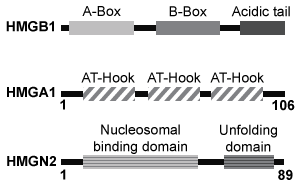 Figure 1 Unique chromatin binding motifs of HMG proteinsDuring analysis, HMGA1 and HMGB1 were microinjected into the cytoplasm of mouse embryonic fibroblast cells expressing H1-GFP. FRAP was performed on euchromatin and heterochromatin. Euchromatin and heterochromatin domains were identified as regions weakly and strongly stained by H1-GFP, respectively. The relative intensity of H1-GFP fluorescence in euchromatin and heterochromatin of uninjected and injected cells was assessed, and t80 results are shown in Table 1.Table 1 Effect of HMGB1 and HMGA1 on H1-GFP Mobility
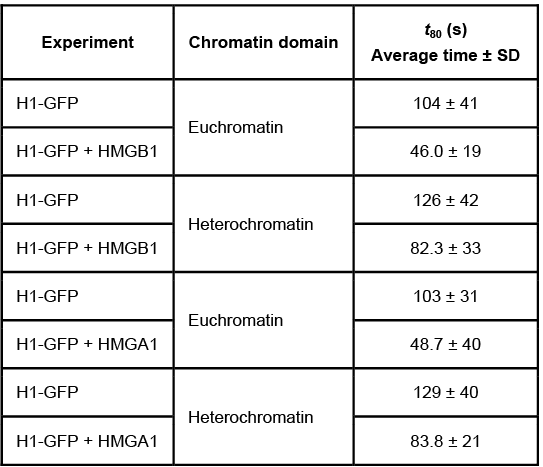 Adapted from Catez F, Yang H, Tracey KJ, Reeves R, Misteli T, Bustin M. Network of dynamic interactions between histone H1 and high-mobility-group proteins in chromatin. Mol Cell Biol. 2004;24(10) :4321-8.
-The experimental design described in the passage allowed researchers to do which of the following?Assess whether structural chromatin organization influences H1 mobilityAssess H1 and GFP competition at different levels of DNA compactionEvaluate if HMG proteins compete with H1 for chromatin-binding sites
A) I and III only
B) I and II only
C) II and III only
D) I, II, and III
Correct Answer:

Verified
Q2: Passage
Lipopolysaccharides (LPS) found in gram-negative bacterial cells
Q3: Passage
At the blood-brain barrier, the cerebral spinal
Q4: Passage
Lipopolysaccharides (LPS) found in gram-negative bacterial cells
Q5: Passage
At the blood-brain barrier, the cerebral spinal
Q6: Passage
The lumen of the human gut is
Q8: Passage
Lipopolysaccharides (LPS) found in gram-negative bacterial cells
Q9: Passage
Lipopolysaccharides (LPS) found in gram-negative bacterial cells
Q10: Passage
The lumen of the human gut is
Q11: Passage
At the blood-brain barrier, the cerebral spinal
Q12: Passage
Quantitative fluorescence recovery after photobleaching (FRAP) is
Unlock this Answer For Free Now!
View this answer and more for free by performing one of the following actions

Scan the QR code to install the App and get 2 free unlocks

Unlock quizzes for free by uploading documents