Solved

Passage the Lac Operon Encodes the Proteins That Metabolize Lactose and and Is

Question 60

Multiple Choice

Passage
The lac operon encodes the proteins that metabolize lactose and is a key biochemical feature that differentiates between members of the Enterobacteriaceae family.  For example, the severely virulent Salmonella typhimurium can be distinguished from its less virulent relative Escherichia coli by the absence of a lac operon.  Researchers propose that the evolutionary loss of the lac operon may contribute to S. typhimurium's ability to invade epithelial cells.To test the hypothesis, wild-type (WT) S. typhimurium cells were transformed with plasmids encoding components of the lac operon (Figure 1) : β-galactosidase (lacZ+) , lactose permease (lacY+) , transacetylase (lacA+) , or all three (lac+) .  Each plasmid also contained genes for the lac repressor (lacI) , which can inhibit lac operon transcription in the absence of lactose; the cAMP receptor protein (crp) , which induces lac expression in low glucose; and a chloramphenicol resistance gene (cat) .
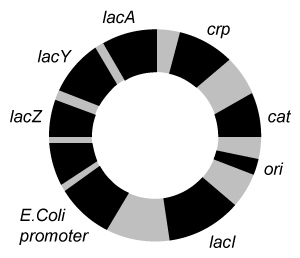
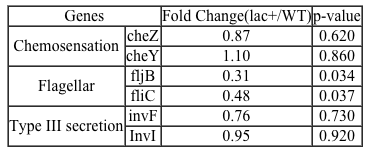
Passage The lac operon encodes the proteins that metabolize lactose and is a key biochemical feature that differentiates between members of the Enterobacteriaceae family.  For example, the severely virulent Salmonella typhimurium can be distinguished from its less virulent relative Escherichia coli by the absence of a lac operon.  Researchers propose that the evolutionary loss of the lac operon may contribute to S. typhimurium's ability to invade epithelial cells.To test the hypothesis, wild-type (WT)  S. typhimurium cells were transformed with plasmids encoding components of the lac operon (Figure 1) : β-galactosidase (lacZ<sup>+</sup>) , lactose permease (lacY<sup>+</sup>) , transacetylase (lacA<sup>+</sup>) , or all three (lac<sup>+</sup>) .  Each plasmid also contained genes for the lac repressor (lacI) , which can inhibit lac operon transcription in the absence of lactose; the cAMP receptor protein (crp) , which induces lac expression in low glucose; and a chloramphenicol resistance gene (cat) .    <strong>Figure 1</strong>  Plasmid PYM-LACZYA (lac<sup>+</sup>) , used to transform WT S. typhimurium.  Similar plasmids containing only one of the three lacZ, lacY, or lacA genes were also used.Virulence assays were performed in mice by inoculating with WT or lac<sup>+</sup> S. typhimurium.  The assays confirmed that lac<sup>+</sup> bacteria were less virulent than their WT counterparts, and that both WT and lac<sup>+</sup> bacteria were more virulent in the presence of glucose.  Subsequently, several genes related to invasion were analyzed for their expression levels in the presence or absence of lac plasmids (Table 1; Figure 2) .<strong>Table 1</strong>  Transcription Levels of Invasion-Associated Genes in lac<sup>+</sup> S. typhimurium Relative to WT      <strong>Figure 2</strong>  Transcript concentrations of two S. typhimurium flagellar genes, fljB and fliC, in bacteria transformed with lacZ<sup>+</sup>, lacY<sup>+</sup>, lacA<sup>+</sup>, or lac<sup>+</sup> plasmids.  Concentrations are expressed as a percentage of WT levels. Adapted from Jiang L, Ni Z, Wang L, Feng L, Liu B. Loss of the lac operon contributes to Salmonella invasion of epithelial cells through derepression of flagellar synthesis. Curr Microbiol. 2015;70(3) :315-23. -Which of the following conclusions regarding virulence of lac<sup>+</sup> S. typhimurium is most accurate? A) It cannot detect the presence of epithelial cells. B) It lacks the type III secretion proteins needed for invasion. C) It infects epithelial cells without using type III secretion proteins. D) It senses epithelial cells but cannot move toward them. Figure 1  Plasmid PYM-LACZYA (lac+) , used to transform WT S. typhimurium.  Similar plasmids containing only one of the three lacZ, lacY, or lacA genes were also used.Virulence assays were performed in mice by inoculating with WT or lac+ S. typhimurium.  The assays confirmed that lac+ bacteria were less virulent than their WT counterparts, and that both WT and lac+ bacteria were more virulent in the presence of glucose.  Subsequently, several genes related to invasion were analyzed for their expression levels in the presence or absence of lac plasmids (Table 1; Figure 2) .Table 1  Transcription Levels of Invasion-Associated Genes in lac+ S. typhimurium Relative to WT
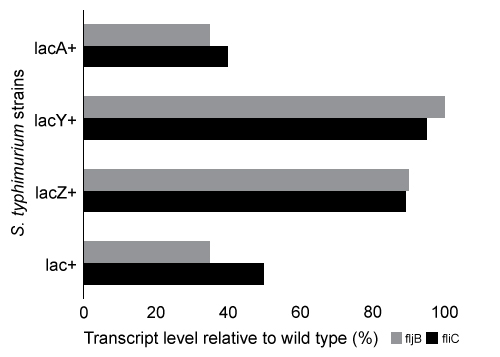
Passage The lac operon encodes the proteins that metabolize lactose and is a key biochemical feature that differentiates between members of the Enterobacteriaceae family.  For example, the severely virulent Salmonella typhimurium can be distinguished from its less virulent relative Escherichia coli by the absence of a lac operon.  Researchers propose that the evolutionary loss of the lac operon may contribute to S. typhimurium's ability to invade epithelial cells.To test the hypothesis, wild-type (WT)  S. typhimurium cells were transformed with plasmids encoding components of the lac operon (Figure 1) : β-galactosidase (lacZ<sup>+</sup>) , lactose permease (lacY<sup>+</sup>) , transacetylase (lacA<sup>+</sup>) , or all three (lac<sup>+</sup>) .  Each plasmid also contained genes for the lac repressor (lacI) , which can inhibit lac operon transcription in the absence of lactose; the cAMP receptor protein (crp) , which induces lac expression in low glucose; and a chloramphenicol resistance gene (cat) .    <strong>Figure 1</strong>  Plasmid PYM-LACZYA (lac<sup>+</sup>) , used to transform WT S. typhimurium.  Similar plasmids containing only one of the three lacZ, lacY, or lacA genes were also used.Virulence assays were performed in mice by inoculating with WT or lac<sup>+</sup> S. typhimurium.  The assays confirmed that lac<sup>+</sup> bacteria were less virulent than their WT counterparts, and that both WT and lac<sup>+</sup> bacteria were more virulent in the presence of glucose.  Subsequently, several genes related to invasion were analyzed for their expression levels in the presence or absence of lac plasmids (Table 1; Figure 2) .<strong>Table 1</strong>  Transcription Levels of Invasion-Associated Genes in lac<sup>+</sup> S. typhimurium Relative to WT      <strong>Figure 2</strong>  Transcript concentrations of two S. typhimurium flagellar genes, fljB and fliC, in bacteria transformed with lacZ<sup>+</sup>, lacY<sup>+</sup>, lacA<sup>+</sup>, or lac<sup>+</sup> plasmids.  Concentrations are expressed as a percentage of WT levels. Adapted from Jiang L, Ni Z, Wang L, Feng L, Liu B. Loss of the lac operon contributes to Salmonella invasion of epithelial cells through derepression of flagellar synthesis. Curr Microbiol. 2015;70(3) :315-23. -Which of the following conclusions regarding virulence of lac<sup>+</sup> S. typhimurium is most accurate? A) It cannot detect the presence of epithelial cells. B) It lacks the type III secretion proteins needed for invasion. C) It infects epithelial cells without using type III secretion proteins. D) It senses epithelial cells but cannot move toward them. Passage The lac operon encodes the proteins that metabolize lactose and is a key biochemical feature that differentiates between members of the Enterobacteriaceae family.  For example, the severely virulent Salmonella typhimurium can be distinguished from its less virulent relative Escherichia coli by the absence of a lac operon.  Researchers propose that the evolutionary loss of the lac operon may contribute to S. typhimurium's ability to invade epithelial cells.To test the hypothesis, wild-type (WT)  S. typhimurium cells were transformed with plasmids encoding components of the lac operon (Figure 1) : β-galactosidase (lacZ<sup>+</sup>) , lactose permease (lacY<sup>+</sup>) , transacetylase (lacA<sup>+</sup>) , or all three (lac<sup>+</sup>) .  Each plasmid also contained genes for the lac repressor (lacI) , which can inhibit lac operon transcription in the absence of lactose; the cAMP receptor protein (crp) , which induces lac expression in low glucose; and a chloramphenicol resistance gene (cat) .    <strong>Figure 1</strong>  Plasmid PYM-LACZYA (lac<sup>+</sup>) , used to transform WT S. typhimurium.  Similar plasmids containing only one of the three lacZ, lacY, or lacA genes were also used.Virulence assays were performed in mice by inoculating with WT or lac<sup>+</sup> S. typhimurium.  The assays confirmed that lac<sup>+</sup> bacteria were less virulent than their WT counterparts, and that both WT and lac<sup>+</sup> bacteria were more virulent in the presence of glucose.  Subsequently, several genes related to invasion were analyzed for their expression levels in the presence or absence of lac plasmids (Table 1; Figure 2) .<strong>Table 1</strong>  Transcription Levels of Invasion-Associated Genes in lac<sup>+</sup> S. typhimurium Relative to WT      <strong>Figure 2</strong>  Transcript concentrations of two S. typhimurium flagellar genes, fljB and fliC, in bacteria transformed with lacZ<sup>+</sup>, lacY<sup>+</sup>, lacA<sup>+</sup>, or lac<sup>+</sup> plasmids.  Concentrations are expressed as a percentage of WT levels. Adapted from Jiang L, Ni Z, Wang L, Feng L, Liu B. Loss of the lac operon contributes to Salmonella invasion of epithelial cells through derepression of flagellar synthesis. Curr Microbiol. 2015;70(3) :315-23. -Which of the following conclusions regarding virulence of lac<sup>+</sup> S. typhimurium is most accurate? A) It cannot detect the presence of epithelial cells. B) It lacks the type III secretion proteins needed for invasion. C) It infects epithelial cells without using type III secretion proteins. D) It senses epithelial cells but cannot move toward them. Figure 2  Transcript concentrations of two S. typhimurium flagellar genes, fljB and fliC, in bacteria transformed with lacZ+, lacY+, lacA+, or lac+ plasmids.  Concentrations are expressed as a percentage of WT levels.
Adapted from Jiang L, Ni Z, Wang L, Feng L, Liu B. Loss of the lac operon contributes to Salmonella invasion of epithelial cells through derepression of flagellar synthesis. Curr Microbiol. 2015;70(3) :315-23.
-Which of the following conclusions regarding virulence of lac+ S. typhimurium is most accurate?


A) It cannot detect the presence of epithelial cells.
B) It lacks the type III secretion proteins needed for invasion.
C) It infects epithelial cells without using type III secretion proteins.
D) It senses epithelial cells but cannot move toward them.

Correct Answer:

verifed

Verified

Unlock this answer now
Get Access to more Verified Answers free of charge

Related Questions

Unlock this Answer For Free Now!

View this answer and more for free by performing one of the following actions

qr-code

Scan the QR code to install the App and get 2 free unlocks

upload documents

Unlock quizzes for free by uploading documents