Passage
Alzheimer disease (AD) is a progressive condition affecting memory and cognition that can be pathologically characterized by the presence of neurofibrillary tangles (NFTs) . NFTs, aggregates of hyperphosphorylated tau proteins that have dissociated from microtubules, are believed to contribute to neuronal degradation and subsequent AD symptoms. In general, ribosomes initiate translation of tau mRNA by binding the 7-methylguanosine (m7Gpp) cap present at the end of the 5′ untranslated region (UTR) of the mRNA molecule. However, researchers believe that tau protein translation initiation can occur without recognition of the m7Gpp cap. This alternate mechanism, referred to as cap-independent translation, indicates that ribosomes are recruited by internal ribosome entry sites (IRES) generally located in the 5′ UTR of the mRNA sequence.To determine the initiation mechanism of tau mRNA translation, neuroblastoma cells of AD mice were transfected with two different DNA constructs (Figure 1) . Construct 1 contained the 5′ UTR of tau mRNA isoforms (v1 and v2) extracted from cells displaying NFTs. Construct 2 included the 5′ UTR of the β-globulin gene, which normally codes for a plasma protein. The luciferase reporter genes, Renillla and Photinus, were also included in the two constructs.
/_
/_
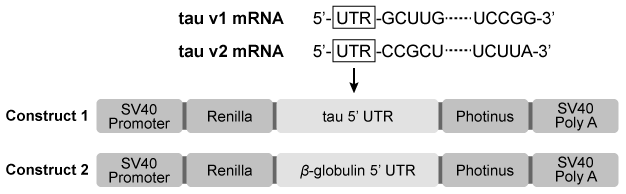 Figure 1 DNA constructs containing β-globulin or tau gene used to transfect neuroblastoma cellsLuciferase gene expression from the constructs was monitored in the absence and presence of a synthetic m7Gpp cap analog (Figure 2) . Translation of Renillla luciferase mRNA depended on ribosomal binding to the m7Gpp cap of the mRNA, but translation of Photinus luciferase required ribosome recruitment by an IRES in the 5′ UTR of the adjacent gene.
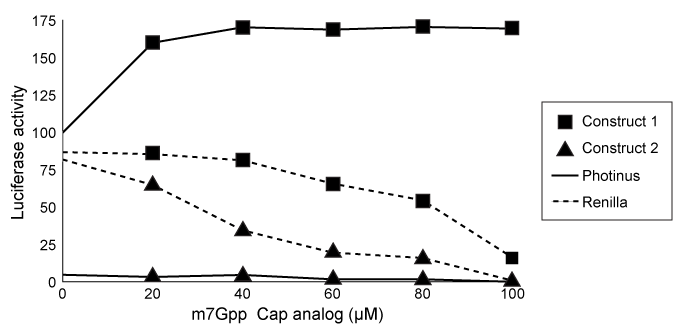 Figure 2 Luciferase activity in neuroblastoma cells exposed to m7Gpp cap analogIn a second study, researchers used siRNA to target initiation factor eIF4E, a peptide translated in a cap-dependent manner that facilitates the binding of ribosomes to the m7Gpp cap. Expression of factor eIF4E, elongation factor eEF2K, and tau v2 protein was assessed in siRNA-treated cells (Figure 3) .
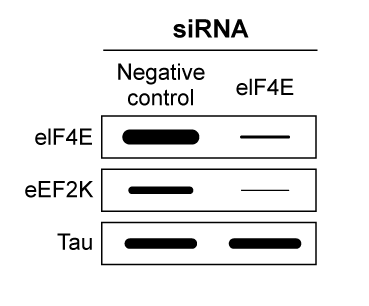 Figure 3 Western blot of eIF4E, eEF2K, and tau v2 extracted from non-AD cells treated with eIF4E siRNA
Adapted from Veo BL, Krushel LA. Translation initiation of the human tau mRNA through an internal ribosomal entry site. J Alzheimers Dis. 2009; 16(2) :271-5.
-Assume gene expression of tau v1 and v2 are synchronized in AD mice cells, and tau mRNA levels are analyzed. Of the following, which technique would researchers use to identify the tau mRNA isoform with the longer half-life in the cytoplasm of AD mice cells?
A) RT-PCR at a single time point
B) Western blot at a single time point
C) RT-PCR at varying time points
D) Western blot at varying time points
Correct Answer:

Verified
Q54: Passage
The lac operon encodes the proteins that
Q55: Passage
Overexpression of the miR-17~92 gene cluster occurs
Q56: Passage
The lac operon encodes the proteins that
Q57: Passage
The lac operon encodes the proteins that
Q58: Passage
Alzheimer disease (AD) is a progressive condition
Q60: Passage
The lac operon encodes the proteins that
Q61: Passage
Obstructive respiratory illnesses are characterized by an
Q62: Passage
Mitochondria are thought to have been independent
Q63: Passage
Obstructive respiratory illnesses are characterized by an
Q64: Passage
Obstructive respiratory illnesses are characterized by an
Unlock this Answer For Free Now!
View this answer and more for free by performing one of the following actions

Scan the QR code to install the App and get 2 free unlocks

Unlock quizzes for free by uploading documents