Passage
Rheumatoid arthritis (RA) is an autoimmune disease that causes chronic synovial (joint) inflammation. RA immunopathogenesis involves LFA-1, a surface receptor found on leukocytes that is composed of an α-chain (CD11a) and a β-chain (CD18) . The binding of LFA-1 to ICAM-1, an adhesion protein on the surface of B cells and endothelial cells, stimulates the migration of leukocytes to specific areas of inflammation. After successful LFA-1/ICAM-1 binding, CD18 is released into the plasma and synovial fluid (SF) , where it exists in soluble form (sCD18) . The levels of sCD18 in SF can be used as a marker for inflammation in RA.CD18 release has been shown to increase in response to tumor necrosis factor (TNF) , a pro-inflammatory cytokine involved in the inflammatory response of RA. In patients with newly diagnosed and untreated RA (eRA) , leukocytes produce adequate quantities of LFA-1 and plasma sCD18 levels are unchanged. However, over time there is dysregulation of LFA-1 synthesis and an increase in competition for ICAM-1 by other ligands, leading to a reduction in CD18 shedding. As a result, sCD18 is decreased in patients with chronic RA (cRA) .Experiment 1An immunofluorescence assay was used to measure plasma sCD18 levels in patients with eRA and cRA, and in age- and gender-matched healthy controls (HC) .
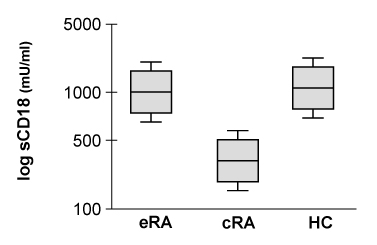 Figure 1 Baseline sCD18 measurements (Note: 50% of data points are below the median value; median = line inside the box.) Experiment 2Clinical assessments were performed in eRA patients to establish a baseline disease status. eRA patients were assigned DAS28CRP scores measured by RA-specific laboratory values. This was followed by treatment with anti-inflammatory drugs. DAS28CRP scores were calculated at 3-month intervals for 12 months, with lower scores indicating decreased RA severity (Figure 2) .
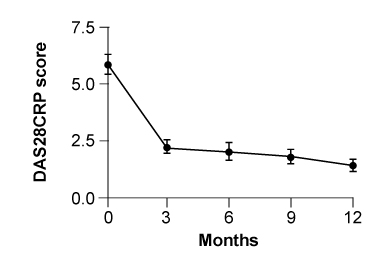 Figure 2 DAS28CRP scores in eRA patientsExperiment 3Heterogeneous populations of mononuclear cells were cultured from the synovial fluid (SFMC) and peripheral blood (PBMC) of eRA patients during an acute exacerbation of their symptoms. sCD18 levels were measured in SFMCs and PBMCs that were untreated, treated with TNF, or treated with monoclonal antibodies targeting TNF (anti-TNF) .
Adapted from Kragstrup TW, Jalilian B, Keller KK, et al. Changes in Soluble CD18 in Murine Autoimmune Arthritis and Rheumatoid Arthritis Reflect Disease Establishment and Treatment Response. PLoS ONE. 2016;11(2) :e0148486.
-A self-directed antibody known as rheumatoid factor (RF) has been found to be involved in RA-mediated inflammation. RF is an antibody that targets a patient's own IgG antibodies, which results in the formation of immune complexes that induce an inflammatory response. High concentrations of self-antibodies such as RF are NOT typically found in the human body because:
A) RF functions as a complement protein.
B) B cells and T cells against self-antigens are destroyed.
C) antigen-presenting cells cannot present self-antigens.
D) T-cell receptor recombination cannot produce self-identifying receptors.
Correct Answer:

Verified
Q83: Passage
Spinal muscular atrophy (SMA) is an autosomal
Q84: Passage
Spinal muscular atrophy (SMA) is an autosomal
Q85: Passage
Autosomal dominant polycystic kidney disease (ADPKD) is
Q86: Passage
Autosomal dominant polycystic kidney disease (ADPKD) is
Q87: Passage
Eukaryotic organelles such as mitochondria and chloroplasts
Q89: Passage
Autosomal dominant polycystic kidney disease (ADPKD) is
Q90: Passage
Spinal muscular atrophy (SMA) is an autosomal
Q91: Passage
Rheumatoid arthritis (RA) is an autoimmune disease
Q92: Passage
Spinal muscular atrophy (SMA) is an autosomal
Q93: Passage
Spinal muscular atrophy (SMA) is an autosomal
Unlock this Answer For Free Now!
View this answer and more for free by performing one of the following actions

Scan the QR code to install the App and get 2 free unlocks

Unlock quizzes for free by uploading documents