Passage
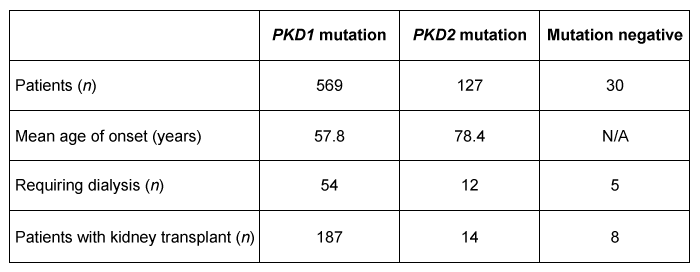
Autosomal dominant polycystic kidney disease (ADPKD) is one of the most common heterogeneous disorders, with a reported incidence of 1 in 1,000 people. The primary pathology is the development of numerous fluid-filled renal cysts that ultimately expand and severely impair kidney function. By age 60, approximately 50% of patients with ADPKD progress to end-stage renal disease (ESRD) and kidney failure. Clinical complications include high blood pressure, urinary tract infections, and cysts in other organs such as the liver and pancreas.Approximately 85% of ADPKD cases are caused by mutations in the PKD1 gene, which codes for the protein polycystin-1 (PC1) . The remaining 15% of cases are caused by mutations in the PKD2 gene, which codes for the protein polycystin-2 (PC2) . The PC2 protein functions as a mechanically activated calcium (Ca2+) channel in ciliated renal epithelial cells. PC1 and PC2 interact via their C-terminal cytoplasmic tails to form a heteromer that modulates intracellular calcium homeostasis. Disruption of calcium signaling as a result of mutations in either PKD1 or PKD2 is associated with increased cell growth and cyst formation in ADPKD patients.To identify individuals with mutations in PKD1 and PKD2, researchers analyzed phenotypic and genetic data from patients with established renal disease, as shown in Table 1.Table 1 Comparison of Renal Disease Onset and Symptom Severity in Various Patient Groups
 Next, researchers examined how phenotypic disease severity was affected by both the position of the mutations in PKD1 (5′ or 3′ end) and the type of mutation in PKD1 or PKD2. In Figure 1, disease severity is given as the cumulative probability of renal survival as a function of age.
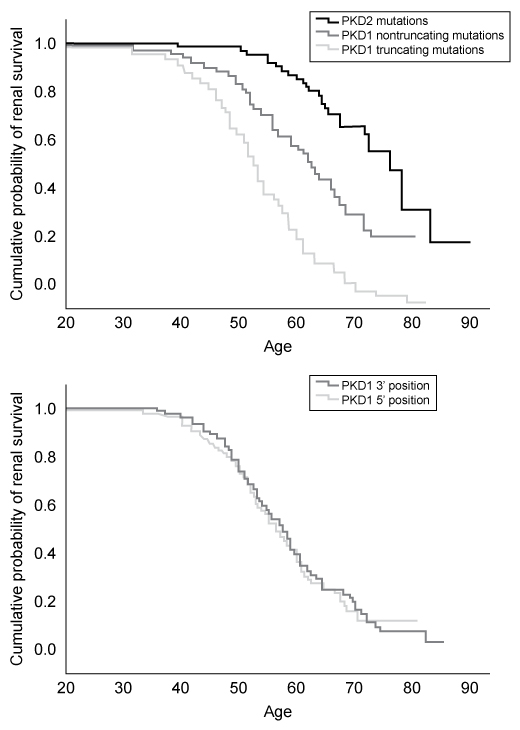 Figure 1 Probability of maintaining healthy kidney physiology as a function of age, analyzed by mutation type and position
Adapted from Cornec-le gall E, Audrézet MP, Chen JM, et al. J Am Soc Nephrol. 2013;24(6) :1006-13.
-A woman whose father is heterozygous for an ADPKD-causing mutation in PKD1 and whose mother is unaffected has a child with a man with no family history of ADPKD. What is the percent chance that their first child will have ADPKD? (Note: Assume the woman's ADPKD status is unknown.)
A) 0%
B) 25%
C) 50%
D) 100%
Correct Answer:

Verified
Q80: Passage
Alzheimer disease (AD) is a progressive condition
Q81: Passage
Autosomal dominant polycystic kidney disease (ADPKD) is
Q82: Passage
Spinal muscular atrophy (SMA) is an autosomal
Q83: Passage
Spinal muscular atrophy (SMA) is an autosomal
Q84: Passage
Spinal muscular atrophy (SMA) is an autosomal
Q86: Passage
Autosomal dominant polycystic kidney disease (ADPKD) is
Q87: Passage
Eukaryotic organelles such as mitochondria and chloroplasts
Q88: Passage
Rheumatoid arthritis (RA) is an autoimmune disease
Q89: Passage
Autosomal dominant polycystic kidney disease (ADPKD) is
Q90: Passage
Spinal muscular atrophy (SMA) is an autosomal
Unlock this Answer For Free Now!
View this answer and more for free by performing one of the following actions

Scan the QR code to install the App and get 2 free unlocks

Unlock quizzes for free by uploading documents