Passage
In 1906, the Nobel Prize in Physiology or Medicine was awarded to two biologists for their groundbreaking work in the field of neuroanatomy. Despite using the same technique to visualize neurons, the two biologists formed opposing theories regarding nervous system organization.Hypothesis 1: Reticular TheoryBiologist 1 developed a neural staining technique that was carried out by fixing brain tissue in potassium dichromate (K2Cr2O7) before treating it with silver nitrate (AgNO3) . A silver chromate (Ag2CrO4) precipitate deposited within the neurons, making them appear black. The silver impregnation method was revolutionary because of two features. First, only a random subset of neurons within a given tissue sample (~1% of the total cell population) was subject to silver impregnation. Second, the impregnated cells were stained in their entirety, allowing for visualization of the complete neuron. Biologist 1 concluded that his findings supported the idea that the nervous system is a single reticulum of fused neural processes that transmit information via cytoplasmic continuity.Hypothesis 2: Neuron DoctrineBiologist 2 modified the silver impregnation method by first subjecting the brain tissue to two rounds of staining ("double impregnation") rather than one. Second, where Biologist 1 studied the brain tissue of older animals with myelinated nerve fibers, Biologist 2 employed the silver stain on brain tissue from younger animals, which made it easier for the silver to impregnate the neural processes due to relative lack of myelination. Biologist 2 reasoned that the nervous system is not a single web of interconnected fibers but rather is made up of discrete neural units that communicate via close, but not continuous, contact.The neuron doctrine was later proven correct with the advent of electron microscopy, which allowed scientists to visualize the synapse (the point of communication between two distinct neurons) . Further investigation allowed researchers to ultimately discover that there are two types of synapses: electrical and chemical.
-A neuron is exposed to a compound that prevents the passage of Na+ ions through voltage-gated Na+ channels. Which of the following graphs best represents the local membrane potential change of this neuron upon injection of a positive current that allows the membrane to reach the threshold value? (Note: The solid line represents the action potential after normal stimulation; the dashed line represents the action potential after exposure to the compound.)
A) 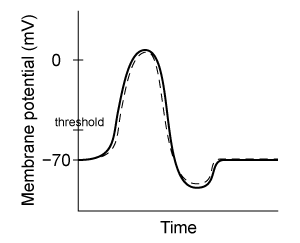
B) 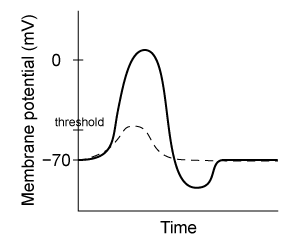
C) 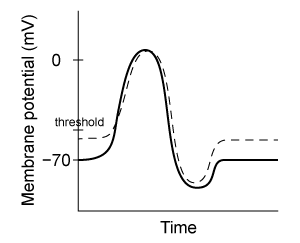
D) 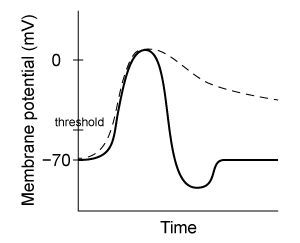
Correct Answer:

Verified
Q115: Passage
Renal reabsorption of glucose is facilitated by
Q116: Passage
Renal reabsorption of glucose is facilitated by
Q117: Passage
Renal reabsorption of glucose is facilitated by
Q118: Passage
In 1906, the Nobel Prize in Physiology
Q119: Passage
In 1906, the Nobel Prize in Physiology
Q121: Passage
Parathyroid hormone (PTH) is an important regulator
Q122: Passage
Parathyroid hormone (PTH) is an important regulator
Q123: Passage
Parathyroid hormone (PTH) is an important regulator
Q124: Passage
Domestic pigs have been used as valuable
Q125: Passage
Neurulation refers to the early formation of
Unlock this Answer For Free Now!
View this answer and more for free by performing one of the following actions

Scan the QR code to install the App and get 2 free unlocks

Unlock quizzes for free by uploading documents