Solved

Passage The Namibian Cheetah (Acinonyx Jubatus Jubatus), the World's Fastest Land-Dwelling

Question 170

Multiple Choice

Passage
The Namibian cheetah (Acinonyx jubatus jubatus) , the world's fastest land-dwelling animal, hunts across the African grasslands using high-speed sprints.  Cheetahs possess unique anatomical features specialized for speed, including an aerodynamic skull, elongated legs, and an enlarged heart.  These physiological adaptations have occurred over time and allow cheetahs to achieve speeds greater than 100 km/h.  However, due to their small body and slender limbs, cheetahs (50-64 kg) are limited with regard to the size of the animals they can successfully hunt and therefore typically prey on slightly smaller species that inhabit open grasslands.It is believed that around 12,000 years ago, Namibian cheetahs experienced an environmental catastrophe that drastically reduced their population.  The small number of surviving cheetahs began mating with one another, which led to severe inbreeding depression.  Over time, the offspring of subsequent generations exhibited decreased fitness, reduced fecundity (number of offspring) , and sustained a loss of major histocompatibility complex (MHC) allele diversity.  To study if low MHC diversity correlates with low fitness in cheetahs, scientists analyzed the genetic diversity and disease prevalence in a group of free-ranging and captive male cheetahs.Experiment 1MHC allele genotyping and analysis was performed in wild (free-ranging) and captive male cheetahs (Figure 1) .  Because MHC diversity is strongly correlated with genetic diversity, MHC diversity is used as a marker for an organism's overall genetic variability.
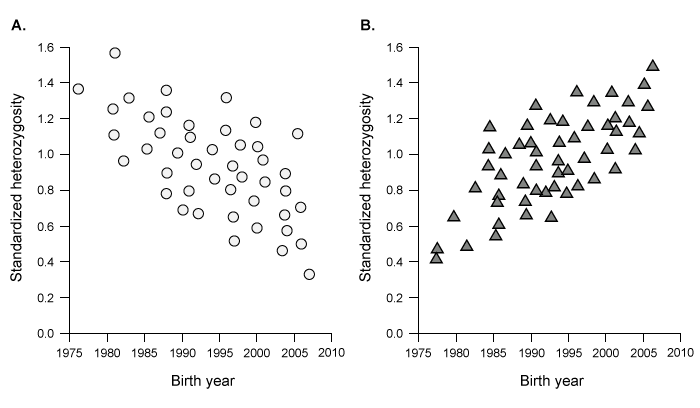
Passage The Namibian cheetah (Acinonyx jubatus jubatus) , the world's fastest land-dwelling animal, hunts across the African grasslands using high-speed sprints.  Cheetahs possess unique anatomical features specialized for speed, including an aerodynamic skull, elongated legs, and an enlarged heart.  These physiological adaptations have occurred over time and allow cheetahs to achieve speeds greater than 100 km/h.  However, due to their small body and slender limbs, cheetahs (50-64 kg)  are limited with regard to the size of the animals they can successfully hunt and therefore typically prey on slightly smaller species that inhabit open grasslands.It is believed that around 12,000 years ago, Namibian cheetahs experienced an environmental catastrophe that drastically reduced their population.  The small number of surviving cheetahs began mating with one another, which led to severe inbreeding depression.  Over time, the offspring of subsequent generations exhibited decreased fitness, reduced fecundity (number of offspring) , and sustained a loss of major histocompatibility complex (MHC)  allele diversity.  To study if low MHC diversity correlates with low fitness in cheetahs, scientists analyzed the genetic diversity and disease prevalence in a group of free-ranging and captive male cheetahs.Experiment 1MHC allele genotyping and analysis was performed in wild (free-ranging)  and captive male cheetahs (Figure 1) .  Because MHC diversity is strongly correlated with genetic diversity, MHC diversity is used as a marker for an organism's overall genetic variability.    <strong>Figure 1</strong>  Evaluation of heterozygosity in (A)  wild and (B)  captive male cheetahs born between 1976 and 2007 (Note:  Each data point represents a single male cheetah.) Experiment 2Disease prevalence was evaluated in wild and captive male cheetahs by quantitative analysis of symptoms relating gastrointestinal, liver, and kidney disease.  The percentages of cheetahs affected by each disease are shown in Figure 2.    <strong>Figure 2</strong>  Evaluation of disease prevalence in wild and captive male cheetahsExperiment 3Fecal cortisol levels were noninvasively evaluated in wild and captive cheetahs over a period of 6 months (Figure 3) .    <strong>Figure 3</strong>  Average fecal cortisol concentrations of wild and captive male cheetahs Adapted from Castro-prieto A, Wachter B, Sommer S. Cheetah paradigm revisited: MHC diversity in the world's largest free-ranging population. Mol Biol Evol. 2011;28(4) :1455-68. -The cheetahs that survived the environmental catastrophe that occurred 12,000 years ago are at greater risk of extinction because of: A) naturally selected changes in allele frequencies. B) random changes in allele frequencies. C) changes in allele frequencies due to migration. D) changes in allele frequencies due to random mating. Figure 1  Evaluation of heterozygosity in (A) wild and (B) captive male cheetahs born between 1976 and 2007 (Note:  Each data point represents a single male cheetah.) Experiment 2Disease prevalence was evaluated in wild and captive male cheetahs by quantitative analysis of symptoms relating gastrointestinal, liver, and kidney disease.  The percentages of cheetahs affected by each disease are shown in Figure 2.
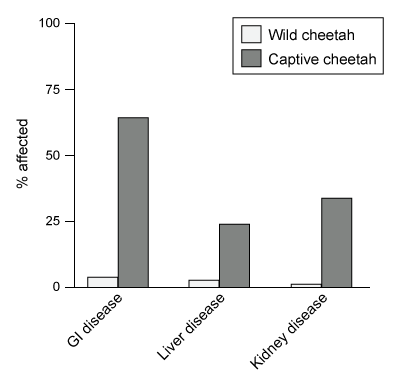
Passage The Namibian cheetah (Acinonyx jubatus jubatus) , the world's fastest land-dwelling animal, hunts across the African grasslands using high-speed sprints.  Cheetahs possess unique anatomical features specialized for speed, including an aerodynamic skull, elongated legs, and an enlarged heart.  These physiological adaptations have occurred over time and allow cheetahs to achieve speeds greater than 100 km/h.  However, due to their small body and slender limbs, cheetahs (50-64 kg)  are limited with regard to the size of the animals they can successfully hunt and therefore typically prey on slightly smaller species that inhabit open grasslands.It is believed that around 12,000 years ago, Namibian cheetahs experienced an environmental catastrophe that drastically reduced their population.  The small number of surviving cheetahs began mating with one another, which led to severe inbreeding depression.  Over time, the offspring of subsequent generations exhibited decreased fitness, reduced fecundity (number of offspring) , and sustained a loss of major histocompatibility complex (MHC)  allele diversity.  To study if low MHC diversity correlates with low fitness in cheetahs, scientists analyzed the genetic diversity and disease prevalence in a group of free-ranging and captive male cheetahs.Experiment 1MHC allele genotyping and analysis was performed in wild (free-ranging)  and captive male cheetahs (Figure 1) .  Because MHC diversity is strongly correlated with genetic diversity, MHC diversity is used as a marker for an organism's overall genetic variability.    <strong>Figure 1</strong>  Evaluation of heterozygosity in (A)  wild and (B)  captive male cheetahs born between 1976 and 2007 (Note:  Each data point represents a single male cheetah.) Experiment 2Disease prevalence was evaluated in wild and captive male cheetahs by quantitative analysis of symptoms relating gastrointestinal, liver, and kidney disease.  The percentages of cheetahs affected by each disease are shown in Figure 2.    <strong>Figure 2</strong>  Evaluation of disease prevalence in wild and captive male cheetahsExperiment 3Fecal cortisol levels were noninvasively evaluated in wild and captive cheetahs over a period of 6 months (Figure 3) .    <strong>Figure 3</strong>  Average fecal cortisol concentrations of wild and captive male cheetahs Adapted from Castro-prieto A, Wachter B, Sommer S. Cheetah paradigm revisited: MHC diversity in the world's largest free-ranging population. Mol Biol Evol. 2011;28(4) :1455-68. -The cheetahs that survived the environmental catastrophe that occurred 12,000 years ago are at greater risk of extinction because of: A) naturally selected changes in allele frequencies. B) random changes in allele frequencies. C) changes in allele frequencies due to migration. D) changes in allele frequencies due to random mating. Figure 2  Evaluation of disease prevalence in wild and captive male cheetahsExperiment 3Fecal cortisol levels were noninvasively evaluated in wild and captive cheetahs over a period of 6 months (Figure 3) .
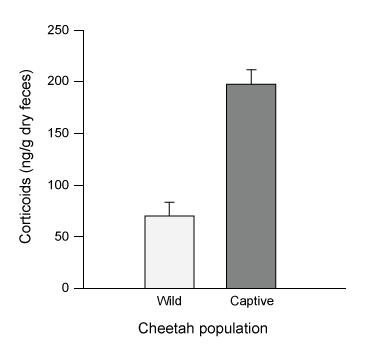
Passage The Namibian cheetah (Acinonyx jubatus jubatus) , the world's fastest land-dwelling animal, hunts across the African grasslands using high-speed sprints.  Cheetahs possess unique anatomical features specialized for speed, including an aerodynamic skull, elongated legs, and an enlarged heart.  These physiological adaptations have occurred over time and allow cheetahs to achieve speeds greater than 100 km/h.  However, due to their small body and slender limbs, cheetahs (50-64 kg)  are limited with regard to the size of the animals they can successfully hunt and therefore typically prey on slightly smaller species that inhabit open grasslands.It is believed that around 12,000 years ago, Namibian cheetahs experienced an environmental catastrophe that drastically reduced their population.  The small number of surviving cheetahs began mating with one another, which led to severe inbreeding depression.  Over time, the offspring of subsequent generations exhibited decreased fitness, reduced fecundity (number of offspring) , and sustained a loss of major histocompatibility complex (MHC)  allele diversity.  To study if low MHC diversity correlates with low fitness in cheetahs, scientists analyzed the genetic diversity and disease prevalence in a group of free-ranging and captive male cheetahs.Experiment 1MHC allele genotyping and analysis was performed in wild (free-ranging)  and captive male cheetahs (Figure 1) .  Because MHC diversity is strongly correlated with genetic diversity, MHC diversity is used as a marker for an organism's overall genetic variability.    <strong>Figure 1</strong>  Evaluation of heterozygosity in (A)  wild and (B)  captive male cheetahs born between 1976 and 2007 (Note:  Each data point represents a single male cheetah.) Experiment 2Disease prevalence was evaluated in wild and captive male cheetahs by quantitative analysis of symptoms relating gastrointestinal, liver, and kidney disease.  The percentages of cheetahs affected by each disease are shown in Figure 2.    <strong>Figure 2</strong>  Evaluation of disease prevalence in wild and captive male cheetahsExperiment 3Fecal cortisol levels were noninvasively evaluated in wild and captive cheetahs over a period of 6 months (Figure 3) .    <strong>Figure 3</strong>  Average fecal cortisol concentrations of wild and captive male cheetahs Adapted from Castro-prieto A, Wachter B, Sommer S. Cheetah paradigm revisited: MHC diversity in the world's largest free-ranging population. Mol Biol Evol. 2011;28(4) :1455-68. -The cheetahs that survived the environmental catastrophe that occurred 12,000 years ago are at greater risk of extinction because of: A) naturally selected changes in allele frequencies. B) random changes in allele frequencies. C) changes in allele frequencies due to migration. D) changes in allele frequencies due to random mating. Figure 3  Average fecal cortisol concentrations of wild and captive male cheetahs
Adapted from Castro-prieto A, Wachter B, Sommer S. Cheetah paradigm revisited: MHC diversity in the world's largest free-ranging population. Mol Biol Evol. 2011;28(4) :1455-68.
-The cheetahs that survived the environmental catastrophe that occurred 12,000 years ago are at greater risk of extinction because of:


A) naturally selected changes in allele frequencies.
B) random changes in allele frequencies.
C) changes in allele frequencies due to migration.
D) changes in allele frequencies due to random mating.

Correct Answer:

verifed

Verified

Unlock this answer now
Get Access to more Verified Answers free of charge

Related Questions

Unlock this Answer For Free Now!

View this answer and more for free by performing one of the following actions

qr-code

Scan the QR code to install the App and get 2 free unlocks

upload documents

Unlock quizzes for free by uploading documents