Passage
Viruses are known as obligate intracellular parasites because they cannot reproduce independently (outside of a host cell) . Viral genomes (RNA or DNA) are enclosed by a protein shell known as the capsid. Some viruses, known as enveloped viruses, have an additional phospholipid bilayer that fully envelops the capsid. Viruses that lack this outermost phospholipid covering are labeled non-enveloped. The entry of either enveloped or nonenveloped viruses into a host cell enables the production of viral proteins and the subsequent assembly of viral progeny.Immune cells (B and T cells) protect host organisms against viral infections by recognizing viral particles (antigens) as foreign. In response to the recognition of foreign particles, antigen-presenting cells display cleaved antigens (also known as antigen fragments) on their surface, which enable the activation of other immune cells that stimulate an immune response, including the production of neutralizing antibodies.An example of an infectious disease is viral hepatitis (inflammation of the liver) , which can be caused by any one of five distinct hepatitis viruses (A-E) that infect hepatocytes (liver cells) . HAV, HCV, and HEV contain positive-sense, single-stranded RNA (+ssRNA) as genetic material. In contrast, HBV has a partially double-stranded circular DNA genome. HDV is unique because it has a negative-sense, single-stranded RNA (−ssRNA) genome.Researchers hypothesized that synthetic antibodies could be used to treat viral hepatitis in patients with compromised immune systems. Fluorescent antibodies, designed to bind the capsid proteins of the five hepatitis viruses, were added to separate wells containing each type of virus. The fluorescence assay that was performed detected only bound antibodies in media with HAV or HEV.
Adapted from Shin EC, Sung PS, Park SH. Immune responses and immunopathology in acute and chronic viral hepatitis. Nat Rev Immunol. 2016;16(8) :509-23.
-An individual with hepatitis is suspected to have been exposed to either a bacterial strain of Bartonella henselae (0.5 µm) or HCV (0.055 µm) . Healthy hepatocytes and hepatocytes infected with serum from the affected patient were grown on chamber slides separated by double membranes, as shown below. 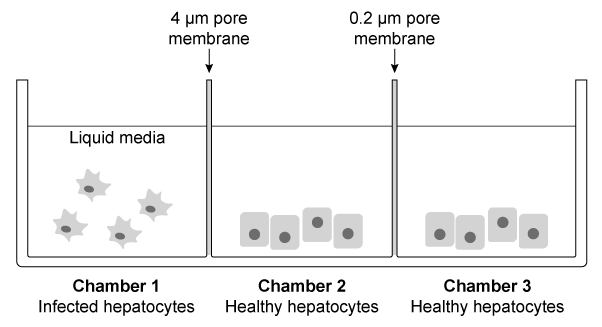 A cellular morphology similar to infected hepatocytes was observed in both chambers 2 and 3 after a 6 hour incubation time. Using a light microscope, can investigators observe the agent that caused the patient's hepatitis in chamber 3?
A) Yes, because it was caused by HCV
B) Yes, because it was caused by B. henselae
C) No, because it was caused by HCV
D) No, because it was caused by B. henselae
Correct Answer:

Verified
Q162: Passage
Viruses are known as obligate intracellular parasites
Q163: Impaired release of which of the following
Q164: During muscle contraction, the power stroke is
Q165: One function of endothelial cells is to:
A)contract
Q166: Passage
The Namibian cheetah (Acinonyx jubatus jubatus), the
Q168: Passage
Viruses are known as obligate intracellular parasites
Q169: Which statement best describes the characteristics of
Q170: Passage
The Namibian cheetah (Acinonyx jubatus jubatus), the
Q171: Which of the following cellular processes would
Q172: Which of the following cell-cell junctions would
Unlock this Answer For Free Now!
View this answer and more for free by performing one of the following actions

Scan the QR code to install the App and get 2 free unlocks

Unlock quizzes for free by uploading documents