Solved

Passage Within the Actinopterygii (Bony Fish) Lineage, Marine Teleosts (Bony Fish

Question 286

Multiple Choice

Passage
Within the Actinopterygii (bony fish) lineage, marine teleosts (bony fish with mobile jaws) live in an aquatic environment where there is a higher external concentration of salt and a lower concentration of water relative to the internal concentrations.  Owing to these conditions, salt ions tend to diffuse into the teleost through its skin, whereas water molecules within the organism osmotically traverse the opposite path.Irrespective of lineage, many fish species actively assess their environment and regulate their internal concentration of fluids and electrolytes via a homeostatic process known as osmoregulation.  Teleosts with either glomerular kidneys (eg, eels, sculpin) or aglomerular kidneys that are purely tubular (eg, goosefish, toadfish) have served as experimental subjects for the study of marine teleost osmoregulation.  Analyzing the ionic (ie, Na+, Cl, Mg2+, SO42−) concentration of intestinal fluids, urine, and plasma in each species led to the discovery that the renal tubule of the goosefish has both excretory and reabsorptive functions.Scientists have concluded that marine teleost osmoregulation involves the ingestion of seawater, retrieval of NaCl and water from the intestine, and primary excretion of divalent ions via urine and monovalent ions through the gills (thin barriers between the organism's blood and the aquatic environment) .In an experiment to further study osmoregulatory mechanisms, researchers emptied the gut of an eel and sealed the anus to prevent fluid loss.  The eel was transported into seawater that had been treated with the volume marker phenol red.  After 20 hours, the eel's gut contained 2.3 mL of fluid but showed a phenol red concentration equivalent to 12.3 mL of ingested seawater.  Researchers found that the eel lost 2.3 g of weight due to urine output.  They ultimately reported that the eel had lost all the seawater it absorbed through the gut via various mechanisms.
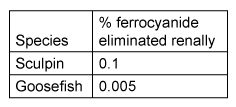
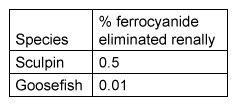
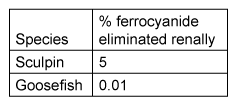
-Researchers studying marine teleosts claim that the glomerular kidney is 500 times as efficient as the aglomerular kidney in eliminating nontoxic substances.  Similar amounts of nontoxic ferrocyanide are intramuscularly injected into a sculpin and a goosefish of comparable weight.  Given this, which of the following tables showing renal elimination of ferrocyanide after 5 hours would support the researchers' claim?


A) Passage Within the Actinopterygii (bony fish)  lineage, marine teleosts (bony fish with mobile jaws)  live in an aquatic environment where there is a higher external concentration of salt and a lower concentration of water relative to the internal concentrations.  Owing to these conditions, salt ions tend to diffuse into the teleost through its skin, whereas water molecules within the organism osmotically traverse the opposite path.Irrespective of lineage, many fish species actively assess their environment and regulate their internal concentration of fluids and electrolytes via a homeostatic process known as osmoregulation.  Teleosts with either glomerular kidneys (eg, eels, sculpin)  or aglomerular kidneys that are purely tubular (eg, goosefish, toadfish)  have served as experimental subjects for the study of marine teleost osmoregulation.  Analyzing the ionic (ie, Na<sup>+</sup>, Cl<sup>−</sup>, Mg<sup>2+</sup>, SO<sub>4</sub><sup>2−</sup>)  concentration of intestinal fluids, urine, and plasma in each species led to the discovery that the renal tubule of the goosefish has both excretory and reabsorptive functions.Scientists have concluded that marine teleost osmoregulation involves the ingestion of seawater, retrieval of NaCl and water from the intestine, and primary excretion of divalent ions via urine and monovalent ions through the gills (thin barriers between the organism's blood and the aquatic environment) .In an experiment to further study osmoregulatory mechanisms, researchers emptied the gut of an eel and sealed the anus to prevent fluid loss.  The eel was transported into seawater that had been treated with the volume marker phenol red.  After 20 hours, the eel's gut contained 2.3 mL of fluid but showed a phenol red concentration equivalent to 12.3 mL of ingested seawater.  Researchers found that the eel lost 2.3 g of weight due to urine output.  They ultimately reported that the eel had lost all the seawater it absorbed through the gut via various mechanisms. -Researchers studying marine teleosts claim that the glomerular kidney is 500 times as efficient as the aglomerular kidney in eliminating nontoxic substances.  Similar amounts of nontoxic ferrocyanide are intramuscularly injected into a sculpin and a goosefish of comparable weight.  Given this, which of the following tables showing renal elimination of ferrocyanide after 5 hours would support the researchers' claim? A)    B)    C)    D)
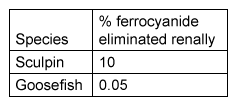
B) Passage Within the Actinopterygii (bony fish)  lineage, marine teleosts (bony fish with mobile jaws)  live in an aquatic environment where there is a higher external concentration of salt and a lower concentration of water relative to the internal concentrations.  Owing to these conditions, salt ions tend to diffuse into the teleost through its skin, whereas water molecules within the organism osmotically traverse the opposite path.Irrespective of lineage, many fish species actively assess their environment and regulate their internal concentration of fluids and electrolytes via a homeostatic process known as osmoregulation.  Teleosts with either glomerular kidneys (eg, eels, sculpin)  or aglomerular kidneys that are purely tubular (eg, goosefish, toadfish)  have served as experimental subjects for the study of marine teleost osmoregulation.  Analyzing the ionic (ie, Na<sup>+</sup>, Cl<sup>−</sup>, Mg<sup>2+</sup>, SO<sub>4</sub><sup>2−</sup>)  concentration of intestinal fluids, urine, and plasma in each species led to the discovery that the renal tubule of the goosefish has both excretory and reabsorptive functions.Scientists have concluded that marine teleost osmoregulation involves the ingestion of seawater, retrieval of NaCl and water from the intestine, and primary excretion of divalent ions via urine and monovalent ions through the gills (thin barriers between the organism's blood and the aquatic environment) .In an experiment to further study osmoregulatory mechanisms, researchers emptied the gut of an eel and sealed the anus to prevent fluid loss.  The eel was transported into seawater that had been treated with the volume marker phenol red.  After 20 hours, the eel's gut contained 2.3 mL of fluid but showed a phenol red concentration equivalent to 12.3 mL of ingested seawater.  Researchers found that the eel lost 2.3 g of weight due to urine output.  They ultimately reported that the eel had lost all the seawater it absorbed through the gut via various mechanisms. -Researchers studying marine teleosts claim that the glomerular kidney is 500 times as efficient as the aglomerular kidney in eliminating nontoxic substances.  Similar amounts of nontoxic ferrocyanide are intramuscularly injected into a sculpin and a goosefish of comparable weight.  Given this, which of the following tables showing renal elimination of ferrocyanide after 5 hours would support the researchers' claim? A)    B)    C)    D)
C) Passage Within the Actinopterygii (bony fish)  lineage, marine teleosts (bony fish with mobile jaws)  live in an aquatic environment where there is a higher external concentration of salt and a lower concentration of water relative to the internal concentrations.  Owing to these conditions, salt ions tend to diffuse into the teleost through its skin, whereas water molecules within the organism osmotically traverse the opposite path.Irrespective of lineage, many fish species actively assess their environment and regulate their internal concentration of fluids and electrolytes via a homeostatic process known as osmoregulation.  Teleosts with either glomerular kidneys (eg, eels, sculpin)  or aglomerular kidneys that are purely tubular (eg, goosefish, toadfish)  have served as experimental subjects for the study of marine teleost osmoregulation.  Analyzing the ionic (ie, Na<sup>+</sup>, Cl<sup>−</sup>, Mg<sup>2+</sup>, SO<sub>4</sub><sup>2−</sup>)  concentration of intestinal fluids, urine, and plasma in each species led to the discovery that the renal tubule of the goosefish has both excretory and reabsorptive functions.Scientists have concluded that marine teleost osmoregulation involves the ingestion of seawater, retrieval of NaCl and water from the intestine, and primary excretion of divalent ions via urine and monovalent ions through the gills (thin barriers between the organism's blood and the aquatic environment) .In an experiment to further study osmoregulatory mechanisms, researchers emptied the gut of an eel and sealed the anus to prevent fluid loss.  The eel was transported into seawater that had been treated with the volume marker phenol red.  After 20 hours, the eel's gut contained 2.3 mL of fluid but showed a phenol red concentration equivalent to 12.3 mL of ingested seawater.  Researchers found that the eel lost 2.3 g of weight due to urine output.  They ultimately reported that the eel had lost all the seawater it absorbed through the gut via various mechanisms. -Researchers studying marine teleosts claim that the glomerular kidney is 500 times as efficient as the aglomerular kidney in eliminating nontoxic substances.  Similar amounts of nontoxic ferrocyanide are intramuscularly injected into a sculpin and a goosefish of comparable weight.  Given this, which of the following tables showing renal elimination of ferrocyanide after 5 hours would support the researchers' claim? A)    B)    C)    D)
D) Passage Within the Actinopterygii (bony fish)  lineage, marine teleosts (bony fish with mobile jaws)  live in an aquatic environment where there is a higher external concentration of salt and a lower concentration of water relative to the internal concentrations.  Owing to these conditions, salt ions tend to diffuse into the teleost through its skin, whereas water molecules within the organism osmotically traverse the opposite path.Irrespective of lineage, many fish species actively assess their environment and regulate their internal concentration of fluids and electrolytes via a homeostatic process known as osmoregulation.  Teleosts with either glomerular kidneys (eg, eels, sculpin)  or aglomerular kidneys that are purely tubular (eg, goosefish, toadfish)  have served as experimental subjects for the study of marine teleost osmoregulation.  Analyzing the ionic (ie, Na<sup>+</sup>, Cl<sup>−</sup>, Mg<sup>2+</sup>, SO<sub>4</sub><sup>2−</sup>)  concentration of intestinal fluids, urine, and plasma in each species led to the discovery that the renal tubule of the goosefish has both excretory and reabsorptive functions.Scientists have concluded that marine teleost osmoregulation involves the ingestion of seawater, retrieval of NaCl and water from the intestine, and primary excretion of divalent ions via urine and monovalent ions through the gills (thin barriers between the organism's blood and the aquatic environment) .In an experiment to further study osmoregulatory mechanisms, researchers emptied the gut of an eel and sealed the anus to prevent fluid loss.  The eel was transported into seawater that had been treated with the volume marker phenol red.  After 20 hours, the eel's gut contained 2.3 mL of fluid but showed a phenol red concentration equivalent to 12.3 mL of ingested seawater.  Researchers found that the eel lost 2.3 g of weight due to urine output.  They ultimately reported that the eel had lost all the seawater it absorbed through the gut via various mechanisms. -Researchers studying marine teleosts claim that the glomerular kidney is 500 times as efficient as the aglomerular kidney in eliminating nontoxic substances.  Similar amounts of nontoxic ferrocyanide are intramuscularly injected into a sculpin and a goosefish of comparable weight.  Given this, which of the following tables showing renal elimination of ferrocyanide after 5 hours would support the researchers' claim? A)    B)    C)    D)

Correct Answer:

verifed

Verified

Unlock this answer now
Get Access to more Verified Answers free of charge

Related Questions

Unlock this Answer For Free Now!

View this answer and more for free by performing one of the following actions

qr-code

Scan the QR code to install the App and get 2 free unlocks

upload documents

Unlock quizzes for free by uploading documents