Solved

Passage Magnetic Resonance Imaging (MRI) Interprets the Nuclear Relaxation or Relaxivity

Question 12

Multiple Choice

Passage
Magnetic resonance imaging (MRI) interprets the nuclear relaxation or relaxivity of hydrogen nuclei in resident water molecules.  Hydrogen nuclei in water have two magnetic spin states:  alpha and beta.  In the presence of an applied magnetic field, these spins will align with the field in an "excited" state and then relax back to the "ground" state, producing a signal with intensity proportional to relaxivity.  Frequently, an MRI contrast agent is used to increase the relaxation time in coordinated molecules, resulting in a more intense signal.Commonly used contrast agents include gadolinium-based agents.  Depending on its environment, gadolinium (Gd) can have eight or nine sites in its coordination sphere, allowing Gd3+ to interact with eight water molecules as in Gd(H2O) 83+.  The electronic configuration of gadolinium is shown in Figure 1.

Passage Magnetic resonance imaging (MRI)  interprets the nuclear relaxation or relaxivity of hydrogen nuclei in resident water molecules.  Hydrogen nuclei in water have two magnetic spin states:  alpha and beta.  In the presence of an applied magnetic field, these spins will align with the field in an  excited  state and then relax back to the  ground  state, producing a signal with intensity proportional to relaxivity.  Frequently, an MRI contrast agent is used to increase the relaxation time in coordinated molecules, resulting in a more intense signal.Commonly used contrast agents include gadolinium-based agents.  Depending on its environment, gadolinium (Gd)  can have eight or nine sites in its coordination sphere, allowing Gd<sup>3+</sup> to interact with eight water molecules as in Gd(H<sub>2</sub>O) <sub>8</sub><sup>3+</sup>.  The electronic configuration of gadolinium is shown in Figure 1.    <strong>Figure 1</strong>  Electronic configuration of gadoliniumGd<sup>3+</sup> alone is toxic to cells because its ionic radius is similar to that of Ca<sup>2+</sup>, allowing Gd<sup>3+</sup> to displace Ca<sup>2+</sup> in biologically important settings.  Therefore, Gd<sup>3+</sup> must be coordinated to an organic ligand such as 1,4,7,10-tetraazacyclododecane-1,4,7,10-tetraacetic acid (DOTA)  to allow it to pass through the body safely.  When chelated, DOTA displaces the water around gadolinium and leaves only one coordination site for a water molecule (Figure 2) .    <strong>Figure 2</strong>  Gd-DOTA with a water coordinated to Gd<sup>3+</sup>Zinc ions (Zn<sup>2+</sup>)  are required to store insulin and are co-released when insulin is secreted by the pancreas.  To detect zinc ions in the body, researchers have designed a variation of Gd-DOTA called Gd-daa3 with two diaminoacetate (daa)  arms that preferentially bind to Zn<sup>2+</sup> ions (Figure 3) .  When Zn<sup>2+</sup> is absent, these arms coordinate to Gd<sup>3+</sup> and create a nine-coordinate complex that prohibits water from binding to Gd<sup>3+</sup>.  Binding of diaminoacetate arms to Zn<sup>2+</sup> frees Gd<sup>3+</sup> to coordinate with water molecules.  This configuration results in increased signal intensity in the parts of the cell where Zn<sup>2+</sup> is located.    <strong>Figure 3</strong>  Gd-daa3 when Zn<sup>2+</sup> is present Adapted from Louie A. MRI biosensors: a short primer. J Magn Reson Imaging. 2013;38(3) :530-9. -Gadolinium becomes ionized to Gd<sup>3+</sup> when it loses electrons from which orbital(s) ? A) 4f, 4d, and 5s B) 4f C) 4f, 5d, and 6s D) 5d and 6s Figure 1  Electronic configuration of gadoliniumGd3+ alone is toxic to cells because its ionic radius is similar to that of Ca2+, allowing Gd3+ to displace Ca2+ in biologically important settings.  Therefore, Gd3+ must be coordinated to an organic ligand such as 1,4,7,10-tetraazacyclododecane-1,4,7,10-tetraacetic acid (DOTA) to allow it to pass through the body safely.  When chelated, DOTA displaces the water around gadolinium and leaves only one coordination site for a water molecule (Figure 2) .
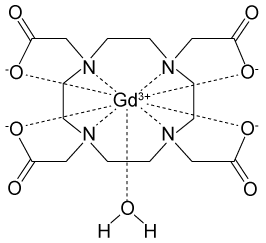
Passage Magnetic resonance imaging (MRI)  interprets the nuclear relaxation or relaxivity of hydrogen nuclei in resident water molecules.  Hydrogen nuclei in water have two magnetic spin states:  alpha and beta.  In the presence of an applied magnetic field, these spins will align with the field in an  excited  state and then relax back to the  ground  state, producing a signal with intensity proportional to relaxivity.  Frequently, an MRI contrast agent is used to increase the relaxation time in coordinated molecules, resulting in a more intense signal.Commonly used contrast agents include gadolinium-based agents.  Depending on its environment, gadolinium (Gd)  can have eight or nine sites in its coordination sphere, allowing Gd<sup>3+</sup> to interact with eight water molecules as in Gd(H<sub>2</sub>O) <sub>8</sub><sup>3+</sup>.  The electronic configuration of gadolinium is shown in Figure 1.    <strong>Figure 1</strong>  Electronic configuration of gadoliniumGd<sup>3+</sup> alone is toxic to cells because its ionic radius is similar to that of Ca<sup>2+</sup>, allowing Gd<sup>3+</sup> to displace Ca<sup>2+</sup> in biologically important settings.  Therefore, Gd<sup>3+</sup> must be coordinated to an organic ligand such as 1,4,7,10-tetraazacyclododecane-1,4,7,10-tetraacetic acid (DOTA)  to allow it to pass through the body safely.  When chelated, DOTA displaces the water around gadolinium and leaves only one coordination site for a water molecule (Figure 2) .    <strong>Figure 2</strong>  Gd-DOTA with a water coordinated to Gd<sup>3+</sup>Zinc ions (Zn<sup>2+</sup>)  are required to store insulin and are co-released when insulin is secreted by the pancreas.  To detect zinc ions in the body, researchers have designed a variation of Gd-DOTA called Gd-daa3 with two diaminoacetate (daa)  arms that preferentially bind to Zn<sup>2+</sup> ions (Figure 3) .  When Zn<sup>2+</sup> is absent, these arms coordinate to Gd<sup>3+</sup> and create a nine-coordinate complex that prohibits water from binding to Gd<sup>3+</sup>.  Binding of diaminoacetate arms to Zn<sup>2+</sup> frees Gd<sup>3+</sup> to coordinate with water molecules.  This configuration results in increased signal intensity in the parts of the cell where Zn<sup>2+</sup> is located.    <strong>Figure 3</strong>  Gd-daa3 when Zn<sup>2+</sup> is present Adapted from Louie A. MRI biosensors: a short primer. J Magn Reson Imaging. 2013;38(3) :530-9. -Gadolinium becomes ionized to Gd<sup>3+</sup> when it loses electrons from which orbital(s) ? A) 4f, 4d, and 5s B) 4f C) 4f, 5d, and 6s D) 5d and 6s Figure 2  Gd-DOTA with a water coordinated to Gd3+Zinc ions (Zn2+) are required to store insulin and are co-released when insulin is secreted by the pancreas.  To detect zinc ions in the body, researchers have designed a variation of Gd-DOTA called Gd-daa3 with two diaminoacetate (daa) arms that preferentially bind to Zn2+ ions (Figure 3) .  When Zn2+ is absent, these arms coordinate to Gd3+ and create a nine-coordinate complex that prohibits water from binding to Gd3+.  Binding of diaminoacetate arms to Zn2+ frees Gd3+ to coordinate with water molecules.  This configuration results in increased signal intensity in the parts of the cell where Zn2+ is located.
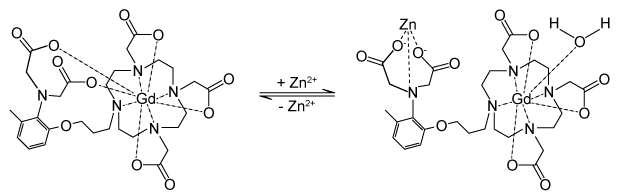
Passage Magnetic resonance imaging (MRI)  interprets the nuclear relaxation or relaxivity of hydrogen nuclei in resident water molecules.  Hydrogen nuclei in water have two magnetic spin states:  alpha and beta.  In the presence of an applied magnetic field, these spins will align with the field in an  excited  state and then relax back to the  ground  state, producing a signal with intensity proportional to relaxivity.  Frequently, an MRI contrast agent is used to increase the relaxation time in coordinated molecules, resulting in a more intense signal.Commonly used contrast agents include gadolinium-based agents.  Depending on its environment, gadolinium (Gd)  can have eight or nine sites in its coordination sphere, allowing Gd<sup>3+</sup> to interact with eight water molecules as in Gd(H<sub>2</sub>O) <sub>8</sub><sup>3+</sup>.  The electronic configuration of gadolinium is shown in Figure 1.    <strong>Figure 1</strong>  Electronic configuration of gadoliniumGd<sup>3+</sup> alone is toxic to cells because its ionic radius is similar to that of Ca<sup>2+</sup>, allowing Gd<sup>3+</sup> to displace Ca<sup>2+</sup> in biologically important settings.  Therefore, Gd<sup>3+</sup> must be coordinated to an organic ligand such as 1,4,7,10-tetraazacyclododecane-1,4,7,10-tetraacetic acid (DOTA)  to allow it to pass through the body safely.  When chelated, DOTA displaces the water around gadolinium and leaves only one coordination site for a water molecule (Figure 2) .    <strong>Figure 2</strong>  Gd-DOTA with a water coordinated to Gd<sup>3+</sup>Zinc ions (Zn<sup>2+</sup>)  are required to store insulin and are co-released when insulin is secreted by the pancreas.  To detect zinc ions in the body, researchers have designed a variation of Gd-DOTA called Gd-daa3 with two diaminoacetate (daa)  arms that preferentially bind to Zn<sup>2+</sup> ions (Figure 3) .  When Zn<sup>2+</sup> is absent, these arms coordinate to Gd<sup>3+</sup> and create a nine-coordinate complex that prohibits water from binding to Gd<sup>3+</sup>.  Binding of diaminoacetate arms to Zn<sup>2+</sup> frees Gd<sup>3+</sup> to coordinate with water molecules.  This configuration results in increased signal intensity in the parts of the cell where Zn<sup>2+</sup> is located.    <strong>Figure 3</strong>  Gd-daa3 when Zn<sup>2+</sup> is present Adapted from Louie A. MRI biosensors: a short primer. J Magn Reson Imaging. 2013;38(3) :530-9. -Gadolinium becomes ionized to Gd<sup>3+</sup> when it loses electrons from which orbital(s) ? A) 4f, 4d, and 5s B) 4f C) 4f, 5d, and 6s D) 5d and 6s Figure 3  Gd-daa3 when Zn2+ is present
Adapted from Louie A. MRI biosensors: a short primer. J Magn Reson Imaging. 2013;38(3) :530-9.
-Gadolinium becomes ionized to Gd3+ when it loses electrons from which orbital(s) ?


A) 4f, 4d, and 5s
B) 4f
C) 4f, 5d, and 6s
D) 5d and 6s

Correct Answer:

verifed

Verified

Unlock this answer now
Get Access to more Verified Answers free of charge

Related Questions

Unlock this Answer For Free Now!

View this answer and more for free by performing one of the following actions

qr-code

Scan the QR code to install the App and get 2 free unlocks

upload documents

Unlock quizzes for free by uploading documents